By William Wiley, Deborah HopkinsDan Gephart, November 28, 2018


The MSPB is hanging by a thread.

This morning, the Senate Committee on Homeland Security and Government Affairs recessed without voting on the three US Merit Systems Protection Board nominees. Sen. Ron Johnson, the Committee Chairman, told reporters that he decided to not bring up a vote after a 7-7 roll call vote on member Andrew Maunz. There was not a roll call vote on either of the two other nominees.

Wait, you wise FELTG readers are probably saying, “Doesn’t the committee have 15 members? And don’t Republicans have the majority?” Per a source, Sen. Rand Paul voted no by proxy, depriving the majority of an 8-7 vote. Sen. Paul opposes the existence of the MSPB, according to the source.The nominations of Chairman Dennis D. Kirk and Members Julia A. Clark and Maunz will be returned to the administration without a vote and the nomination process will have to begin all over again with a new Senate in January.

Meanwhile, more  than 1,500 cases in the MSPB backlog will go unaddressed. By the time the new Board members, hopefully, get confirmed sometime next spring, there will probably be about 1750 cases waiting to be adjudicated.

Hopefully is the critical word. Sen. Johnson, according to a source, will not review the nominations if they are resent next year unless he can get Sen. Paul or a Democrat to change their minds.Remember: Acting Chairman Mark Robbins, the sole remaining member of the MSPB, turns into a political pumpkin at midnight on March 1. His term will expire, and he cannot be renewed or held over any longer. Unless a miracle occurs in February, it’s likely that come March, the Board will be without any members for the first time in history.Meanwhile, FELTG has been told that there is a legal opinion floating around that if Robbins leaves and no Senate-confirmed Article II person is on board to replace him, then the MSPB as an agency goes out of existence.

Before today, not one nominee to be a member of MSPB was rejected at the committee level in the Senate. Today, that happened to three nominees. It is impossible to predict what will happen next, other than that the federal civil service will continue to suffer and employee appeals will continue to disappear into the gapping void that was formerly the US Merit Systems Protection Board.

These are sad times, indeed, for the federal civil service. With respects to John Donne: “No federal employee is an island, entire of itself; every employee is a piece of the civil service, a part of the main. If a single employee be washed away by the loss of oversight protections, the federal civil service is the less, as well as if an entire agency were, as well as if a position of thy friend’s or of thine own were: any employee’s loss of rights diminishes me, because I am involved in the civil service, and therefore never send to know for whom the bells tolls; it tolls for thee.”

By Barbara Haga, November 26, 2018

Holiday parties will be held soon and, inevitably, there will be some bad behavior that goes along with them. It seemed prudent to look at a 2017 case that involved all of the items mentioned in the title and a subsequent removal sustained based on them. It is an interesting case that includes the issue of contact between coworkers, not a supervisor per se, he said/she said explanations of what happened, and the use of a general charge of conduct unbecoming. I’m guessing this one may be in that pile of over a thousand petitions for review, but for now let’s see how the AJ ruled.

The case is Doe v. Air Force, DA-0752-16-0100-I-2 (2017). The appellant asked that the case be processed anonymously, and the agency requested that the names of the witnesses be protected. There are three primary players in the case – Doe, his girlfriend, JD, and the person who reported unwanted sexual contact, KB.

Doe was an Air Traffic Control (ATC) Specialist (Terminal), GS-2152-12, working for the Air Force in Oklahoma. He was a former active duty Air Force ATC. JD and KB were also ATCs, except KB was a military member. JD had worked on the same shift with Doe, but once they started dating, she moved to another shift per management’s direction. Doe and KB worked on the same shift. All three were good friends, as stated in the decision. KB was married, but her husband was out of town during the events recounted in the decision.

The 2014 Holiday Party

The events that led to the removal began with the holiday party at a local restaurant and banquet hall. Doe, JD, and KB sat together at the party. From the decision, it is clear that there was a significant amount of drinking throughout the evening and into the next morning. The party at the commercial facility ended and progressed to an after-party in a co-worker’s barn. Later in the evening, the after-party got out of control and the owner ended the party. The owner specifically asked Doe to get KB out of the after-party because “she was out of control and making everyone uncomfortable.” The owner told him that people reported seeing KB kissing another female airman. Doe acknowledged in a statement in response to the proposed removal that KB lacked judgment because she kissed him and JD on the mouth in front of others at the after-party.

Doe arranged for transportation home from the after-party for himself, JD, and KB. The driver stopped at Doe’s house, and everyone went in and continued to party. For an unexplained reason, KB did not continue on with the driver when he left and instead remained in Doe’s house. JD prepared to go to bed and apparently slept through everything that happened thereafter. KB ended up in the bed with JD and Doe.

What occurred next depends on whose version you find more credible. There was either no sexual contact or unwelcome sexual contact. KB eventually called another coworker and his wife to pick her up and take her home after the incident. She called her husband and told him her version of what had happened and reported the contact to her First Sergeant the next day.

Charge and Specifications

The removal — effective in October 2015 — was based on one charge of conduct unbecoming. The specification read as follows:

On or about December 7, 2014, approximately between the hours of 0100 and 0300 hours, you brought Senior Airman (SrA) KB, a junior enlisted Airman, to whom you provided training and on-duty supervisory oversight, to your home. SrA KB was intoxicated from consuming alcoholic beverages. You initiated unwelcome sexual contact with SrA KB in your bed. To wit: While SrA KB was in your bed you kissed her stomach and vaginal area before digitally penetrating her vagina. DNA evidence confirmed she was in the bed in which you sleep, the same bed in which the unwelcome sexual contact occurred. Because of your actions, SrA KB required premature relocation away from Vance Air Force Base to another Air Force Installation in another state. Your conduct was improper and harmed the efficiency of the service.

Credibility

In this 21-page decision, there are roughly nine pages of discussion regarding credibility. The AJ acknowledged that KB was not the “model” airman, but the AJ found KB’s version of the events more credible than Doe’s. If you want to read a very detailed accounting of the AJ’s view of each version of the events, this is a good analysis.

Doe’s Job Duties

In many agencies, the first reaction to the report of this type of conduct would have been that there was not sufficient nexus between the misconduct and Doe’s position to be able to take an adverse action. Some would view this as being outside the range of actionable misconduct because Doe was not classified as a supervisor and clearly not her supervisor. The events recounted were entirely a matter of off-duty misconduct between coworkers, one civilian and one military. However, the Air Force successfully showed that there was a nexus and that the behavior was unbecoming.

The Air Force policy on personal relationships, “Dress, Appearance, and Relationships,” provided:

4.4. Relationships. While personal relationships between Air Force employees or between Air Force employees and military members are normally matters of individual choice and judgment, they become matters of official concern when they violate existing law or impede the efficiency of the service.

4.4.5. Actions in Response to Unprofessional Relationships. When unprofessional relationships impede the efficiency of the service or adversely affect the mission, appropriate corrective action should be taken IAW AFI 36-704.

The AJ noted that the Board generally recognizes three independent means by which an agency may show a nexus linking an employee’s off-duty misconduct with the efficiency of the service: (1) a rebuttable presumption of nexus that may arise in “certain egregious circumstances” based on the nature and gravity of the misconduct; (2) a showing by preponderant evidence that the misconduct affects the employee’s or his co-workers’ job performance, or management’s trust and confidence in the employee’s job performance; and (3) a showing by preponderant evidence that the misconduct interfered with or adversely affected the agency’s mission. (Kruger v. Justice, 87 FMSR 5004 (1987)).

In this case, the AJ found that the record showed that there was impact on Doe’s job performance. While he was not a supervisor in the classification sense and was not in the military chain of command over KB or other military ATC’s, he performed the duties of a senior level ATC, and those duties required a high level of trust and interaction between him and his co-workers. Because of Doe’s level of experience, he was required to occasionally perform the duties of a controller-in-charge. While performing the duties of a controller-in-charge, the appellant was responsible for the entire Radio Approach Control operation. This included monitoring, and intervening if necessary, in the ATC’s handling of air traffic in and around the base. At any given time, there could be as few as one or two ATC’s handling air traffic, or dozens. During his duties as an ATC, and in an ad-hoc supervisory role as the controller-in-charge, he had to perform these critical duties in two-person teams while controlling many flights.

The deciding official testified that “… it was essential that ATCs not have any distractions because of personal conflicts, animosity of others, or any other type of anxiety.” He testified that it is of paramount importance that the ATCs are focused solely on controlling the (air) environment and keeping planes from running into each other. He explained that anything that would result in an ATC doubting his co-workers or his leadership could result in “taking attention away from their responsibility of monitoring the ‘very complex’ puzzle air traffic on their (radar) scope, which could be devastating.”

Lessons from the Decision

Clearly there were a series of poor decisions on both Doe’s and KB’s part in this unfortunate situation. The deciding official’s testimony noted that Doe never took responsibility for his actions, and that led to a conclusion that there was little potential for rehabilitation. In spite of a policy that talked about personal relationships that could become matters of concern, Doe made choices, in the agency’s view, that were inconsistent with his duties as a trainer and controller in charge. That resulted in a loss of confidence in his ability to meet his job’s requirements.

I hope you don’t have any repercussions from any holiday parties attended by employees of your agency this year. Before the party begins, consider this gentle reminder: After the party when the alcohol wears off, the party clothes are put away, and everyone is back in their appointed places, you still have to be able to look each other in the eye and work together – coworkers and supervisors alike!

By Deborah Hopkins, November 14, 2018

If there’s one thing that bothers federal employees more than anything, it’s slackers in the workplace. And if there’s something even worse than that, it’s the supervisors who refuse to deal with slackers in the workplace. I’m not making it up. Last month, OPM released a Federal Employee Viewpoint Survey that showed around 70% of federal employees do not believe that supervisors take the steps necessary to deal with poor performers. This isn’t breaking news; some version of this concept remains one of the highest negative ratings measured each year.

In the federal government, only about 5% of the 10,000-plus removals annually are for poor performance; the rest are for misconduct. But did you know that it’s almost always easier to remove a poor performer than it is to remove an employee who engages in misconduct?

But Deb, my HR office told me performance removals are really hard. They said I need months of performance tracking, then loads of evidence to start a PIP. Pus at my agency, we do 90-day PIPs, during which I have to double-check everything the employee does. Plus I have to give the employee a chance to get better every week. After all that, I need tons of evidence of all the failures during the PIP before I can even propose removal. I don’t have that kind of time.

Well, if all that were true I wouldn’t have that kind of time either. But that entire statement is full of myths. Ready for me to make your day? Read on.

Performance-based actions DO NOT require months of performance tracking. In fact, as long as the employee has been on her performance plan for around 60 days (known as a warm-up period), you can put her on a PIP (Performance Improvement Plan) after only one or two instances of unacceptable performance on any critical element. You do not need a pattern of unacceptable performance, or a minimum number of mistakes. Read the performance plan and look at the standards for “Unacceptable” on each critical element. Depending on how the plan is written, one instance of unacceptable performance may be enough to trigger the PIP.

Here’s an example:

Critical Element 1: Answers the telephone

  • Performance Standards

Acceptable: Answers within three or fewer rings

Unacceptable: Answers after more than three rings

As soon as that employee answers the phone after 5 rings, you can PIP her. Boom.

Putting someone on a PIP does NOT require tons of evidence. Did you know the amount of proof you need to put someone on a PIP is so low that there’s not even a name for it? At FELTG, we call it an articulation of the reason. So what does an articulation look like? “The employee answered the phone after five rings and the acceptable level is three rings or fewer.” That’s it. As a defensive strategy, we recommend making a note to yourself that day with what you observed, just in case down the road the employee challenges you on why you put her on the PIP; that contemporaneous documentation will be a helpful memory jogger and a solid piece of evidence for the judge or arbitrator to consider in addition to your testimony. Update: As of March 11, 2021, the agency is now required to show substantial evidence of unacceptable performance in order to justify the PIP – more than an articulation.

During the PIP you do NOT have to baby-sit your employee. The regulation requires you to “offer assistance” to the employee during the PIP. 5 CFR 432.104. Assistance is not doing the work for the employee, assigning a mentor, lowering the standard, or double-checking everything the employee does. We know from the case law that offering assistance means providing feedback to the employee during the course of the PIP. At FELTG, we recommend our legal clients meet once a week with the employee during the PIP, but the MSPB has found that even just one or two meetings during the course of a PIP meets the regulatory assistance requirement.

You do NOT have to give the employee a chance to improve during the PIP.  The name “Performance Improvement Plan” is really a misnomer that has caused all kind of confusion. Back in the early ’80s, OPM created the acronym “PIP” (first, Performance Improvement Period, then Performance Improvement Plan) in reference to the period mandated by law for a demonstration of acceptable performance prior to removal. It takes much less time for an employee to demonstrate whether he can do his job than to see if he can improve in doing his job.

President Trump’s Executive Order, referenced above, clarifies what the law says by dropping the concept of an “improvement” period for poor performers and instead uses the legally correct term “demonstration” period. So while most agencies still call it a PIP, the more correct terminology would be Opportunity Period (OP), Demonstration Period (DP), or what our friends at HHS are calling the Opportunity to Demonstrate Acceptable Performance (ODAP).

The PIP does NOT have to be 90 days. FELTG recommends a 30-day PIP regardless of the employee’s job type or GS level. Never, ever, ever in the history of the MSPB, even when former union attorneys were running the place, has the Board found a 30-day PIP to be too short. Towne v. Air Force, 2013 MSPB 81. If that’s not enough for you, take a look at the President’s May 25 Executive Order 13839, which says the performance demonstration period should “generally” be no more than 30 days. Why “generally”? Well, if your union contract requires 90 days, then you’re stuck with 90.

However, it’s perfectly legal to end a PIP early due to the error rate. See Luscri v. Army, 39 MSPR 482 (1989). For example, your employee is a security screener and the PIP says he cannot let any guns get onto an airplane, and on day 5 he lets a gun get onto an airplane. You can end the PIP there. Why on earth would you allow him 25 more days to let MORE guns onto planes? Which leads me to my next point.

Removal for failing a PIP does NOT require a high level of evidence. In fact, it requires less evidence than a misconduct removal. In performance, the level of evidence is called substantial. Substantial evidence is that which a reasonable person might accept [not would accept] to support a conclusion relevant in an unacceptable performance action – even though others may disagree. 5 CFR 1201.56(c)(1). So if you think the employee answered the phone on the fifth ring, that’s enough. You don’t need three witnesses, a customer complaint, and video evidence showing what she did. How about a squishy critical element like “Professional Conduct” that isn’t quantifiable? If you think the person’s performance is unacceptable as applied to the standard, even if another person might disagree with you, that’s enough.

Contrary to what you might hear or read, I actually don’t think the civil service system is broken and inefficient; it’s just being used improperly. Streamline the process and you, too, can get a poor performer out of the workplace in 31 days. We’ve done it hundreds of times in the last 40 years and would be happy to show you how. Your other employees will thank you, and America will thank you too. [email protected]

By William Wiley, November 14, 2018

This is the final article of a three-part series.

As we have discussed previously, one of the Executive Orders (EOs) issued by the White House on May 25 effectively did away with an agency’s ability to resolve an employee controversy by entering into a “clean record” settlement agreement. In a later article, we pointed out the deficiencies in OPM’s “Interpretative Guidance” issued on October 10. OPM intended the guidance to clarify what the EO really means. Our conclusion is that the EO and the interpretation have problems when we try to apply them in a practical front-line situation. And who better to step into the breach and clean things up than little old FELTG?

First, to be perfectly clear: We love clean-record settlements. They are no-fault resolutions in which both sides concede something of value to the other. If they result in a future government employer hiring a formerly bad employee, that’s their problem. There are a number of ways to address that issue without having to take away the flexibility of a clean-record settlement. With that said, if we were trying to implement what appears to be the desires of the White House relative to surfacing prior workplace problems of applicant former employees, here’s what we’d say, in an EO or in interpretative guidance:

To facilitate transparency relative to prior workplace problems job applicants might have had, agencies are to implement the following procedures immediately:

1 – When an adverse action is proposed, the agency will open an adverse action file in the Office of Human Resources. That file is to contain the proposal notice with its attachments, the employee’s response to the proposal, the relevant operative decision letter, a copy of any related appeal, grievance or complaint, and the documents resolving the appeal, grievance, or complaint.

2 – These files on individual employees are to be retained by the agency for at least five years. There is no provision for destroying or altering these documents within this time period. Copies of the files are to be provided to any other federal agency with a need to know on request within seven days of the request.

3 – OPM, as the administer of this provision, may request file copies at any time.

Bottom line: This approach satisfies the goal of the EO to provide real-time information to selecting officials about the government work history of a job applicant. It does not get all wrapped up with what’s a “personnel record,” or the good or not good reasons for altering the document. It allows an agency to honestly offer in settlement that all relevant documents will be removed from the employee’s e-OPF. It even provides that the parties can enter into a settlement agreement, to be incorporated into the adverse action file, in which both management and the individual agree to a no-fault resolution of the matter.

The adverse action record is not thereby “clean,” but it is annotated to show that the parties reached an agreement that the employee should be allowed to go forward with his federal career, albeit at another agency.

What the hiring agency decides to do with that information is up to that agency. At least this way, everything is transparent, above board, and honest. [email protected]

By Deborah Hopkins, November 14, 2018

Let’s say your agency is working on a remote project somewhere and there’s a cargo plane that comes every two weeks to drop off supplies.

One of your employees asks you if the agency will allow a family member to bring a chicken to the airport at the point of origination, so the chicken can be flown, along with the rest of the cargo, on the next plane in. When you ask why, the employee tells you that she has a religious belief that requires a chicken sacrifice every fourth Friday, that her work on the remote project will still be in progress during the next required sacrifice, and she has no access to chickens in this remote place.

What do you do?

Hopefully, before you say anything about how strange you might think that is, or before you laugh the request off, you realize that this a request for religious accommodation and that the employee may be entitled to her request.

Here’s what we know from the law. Title VII requires federal agencies to reasonably accommodate an employee’s religious beliefs or practices, unless doing so would cause more than a minimal burden (undue hardship) on the agency’s operations. This means an agency may be required to make reasonable adjustments to the work environment that will allow an employee to practice his or her religion.

Religion is broadly defined and includes all aspects of religious observance and practice, as well as beliefs – and not just the major world religions we might think of. According to 29 CFR§1605.1, a religion does not have to be practiced by an organized group and includes moral and ethical beliefs as to what is right and wrong that are sincerely held with strength of traditional religious views. It also includes beliefs that are new, uncommon, not part of a formal church or sect, only subscribed to by a small number of people, or that “seem illogical or unreasonable to others.” EEOC Compliance Manual, Section 12-I, A-1.

The employee requesting religious accommodation has to do the following:

  1. Demonstrate she has a bona fide religious belief or practice that conflicts with work requirement
    • “Every fourth Friday I am required to make a chicken sacrifice, and I am scheduled to be working on this remote project next Friday, and no chickens are around for me to sacrifice.”
  2. Inform the agency of conflict
    • The employee told the supervisor, and asked for a chicken to be allowed on the plane.
  3. Show that the work requirement would force complainant to abandon fundamental aspect of belief or practice.
    • “These chicken sacrifices are a fundamental believe of my religion and if I don’t make this sacrifice I will be out of good standing with my faith.”

Now it’s on the agency to accommodate the request unless doing so would cause an undue hardship. The term undue hardship is not defined the same way in religious accommodation cases as it is in disability accommodation cases. When it comes to undue hardship in religion, we are looking at anything more than a de minimis burden.

The EEOC Compliance Manual § 12-I, C-6, gives us more detail:

To prove undue hardship, the employer will need to demonstrate how much cost or disruption the employee’s proposed accommodation would involve. An employer cannot rely on potential or hypothetical hardship when faced with a religious obligation that conflicts with scheduled work, but rather should rely on objective information … [A]n employer never has to accommodate expression of a religious belief in the workplace where such an accommodation could potentially constitute harassment of co-workers, because that would pose an undue hardship for the employer.” (emphasis added).

So let’s look at the request for the chicken to fly in on the cargo plane. Is it more than a de minimis burden for the chicken to ride in with the rest of the supplies, so the employee can perform her religious ritual on the day it’s required? Take another look at the undue hardship determination and then decide that for yourself. After all, this newsletter is a place for training information, not legal advice.  [email protected]

By Meghan Droste November 14, 2018

In April, I shared the Commission’s decision in Jenna P. v. Department of Veterans Affairs, EEOC App. No. 0120150825 (Mar. 9, 2018), which addressed what happens when an agency fails to make a complainant whole after a report of harassment.

The complainant’s first line supervisor sexually harassed her for several months, escalating from inappropriate comments to sharing sexually explicit videos he filmed with another agency employee.  After her second line supervisor learned of the harassment, he took immediate action, including removing the harasser’s supervisory duties, scheduling training, and initiating an investigation.  Within two days the harasser resigned.

Although the agency took several key steps to address the harassment — and did so promptly — the Commission concluded that the agency was unable to establish its affirmative defenses because it failed to make the complainant whole when it did not restore her sick leave and pay the back pay for the leave without pay the complainant used as a result of the harassment. This decision is a good reminder of why it is so important to determine the full extent of the harm and then address it.

I thought the Commission’s decision in Jenna P. was fairly straightforward and reasonable. However, the agency appears to have taken a different view because it filed a request for reconsideration. Jenna P. v. Dep’t of Veterans Affairs, EEOC Req. No. 0520180337 (Aug. 2, 2018). In its request, the agency argued that it should not be liable for the harassment because the complainant took an unreasonably long time to report it, waiting more than seven months from the initial harassing conduct. The agency also questioned the finding that the complainant found the harassment unwelcome, arguing that she only seemed to object after her fiancé discovered the sexually explicit videos the supervisor sent to her. Finally, the agency argued that the Commission’s decision did not fully address that the harm was flawed because the complainant did not request the restoration of her sick leave or request back pay for the leave without pay until well after the agency had initiated its response to the report of harassment.

When the Commission denies a request for reconsideration, it generally does so in a paragraph or two. It will usually remind the parties of the very limited circumstances in which it will grant such a request and then state the request does not fall within one of the categories.  We get a bit more detail in Jenna P. The Commission reminds the agency that it knew, before it learned of the supervisor harassing the complainant, that the supervisor had an “unprofessional interest in his female coworkers.” The Commission also relies on the complainant’s probationary status and the “egregious” nature of the harassment to dispose of the agency’s argument that she should have reported the harassment earlier.  The fact that the harassment increased in severity from complimenting the complainant’s appearance to homemade pornography weighed heavily in the complainant’s favor and made it reasonable and understandable that she did not report the harassment immediately.

The facts in this case — a supervisor who repeatedly harasses his subordinate, escalating from comments to sexually explicit material, while reminding her of the significant power imbalance between them and that he holds her job in his hands — unfortunately are not uncommon. I encourage you all to review the Commission’s unusually detailed decision and consider it when addressing reports of harassment. [email protected]

By William Wiley, November 14, 2018

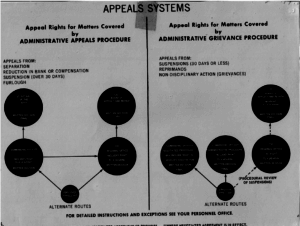
Hey, smart people! Guess what this is?

The photo above is of an “Appeals System” 9×12 card that I took off of a Navy bulletin board in the mid-70s. It shows the appeals processes available to federal civilian employees in 1969.

I thought you might like to know what it was like Back in the Day when old Bill Wiley started in this business. First, there are three major differences in how adverse actions were viewed back then:

  • “Reduction in Rank” was just as appealable as was a monetary or grade demotion. Rank was given an extremely broad definition. If I was reassigned from supervising eight subordinates to only seven, here comes an appeal. Move my office from the top floor to the basement, my rank is starting to feel reduced again. Easy to see why Congress did away with this concept when it passed the Civil Service Reform Act of 1978 (CSRA).
  • Today, to be entitled to a hearing challenging an adverse action, a suspension needs to be more than 14 days long. In 1969 and up to 1978, you got a hearing for a suspension only if it exceeded 30 days.
  • Thanks to the CSRA, unionized civil servants today have a right to binding arbitration. This poster states in a footnote that even though arbitration may be invoked by employees in a collective bargaining unit, the result is only advisory to the agency.

And now, for the procedural choices. If the Navy reprimanded an employee or suspended him for 30 days or fewer, the employee had an appeal choice to make between two options:

  1. A hearing before the Commanding Officer (CO) (facility head for other agencies) followed by a written decision, or
  2. A procedural review for suspensions to a Civil Service Commission (CSC) regional office and then another procedural review by the CSC Board of Appeals and Review. Written decisions at both levels, but no hearings. CSC was the precursor oversight agency before MSPB took over in 1978.

If the Navy invoked a longer suspension, a reduction in rank or compensation, furloughed, or fired the employee, the employee had an appeal choice between two options:

  1. In the Navy (with parallel procedures in other agencies), the employee had a right to a hearing before the CO, followed by a written decision. (Unionized employees could substitute arbitration at this step.) That decision could be appealed to the Secretary of the Navy, with no hearing, just a final written decision. As an alternative to the Secretary of the Navy’s review, the employee could take the CO’s decision to CSC, as below.
  2. As an alternative to the CO’s review, above, or after the employee invoked the CO’s review and received a decision, the employee could appeal to the CSC regional office where he would get a hearing and a written decision. Unlike the CSC review of shorter suspensions that were just on the procedures, these reviews were of the merits of the action. Either the employee or the agency could challenge the decision of the CSC regional office to the CSC Board of Appeals and Review. That review level did not provide for a hearing, but it did provide for a final written decision.

Compare these old appeals procedures to today’s procedures provided for by the CSRA and you will see three huge philosophical shifts that occurred:

  • Binding arbitration! Think about that. The federal government (aka, the king) was yielding its right to decide who worked for it and to award backpay and attorney fees to an unknown, untested, outside entity widely believed to benefit from setting aside disciplinary actions. For no other reason, if I were a federal employee, I would form or join a collective bargaining unit just to get this benefit.
  • Judicial review! Not only was the power of the executive branch being diminished by the implementation of binding arbitration, the CSRA provided that final review of serious adverse actions was vested not with the President via the heads of the federal agencies, but with the courts. Unlike decisions being made within the executive branch, court decisions are not all that concerned about what makes for an effective government. Judicial decisions interpret the law. The negative practical effects of those legal decisions, the court leaves up to Congress to fix.
  • Representation! Although some agencies allowed for representation in the appeals process in bygone times, the only alternative in which representation was guaranteed was in the advisory arbitration procedure. When appealing to the CSC, representatives were sometimes tolerated, although the appellant was given no explicit rights to representation. Under the CSRA, employees have statutory rights to be represented in any adverse action. With representation soon came discovery and trial-like administrative hearings, developments that have evolved too often into tools for the coercion of agencies.

These days, an agency has to not only decide to fire a bad employee, it must be ready to commit the legal resources and management time necessary to defend that decision. It’s easy to see why some managers choose to avoid holding bad employees accountable through adverse actions given the high costs of defending those decisions, even when they are valid decisions for doing so.

So now you know what it used to be like. Good old days, bad old days … you get to decide. In comparison, we have the current days, built on the philosophical decisions made by Congress in 1978. Most importantly, though, we have the days yet to come. There’s significant effort afoot to reduce the power of unions in the civil service. Congress has already made it easier to fire employees at the VA, and is considering language to expand that legislation to the entire executive branch. At least a couple of members of Congress would replace the federal civil service with about two million employees at will. (Can you say “patronage,” boys and girls?)

It’s good to remember the past. It’s essential to know the present. It’s historically vital to pay attention to what will be happening in the future. [email protected]

By Meghan Droste November 14, 2018

Parties in EEO cases have to make many decisions throughout the process — from the complainant deciding at the outset whether to remain anonymous during the counseling period to the agency deciding whether to accept or reject an administrative judge’s findings.  One of the earliest decisions for an agency is whether to accept a complainant’s claims for investigation. In my experience, the answer is usually yes. The agency will accept most, if not all, of the claims and the complaint moves forward. Sometimes, however, an agency will decide to dismiss an entire complaint at the beginning for failing to state a claim.  While the EEOC’s regulations require agencies to do so when appropriate, this decision has the potential to trip up an agency because it can lead to inappropriate weighing the merits of the complaint.

Two recent decisions from the Commission illustrate potential pitfalls in dismissing a complaint for failure to state a claim. In Vickey S. v. U.S. Postal Service, EEOC App. No. 012018055 (Aug. 15, 2018), the complainant asserted that she felt forced to resign when she experienced retaliation for speaking with a union steward, and when her supervisor slammed keys down in front of her, required her to drive in a vehicle with no heat, and threatened to remove her; the complainant alleged that all of these incidents occurred after she notified her supervisor that she was pregnant. The agency dismissed the claim, finding that the complainant was not aggrieved and the incidents were not sufficiently severe or pervasive. The Commission reversed, as it often does when an agency determines at such an early stage that a claim is not sufficiently severe or pervasive.

In Mack R. v. Department of Agriculture, EEOC App. No. 0120181607 (Aug. 3, 2018), the complainant alleged the agency discriminated against him when it issued a Letter of Warning (LOW) to him.  The LOW included a statement that the agency would not place it in the complainant’s official personnel file. As a result, the agency dismissed the complaint, finding that it did not state a claim because the complainant had not articulated a harm or loss.  In its decision reversing the decision, the Commission noted that if the agency had reduced the LOW to a discussion and expunged the LOW from the complainant’s record there would be no harm. As the agency did not do so, and the LOW still existed in the agency’s files, albeit not in the complainant’s OPF, the complainant could allege that he suffered a harm or loss.

While agencies certainly have an obligation to dismiss complaints that do not state a claim, such as claims that allege violations of laws that are not under the EEOC’s jurisdiction, I recommend erring on the side of caution when the concern is not that the complaint could not possibly state a claim, and instead that it could not state a strong claim. [email protected]

By Dan Gephart, November 14, 2018

Is everybody stressed out at work, or does it just seem that way? Why is everybody so stressed? What can we do about this stress? Why do I keep asking questions about stress? Are all of these questions STRESSING you out?

We actually know why people are stressed in the workplace thanks to the American Institute of Stress. Workload issues (45%), people issues (28%), juggling work and family life (20%), and lack of job security (6%) are the leading reasons.

And we know that stress leads to increased workplace accidents, absenteeism, reduced productivity and even workplace violence, as FELTG President Bill Wiley discussed in a recent FELTG News Flash.

And with the holiday season in full swing starting next week, we’re about to hit the most wonderfully stressful time of the year.  What can we do to tame all this workplace stress?

I reached out to the amazing Phillis Morgan, founder of Resilient at Work. I was fortunate enough to edit a book on labor relations that Phillis wrote a few years ago. Phillis is a former federal labor and employment lawyer who worked with the departments of Homeland Security, Justice, and Defense, and with conflict-riddled environments in Afghanistan, Uganda, and Nepal.  For her advisory work in Afghanistan, Phillis was awarded the NATO Service Medal, Secretary of Defense Medal for the Global War on Terrorism, and the Joint Civilian Service Achievement Award.

Earlier this year, she wrote an article on “Fierce Leadership” for a Federal Manager Association publication. I suggest you track it down.

DG: How does anxiety impact performance, particularly for federal managers?

PM: Anxiety and stress are of significant concern for American employees in general, and certainly for managers in the federal work space. Workplace stress and anxiety are related, multi-faceted issues that increasingly are of huge concern to employers and society at large. Anxiety has both a psychological and physical dimension. According to the American Psychological Association, anxiety is an emotion characterized by feelings of tension, worried thoughts and physical changes like increased blood pressure.

Stress is the emotional and physiological response to a trigger. In both cases, our perceptions of the external event make a big difference in whether we regard the event as anxiety or stress-inducing. Not all stress is “bad,” and a healthy level of stress can contribute to optimum performance. For example, a manager can interpret a tight deadline as a positively motivating challenge, producing a healthy stress response. A new project where the learning curve is high can be interpreted as a positively stressful event or a negative one.  Unfortunately, what managers and other employees are experiencing today, and have for some time, are critical and escalating levels of workplace stress.

DG: What suggestions do you have for managers and supervisors who are feeling overwhelmed?

PM: The research is clear that the most stressful type of work is that which values excessive demands and pressures that are not matched to workers’ knowledge and abilities, where there is little opportunity to exercise any choice or control, and where there is little support from others. In fact, a gap between control versus demands is associated with increased rates of heart attack, hypertension and other disorders.

The National Institute for Occupational Safety and Health (NIOSH) recommends that any serious stress reduction program include an effort to remove or reduce the sources of stress at work, such as job redesign or organizational changes, not just manage stress levels on an individual basis.

This view is consistent with the findings of Stanford professor Jeffrey Pfeffer in his latest book titled, “Dying for a Paycheck.”  Pfeffer’s central argument in the book – like NIOSH’s – is that employers need to focus more on those management practices that are leading to substantial health issues in the first place, practices such as layoffs, job insecurity, toxic cultures and long hours.

So, that’s the place to start: Managers and supervisors should turn inward to examine the organizational and managerial policies and practices they have which may be contributing to the problem, and look for ways to redesign them. At the same time, managers and supervisors can take steps to manage their stress and improve their overall well-being.  Here are some strategies that the research demonstrates are the most effective in combating stress and a sense of overwhelm:

Awareness. This includes increasing awareness of your stressful triggers and your responses to them. This is also known as mindfulness.

Reframing the problem or situation. What is the story you are telling yourself about the situation? Is it really a problem? Is it really as disastrous as the story you are spinning?  Can you reframe it in a way that doesn’t seem so overwhelming or intractable?

Task management. Can you delegate any part of the task? Can you break it down into more management chunks?

Exercise. It increases the production of endorphins, (your brain’s feel-good neurotransmitters), improves mood, is relaxing, reduces the symptoms associated with mild depression and anxiety, and can improve sleep.

Meditation. Calming meditation practices such as sitting meditation, moving meditation, (yoga), or breathing exercises promote the body’s relaxation response, groundedness, and resilience.

Get some support. Reach out to, and accept help from, trusted friends and family members. Contact the employee assistance program (EAP) for further guidance and counseling, and referral to mental health professionals, if needed.

DG: Mindfulness is not a widely accepted practice in the workplace. While that’s changing, there are still a lot of people, including supervisors, who don’t take the topic seriously. Do you still deal with negative bias about the term when doing training? And how do you deal with it?

 PM: Many years ago when I first tried introducing mindfulness to workplaces, employers thought it was too woo woo and there was significant reluctance. There’s been a sea change since then with mindfulness becoming much better accepted as a management and leadership strategy.  A client who is a manager at one of the larger agencies suggested I start with the science behind how mindfulness works and that’s what I do, and it really resonates with managers. I’ve been studying and working with these practices for 15 years so for me, personally, I like relating to the practices from a more intuitive or less heavily intellectual approach. Yet, I can understand that for someone who is unfamiliar with mindfulness, combined with perhaps the myths surrounding it, entering from a science gateway is more comfortable. It’s really not a problem because the science is there, supporting what people have been experiencing as the benefits of mindfulness for thousands of years. However a manager or supervisor wants to orient to the subject, there is room. [email protected]

By William Wiley, November 6, 2018

As we discussed last week, one of the Executive Orders (EOs) issued by the White House on MAY 25 effectively did away with an agency’s ability to resolve an employee controversy by entering into a “clean record” settlement agreement. There are several problems with that new limitation. On October 10, OPM issued “Interpretative Guidance” to address one of the problems.

That problem is that the EO left no room for exceptions. When a document was placed in the employee’s personnel record, it could not be removed as part of an agreement with the employee. No exceptions. Well, upon reflection, OPM advises us that there are indeed two exceptions to this iron-clad no-clean-record rule:

Corrective Action Based on Discovery of Agency Error  

Section 5 requirements should not be construed to prevent agencies from taking corrective action should it come to light, including during or after the issuance of an adverse personnel action, that the information contained in a personnel record is not accurate or records an action taken by the agency illegally or in error.

Corrective Action Based on Discovery of Material Information Prior to Final Agency Action

When persuasive evidence comes to light prior to the issuance of a final agency decision on an adverse personnel action casting doubt on the validity of the action or the ability of the agency to sustain the action in litigation, an agency may decide to cancel or vacate the proposed action.

Practitioners on both sides have expressed relief at OPM’s providing exceptions to the EO. You see, every practitioner we’ve spoken with – union or management, attorney or HR specialist – would like to be able to settle cases by agreeing to a clean record. An analogy to the criminal justice system helps us understand the gravity of the EO’s restrictions. Just think what it would be like in the judicial system if charged individuals could not take a plea bargain. These two provisions give at least a little ground for the practitioner to stand when arguing that a document should be removed from the employee’s e-OPF. Besides, these agreements have to be self-reported to OPM annually. There is no oversight to this process. We all learned in elementary school that we get higher grades when we grade our own papers.

At the same time, the EOs’ restriction and OPM’s “clarification” really do not make a lot of practical sense in some ways:

  • The EO says that adverse documents may not be removed from the “employee’s official personnel records.” The only record that meets that definition is the employee’s Official Personnel File, aka the e-OPF. That’s the only employee file that travels everywhere with the individual and lasts forever, into retirement and beyond, perhaps into heaven or hell for all we know, amen.
  • Agencies sometimes maintain separate Employee Relations files or Discipline files. However, strictly speaking, those are not an employee’s “personnel records” because they stay with the agency. They do not follow the employee as he moves from one agency to another. They are “agency” files, not an employee’s “official personnel record.”
  • There are three documents created when an agency fires an employee:
    1. Notice of proposed removal
    2. Decision to remove
    3. SF-50 that effectuates the decision to remove
  • Only the third document is routinely placed into the e-OPF. The first two, if retained at all, are retained in files in human resources. Therefore, there is good argument that the EO restricts agencies from removing an SF-50 from the employee’s e-OPF, but does not affect the retention or deletion of the other two documents: the proposal and decision.

OPM’s clarification, however, seems to take a broader view. It talks about prohibiting the removal of documents in a “personnel file,” not just the employee’s official personnel records. Does that mean that the agency is prohibited from deleting the proposal and decision memos even if an SF-50 is never generated (because the employee resigns)? Who knows?

Separately, both the EO and the OPM memo refer to prohibiting an agency from removing these documents in only three situations:

  1. In response to an employee complaint,
  2. When settling an appeal or grievance initiated by the employee, or
  3. Resolving an employee-initiated action.

That leaves open the question: If there is no employee-initiated complaint/grievance/appeal and the employee simply asks that the documents be removed, does the EO prohibit removal in that situation?

Bottom line: The OPM memo gives the agency a reason to remove documents in a certain limited situation which the EO did not. However, this whole thing is still a mess. Agencies are all over the place interpreting what it means. Gee, don’t we wish that there was a tiny little training company who could provide better guidance than what we have so far? Only time will tell if there is. [email protected]