By Deborah Hopkins, January 17, 2018

It’s every legal writer’s conundrum: when writing a legal document, which word of the following is the strongest to use, imposing a mandatory requirement on the recipient of the document:

A. Shall

B. Will

C. May

D. Must

The answer? D.
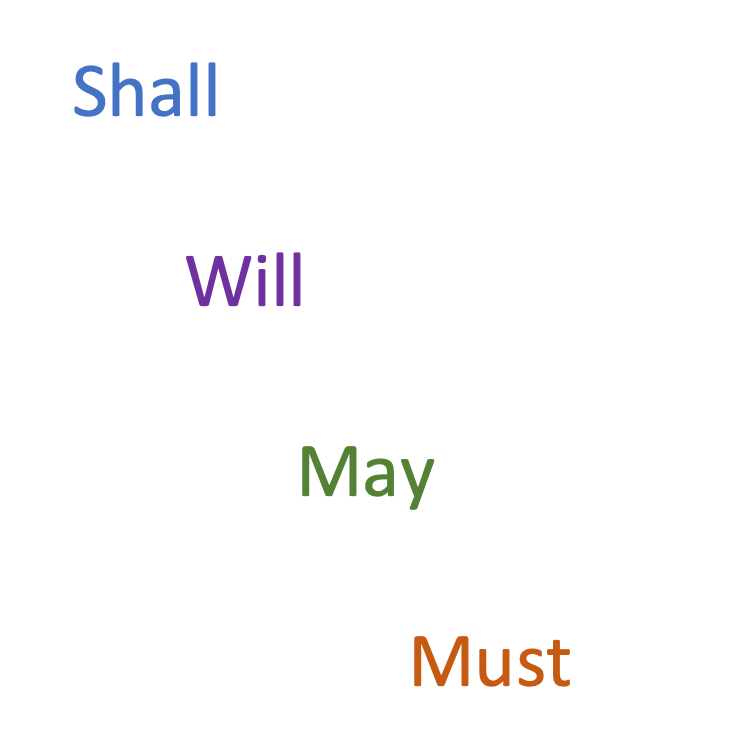
The only word of obligation from the list above is must – and therefore, the only term connoting strict prohibition is must not. The interpretation of everything else is up for debate.

Don’t believe me? You don’t have to take my word for it. Just about every jurisdiction in this great country has held that the word shall, while the most often used of the above, is also the most confusing because it can mean may, will, or must. Our very own U.S. Supreme Court has interpreted the word to mean may. In fact, it’s so confusing that the Federal Rules of Civil Procedure no longer use the word at all.

We quote Bryan Garner, one of our favorite authors, quite a lot during our legal writing classes because the guy just gets it; he understands what it means to beat your head against a wall trying to get a legal document just right, and understands that sometimes one word can alter the meaning of an entire sentence, paragraph, or document. On the topic of today’s article, he says, “In most legal instruments, shall violates the presumption of consistency…which is why shall is among the most heavily litigated words in the English language.” Hahaha. Nothing like lawyers to make black and white seem like all the shades of gray. Isn’t this a fun business we’re in?

To be fair, it’s not really our fault that this confusion exists. We can blame our law school professors: until just a few years ago, even the top tier law schools were teaching students that the word shall means must. The Federal Plain Writing Act only clarified this in 2010, and clearly a lot of us didn’t get the note. Props to the FAA, though, as it was the first agency to bring this topic to our attention.

So, realizing that words that sound alike may have very different meanings, let’s look at an example from a hypothetical EEO settlement agreement:

A. The agency shall return the complainant to her previous position as a GS-4 File Clerk and the complainant shall withdraw her complaint.

B. The agency will return the complainant to her previous position as a GS-4 File Clerk and the complainant will withdraw her complaint.

C. The agency may return the complainant to her previous position as a GS-4 File Clerk and the complainant may withdraw her complaint.

D. The agency must return the complainant to her previous position as a GS-4 File Clerk and the complainant must withdraw her complaint.

Yep, I’m going with D. Remember, when you want something to be mandatory – like a settlement agreement that requires both sides to do something – use the word must instead of shall, and you’ll have a document that carries with it a firm legal obligation. For more on this topic see the Federal Plain Language Guidelines (page 25) and the Federal Register Document Drafting Handbook (Section 3).

And if you really can’t get enough of this stuff, join us for this upcoming writing workshop in Washington, DC: Writing for the Win: Legal Writing in Federal Sector EEO Cases (May 8-10).

And now, I must go. [email protected]

By William Wiley, January 17, 2018

As most of us in this business know, the US Merit Systems Protection Board, our Supreme Court in the civil service, effectively has been shut down for over a year. There are three positions on the Board, we need at least two members to vote on a case for a decision to be issued, and since January 6, 2017, we have had only one Board member (due to the early resignation of the previous chairman).

There are two steps to an appeal to MSPB. After the agency takes an action – say, fires someone – the employee files an appeal with an MSPB judge. That judge conducts a hearing and issues a decision either upholding the removal, or setting it aside. That’s the first step.

The second step is that either the agency or the employee can appeal the judge’s decision to the three political appointees who sit as the Board. The members can either affirm the judge’s decision or change it any way they want. What comes out of all of this is that some removals are upheld and in others, the employee gets his job back with back pay.

Every work day of the year, three or four “petitions for review” are filed with MSPB HQ. Those PFRs are filed by either the agency or the employee; occasionally by both, arguing that the judge made a mistake. The effect of this lack of a quorum to review a judge’s decision is that PFRs go in, but no decisions on the PFRs come out. If you’ve ever had a backed-up drain pipe in your home, you have an appreciation for what this is like.

Talking about this mess in the abstract misses the point as to the magnitude of the harm caused by all of this. Utilizing the power of the Freedom of Information Act, we here at FELTG have obtained a profile of all those cases stuck in the pipe at MSPB since January 6, 2017. These are real people with real problems. These are agencies trying to maintain an effective workforce who might be on the hook for ever-increasing back pay and attorneys fees until these appeals are resolved. Keep that in mind as you think about the following select subsets of PFRs now pending for vote at MSPB:

Unacceptable Performers:  Of the approximately 750 cases pending a vote by the members as of today, 25 are appeals of the decisions of judges in Chapter 43 unacceptable performance removals. In this time of increased focus on performance accountability, the individuals in these cases deserve an answer, and we practitioners could use all the case law guidance we can get as to how to implement a performance-based removal.

General Misconduct:  Legally, these are called appealable “adverse actions.” These cases are almost always removals and involve bad behavior such as sexual harassment, falsification of government documents, theft, workplace violence, and just plain not coming to work. Many times, they involve claims by employees of mistreatment based on a disability or race. There are 345 former-employees awaiting a Board decision in these cases. Some appellants no doubt will be entitled to reinstatement with back pay, whereas others will remain fired, thereby allowing the agency to back-fill their positions. Add to these 20 former probationers who are appealing their removals, and you have about 365 removals that deserve to be decided (one for each day of 2017, if my math is correct).

Veterans:  Under two different laws, vets have a special right not to be mistreated because they served on active duty.  Because of a lack of a quorum, approximately 80 veterans are awaiting a decision as to whether they have been reprised against because of their service to our country. 

Whistleblowers:  Woo-whee; Congress does love those who disclose waste, fraud, and abuse in the executive branch. There’s even a special legal channel Congress has created for MSPB appeals of individuals who believe they have been reprised against because of their whistleblowing. It’s called an Individual Right of Action. Even individuals who simply help someone blow the whistle are allowed to use this specialized process. According to the latest information we can get, approximately 140 of the 750 jammed-up appeals at Board HQ are IRAs. You might think that Congress would be upset that these folks are not getting a final resolution to their claims of mistreatment. Of course, you might also think that Congress would look for common ground and collegial decision-making, but you would be wrong about that, as well.

ALJs: And finally, we see that four of the PFRs currently pending for a vote are proposed disciplines of that unique band of federal employees: Administrative Law Judges. Unlike regular civil servants who cannot appeal until their employing agency fires them (or takes some other appealable action), agencies who employ ALJs have no authority to discipline their ALJ employees. They can only propose to MSPB that the ALJ be disciplined, and the Board decides whether a removal or suspension will occur. Unlike the other appeals, there’s no accumulating back pay here. HOWEVER, the employing agency has already decided through its own internal processing that these four very important individuals are bad federal employees, but they can’t do anything about it until the Board finally acts. Somewhere these four individuals are sitting around drawing a federal salary every two weeks even though their employer thinks they should not.

This number of 750 represents the number of PFRs that have been reviewed by the MSPB career staff and are literally sitting in the front office of MSPB, on pause until just one more Board member is available to sign his or her name to the vote sheet, thereby causing a final Board decision to be issued. If a miracle were to happen and a super-human individual were to be confirmed as a Board member today, and that person miraculously could vote on 750 appeals in 24 hours, then 750 final decisions could be issued the next 24 hours and we’d be back to normal.

But wait; there’s more! Separately from the 750 PFRs waiting for a vote before the Board’s members, there’s another batch of pending PFRs currently being worked on by the HQ Board’s career attorney staff; PFRs that could be voted on today if the staff were to present them to the members for vote. When you add that group in, the total number of PFRs pending at MSPB headquarters as of today, extrapolating from our recently-responded-to FOIA request is … (ready the drum roll) … 1,400! That’s a full year’s worth of cases!

Hopefully as you read through this list, you used your imagination to picture members of each group. These are real people with significant legal rights who were hired to do real work for the government. It’s unfair to them and it’s unfair to us citizens, who appreciate an effective government, that these appeals are not being decided. Hopefully, the White House will soon see the righteousness in nominating a new member to the Board, someone who can hit the ground running, deciding along with the current Acting-Chairman whether the judges who heard these appeals initially made the right or the wrong decision.

And White House, if you’re reading this here article, please immediately nominate ONE not TWO new members. ‘Cause if you name two, it’s going to take twice as long to get concurrence with Chairman Robbin’s existing votes. Nominate one new member now, clear the backlog, then name a second (and then a third to replace Mr. Robbins once his term expires at the end of next month). [email protected]

By Meghan Droste, January 17, 2018

Welcome to the first edition of Tips from the Other Side—insight from a complainant’s counsel that I hope will help those of you who process complaints and represent agencies before the EEOC. In this column I will share some of the things that I look for when representing complainants, mistakes that I regularly see agencies make, and other tips that should make your jobs easier, even if it makes mine harder in the process.

For this month’s column, I am going to focus on the always riveting topic of document retention.  As anyone who attended my presentation during the fall 2017 EEOC Law Week can tell you, I get very excited when I have a non-selection case and I find out that the agency has destroyed the documents related to the selection process.  Why is that? Because I know two things: 1) the agency may have a difficult time articulating a non-discriminatory reason for its decision not to select my client, and 2) I have a chance of prevailing on a motion for sanctions.

Dear readers, this is such an easy one. Retain the documents. I’ll say it again, retain the documents.  Share this advice with everyone at your agency—retain the documents. This isn’t just good advice, it is a requirement.  Pursuant to 29 CFR § 1602.14, agencies are required to preserve selection records for at least one year after the selection decision is made, or, if an applicant files an EEO complaint, until that complaint is fully litigated.

If being required to do it is not enough to convince you, think of the consequences. EEO complaints can take years to litigate. It is not out of the realm of possibility for a complaint to go to hearing two years after the agency decides not to select the complainant.  It is also not out of the realm of possibility that by the time the hearing occurs, the selecting official, or anyone else involved in the selection, does not remember anything about the complainant, or the selectee, or even the position.  If the selection documents—resumes, scoring sheets, ranking lists, notes of any kind—still exist, these can help refresh the recollection of the agency’s key witnesses.  Without these documents, the agency may find itself in the position in which it cannot articulate a legitimate, non-discriminatory reason for not selecting the complainant.  For example, in Hollis v. Veterans Affairs, EEOC App. No. 01934600 (May 3, 1994), the agency destroyed the interview notes and the selecting officials testified that the complainant answered questions poorly but could not recall which ones. The administrative judge concluded that the agency was not able to articulate a non-discriminatory reason for its selection decision.

Another consequence may be sanctions. The specific sanction will depend on the facts of the case; it might be an inference that the complainant performed best in the interviews, or that the complainant provided certain information in his application. Although sanctions do not guarantee that a complainant will win, why take the risk of being disadvantaged with an adverse inference that could have been avoided?

If you have specific questions or topics you would like to see addressed in a future Tips from the Other Side column, email them to me: [email protected]

By Deborah Hopkins, January 17, 2018

One of the more interesting – and precarious – challenges that attorneys, HR practitioners, and supervisors in our business come across in misconduct cases is a word that you probably remember from way back in your Criminal Law class, if you went to law school: intent. Proving intent can be difficult, and while in the criminal world lesser-included offenses automatically apply (for example, if you can’t prove Murder 1, Murder 2 is a lesser-included offense that rides along with the Murder 1 charge), in the business of federal employment law, failing to prove intent might just cause you to lose your entire case – even if you have incontrovertible video evidence and 100 witnesses who can swear that the employee engaged in misconduct.

In our business, labeled charges (for example, falsification; theft) come with an element of intent, and the intent has to be proven by a preponderance of the evidence. So, how does one prove intent? Well, unless we have an appellant who admits they intended to tell a lie or to permanently deprive someone of something, intent is proven by considering the totality of the circumstances. Naekel v. Transportation, 782 F.2d 975, 978 (Fed. Cir. 1986); Boo v. DHS, 2014 MSPB 86.

When it comes to intent charges, we have a few common categories that are worth exploring. Today we’ll cover deceit/falsification and insubordination. In the next newsletter we’ll tackle threat and willful misconduct.

Deceit/Falsification

In order to prove Falsification, the agency must prove that the information given by employee is:
1. Either
– False,
– Misleading, or
– Incomplete,
2. Given with the intent to deceive, and
3. For private material gain
Boo, supra.

All of these elements are required, so just because an agency can show that an appellant has provided incorrect information, this proof in itself does not control the question of intent for purposes of adjudicating a falsification charge. Reid v. Navy, 118 MSPR 396 (2012) (intent may be negated if there is evidence the appellant does not believe he has done anything wrong). Because we’re talking about circumstantial evidence, intent may also be inferred when the misrepresentation is made with a reckless disregard for the truth, or with conscious purpose to prevent the agency from learning the truth. Crump v. VA, 114 MSPR 224, ¶ 6 (2010).

One of the common ways agencies lose the intent argument is when an employee makes a good-faith explanation for the behavior that seems deceitful, and the agency still decides to charge the employee with falsification. A reasonable good-faith belief in the truth of a statement precludes a finding that an employee acted with deceptive intent. See, e.g., Leatherbury v. Army, 524 F.3d 1293 (Fed. Cir. 2008) (appellant who requested mileage reimbursement to which he was not entitled had a reasonable good faith belief that he could seek reimbursement, therefore he could not have been reckless with regard to the truth because of that reasonable good faith belief).

The absence of a credible explanation for the incorrect information can constitute circumstantial evidence of intent to deceive. Crump, supra (the totality of the circumstances and lack of plausible explanation showed the appellant falsified his educational background, a medical record, and information related to a military leave request with the intent to deceive or mislead).

If your intent to deceive evidence is shaky, consider charging lack of candor, which is a more flexible charge that need not require proof of intent to deceive. See, e.g., Ludlum v. DoJ, 278 F.3d 1280 (Fed. Cir. 2002). And always remember, you can pump up the penalty by putting intent in the Douglas analysis; if you lose it down there, your case isn’t necessarily dead.

Insubordination

Insubordination is “The willful and intentional refusal to obey an authorized order of a superior that the superior is entitled to have obeyed.” Phillips v. GSA, 878 F.2d 370 (Fed. Cir. 1989), which is a distinct charge from failure to follow a policy, Brown v. Air Force, 95 FMSR 5182 (1995).

Here are examples of a few cases where agencies were able to prove the intent element in insubordination charges:

• Refusal to comply with a supervisor’s order to go home, Ziegler v. Treasury, DC-0752-11-0645-I-1 (2013)(NP).

• Disobedience of an order to be vaccinated against anthrax, Mazares, Jr. v. Navy, 302 F.3d 1382 (Fed. Cir. 2002).

• Refusal to answer a supervisor’s questions in connection with a work assignment, Shaw v. Air Force, 98 FMSR 5373 (1998).

• Refusal to submit to drug testing, Watson v. Transportation, 91 FMSR 5447 (1991).

And here are a few that agencies lost:

• A brief delay in providing information sought in connection with an investigation, Milner v. Justice, 97 FMSR 5455 (1997).

• Refusal to comply with an order that would have placed the employee in imminent danger of serious injury, Washington v. VA, 91 FMSR 5486 (1991).

• A sincere but unsuccessful attempt to comply with an order, Forgett v. Army, 90 FMSR 5329 (1990).

• Failure to comply with an order or direction that is not sufficiently clear, Drummer v. GSA, 84 FMSR 5706 (1984).

If you’re having trouble on the intent evidence in these cases where you want to charge insubordination, consider instead charging something like failure to follow orders, which does not require willful refusal to obey an order but just requires proof the employee did not do what he was told to do. See Hamilton v. USPS, 71 MSPR 547 (1996).

The bottom line in labeled charges that contain an intent element: be sure you have a preponderance of the evidence on intent, because if you don’t, you lose the whole thing. [email protected]

By William Wiley, January 17, 2018

Oh, boy. Civil service stuff above the fold recently on page A-1 of the Washington Post. Career government employees don’t often rise to that level of awareness in the public eye. Sadly, the article published the last week of 2017 focused on an aspect of federal employment that we wish wasn’t so noteworthy: sexual misconduct in the federal workplace.

They tell you that once you graduate from law school, you won’t see the world the same ever again. For example, a normal person who is not encumbered by a legal education, upon seeing a car wreck, might think, “Oh, those poor people! I hope no one’s injured. I need to call 9-1-1 and then see what I can do to help out.” The first thoughts of a lawyer, upon seeing the same car wreck, might well be, “The west-bound vehicle was negligent in not slowing down for the yellow light, but the north-bound vehicle was speeding. Looks like contributory negligence to me. And the pain and suffering suffered by the by-standers who saw the incident is probably a significant consequential damage. I wonder how many business cards I have with me?”

This same automatic-legal-brain thinking comes into play when you read the Post’s article. First, the subtitles to the piece about sexual misconduct at the Department of Justice: “Systemic Issues in Harassment Cases: Report details a lack of disciplinary action.” From this, one might conclude that the article will be addressing sexual harassment as it was described in a recently-released DoJ IG report. Well, not exactly. For example, here are some of the primary incidents reported as described in the IG report:

  1. A supervisor sending harassing emails to a subordinate who had ended a sexual relationship the two were having.
  2. An employee who groped the breasts and buttocks of two coworkers.
  3. A supervisor who had consensual sex on several occasions in his government office.

If you’ve been to any of our FELTG seminars regarding sexual harassment (and we have done BUCKETS of them recently), you no doubt learned that the law defines sexual harassment in part as “unwelcome” sexual conduct. Clearly, the first two incidents meet that definition. However, nothing in the description of the third incident described the acts as being “unwelcome.” If they were not, then there’s no sexual harassment.

“What? You mean it’s OK to have sex in a government office? Why wasn’t I informed?” No, Poopsie. That’s not what we mean. If you’ve been to the FELTG seminar where we teach how to discipline a civil servant, you would have learned that if you have a rule, and an employee violates the rule, you can discipline the employee. Also, you’ve learned that in addition to published official rules (e.g., agency policies), you also can enforce “common sense” rules, also known as “rules of society.” Unless you have tolerated workplace sex in the past, it’s fair to say that you have a “common sense” rule that having sex in a government office is wrong. Therefore, the supervisor in incident number three above can be disciplined, but not for sexual harassment. Instead, the discipline should rest on the common-sense rule that federal employees are not to have sex in their offices. (You experienced practitioners are probably already thinking that the secondary charge should be “Waste of Government Time” if the acts occurred on the clock rather than after hours. See what I mean about a bit of legal education changing how you think?)

The next legal bump those of us with civil service experience run into is the suggestion in the article that although some of the offending employees were counseled or reprimanded, they should have been suspended or demoted instead; i.e., the agency did not select a severe enough punishment given the nature of the misconduct.

Again, experienced practitioners know that suspensions often hurt the agency more than they hurt the employee. The agency must forgo the employee’s services for the duration of the suspension, and often coworkers suffer by having to perform the work that the suspended employee normally would have performed. If discipline is intended to correct behavior rather than punish the employee, a suspension is of questionable value. As for a demotion, if an agency were to reduce an offending employee in grade, the agency would then have to accept lower-graded work from the individual. Well, maybe the agency doesn’t NEED lower-graded work. Maybe it needs the higher-level of work the employee is already performing. The somewhat cavalier conclusion that DoJ didn’t do enough because it did not suspend or demote the offensive employees fails to acknowledge the reality of the federal workplace.

Finally, the last wrinkle in the analysis in the article is the criticism that some of the offending employees received subsequent performance awards after the misconduct occurred. That might well be a concern and something that should be addressed. But stay with me: you can’t blame DoJ for giving awards based on performance without consideration of any misconduct. Read OPM’s award regulations at 5 CFR 451. According to OPM, awards are to be based on the employee’s performance plan or perhaps other goals set in advance. You’ll find no OPM guidance regarding the consideration of misconduct when making award decisions. The famous Douglas Factors that were developed by MSPB as guidance for agencies when selecting the appropriate level of discipline for misconduct, tie performance awards into the disciple-penalty determination as a mitigating factor. However, nothing from MSPB, OPM, or the courts requires that misconduct be considered when determining a performance rating.

The article in the Post highlighted several incidents of discipline-worthy sexual misconduct. Perhaps in retrospect DoJ should have been more aggressive in its responses to the incidents. Just be careful when assessing an article in the media that discusses civil service law. Not all sexual conduct in the federal workplace is sexual harassment, and disciplinary decisions relative to sexual misconduct are more challenging to make than simply saying that the offending employee should lose some pay. [email protected]


By William Wiley, January 9, 2018

Every now and then, someone will ask one of us here at FELTG, “Hey, you guys claim to be so smart. What would you change in the system if it was up to you?” Obviously, anyone who would say this is unfamiliar with who we really are because “smart” is not an adjective that comes up on the short list, at least not before “a bit silly.”

That still leaves us with the question, what would we change if we had any influence at all as to how the government holds it employees accountable without rewriting the underlying law? Good question. And to start off the new year, here are some hopefully-good suggestions for those who actually do hold The Power. With the stroke of a pen – or a very few key strokes on a computer – here are some simple, yet game-changing, ideas:

OPM

  1. Here’s what the Civil Service Reform Act says about firing bad performers. Agencies must remove employees from their position who have unacceptable performance “only after an opportunity to demonstrate acceptable performance.” 5 USC 4302(b)(6). Back in the very-early 80s, some bright mind at OPM decided that this language called for a “Performance Improvement Period.” That thought gave birth to regulations and case law calling for a structured PIP, complete with a formal notice of failure, the establishment of “firm benchmarks” of expectations during the PIP, and counseling and feedback for a month or more during the PIP.

Well, the law never required that, did it?

Unless identified as a trainee position, we hire only qualified people into government positions. In theory, we hire only the best qualified and provide them a performance plan immediately after hiring. Therefore, they should be able to hit the ground running once in place. After that, several weeks to a couple of months should be adequate to meet the statutory requirement for an “opportunity to demonstrate acceptable performance” without the need of a formal PIP. OPM should rewrite its instructions as follows, consistent with the Reform Act and doing away with the requirement for a PIP:

5 CFR 432.104 Addressing unacceptable performance

The agency is required to provide the employee a periodic performance plan. Once the plan is in place, the employee must be provided an opportunity to demonstrate acceptable performance under the plan with assistance from the agency as necessary, a period generally lasting 30 to 60 days.  Any time after this period, if the agency determines that the employee is performing unacceptably in at least one critical element, the agency must initiate steps immediately to remove the employee from the position by either reassignment, reduction in grade, or removal from service.

For those of you faint at heart who think this approach might be un-American or otherwise un-Constitutional, it is effectively the new approach allowed for at DVA under 5 USC 7701. Congress wouldn’t pass an un-American law, would it? If it’s good enough for our DVA friends, it’s good enough for the rest of the federal agencies.

Alternatively, if OPM chooses to continue to insist that a formal PIP period be employed prior to removing an unacceptable performer, 5 CFR 432.104 should be amended by adding the following sentence at the end:

The opportunity to demonstrate acceptable performance period generally shall not exceed 30 days and can be ended at any time the employee demonstrates the inability to perform acceptably during the period.

  1. The Civil Service Reform Act creates an anomaly not easily explained. Once the agency provides an employee a notice of a proposed removal, the employee must be provided at least seven days to defend himself in a response. 5 USC 7513(b)(2). Once the employee exercises or waives that response right, the agency can effectuate the removal. However, for reasons unexplained in the law, the agency must continue to pay the employee for 30 days from the date of issuance of the notice even though it has already decided to fire him. 5 USC 7513(b)(1).

Unfortunately, a number of Federal managers do not understand the importance of making disciplinary decisions promptly. The flexibility in the law rarely makes for a more efficient accountable government. Therefore, OPM should modify its adverse action regulations as follows, appended to the end of the existing language:

5 CFR 752.404(c)(1) Procedures

Generally, agencies should provide an employee who has been issued a proposed action under this section a seven-day period to respond. Once the employee has either responded or waived the right to respond, the agency should make a decision on the proposal as soon as possible. In most cases, that decision should implemented as soon as the 30-day notice period has expired.

We have written separately and extensively that OPM should issue implementing regulations that make placement on Notice Leave automatic in cases of a proposed removal.   Additionally, we’ve argued that suspending employees is punitive and archaic, and should be avoided as being more helpful than harmful. No need to restate those suggestions here.

Agencies

Our experience here at FELTG is that within agencies, policies are often all over the map when it comes to implementing removals. If OPM does not make the above changes to government-wide policy, nothing prevents agency heads from doing essentially the same thing within agency policy:

  • Establish opportunity periods (PIPs) to be 30 days in length, terminable early if the employee demonstrates unacceptable performance during the period.
  • Mandate that decisions regarding unacceptable performance and discipline be made as soon as the notice time frames are completed.
  • Limit notice periods to seven days, routinely enforce Notice Leave during the notice period, and rarely grant extensions of time.

There are some great minds at work these days developing possible changes to our civil service system. Hopefully, those ideas – perhaps along with these – will encourage deep thought and appropriate policy action. [email protected]

By William Wiley, January 3, 2018

Let’s talk burdens of proof for a few minutes, and along the way, we’ll test your knowledge. For you newcomers to this business, the burden of proof declares how much evidence an agency must have to discipline or fire someone from the federal government. The higher the burden of proof, the more work the agency must do, the longer it takes to prepare a decision, and the harder it is to defend the action on appeal. When given a choice, an agency will (or, should) pick the lower burden of proof every time.

Here are three proof-burdens that demonstrate the relativity of how much evidence is needed for a particular action. First is the official name followed in parentheses by the layperson’s way of saying the same thing:

  • Beyond a reasonable doubt (he certainly did it)
  • A preponderance of evidence (he probably did it)
  • Substantial evidence (he might have done it)

And here are three pop quiz questions to test your employment law knowledge. Get all three correct and you get a free annual subscription to the FELTG Newsletter plus free coffee at all of our open enrollment seminars for the year:

1. What is the agency’s statutory burden of proof when firing someone for unacceptable performance?

A. He certainly did it

B. He probably did it

C. He might have done it

D. None of the above

Answer: C. Every employment law practitioner and federal supervisor should know that almost 40 years ago, Congress made it drop-dead easy to fire a poor performer. It gets no lower than the he-might-have-performed-unacceptably standard. If the choice is to fire a bad employee for performance or misconduct, pick performance as you’re less likely to lose for lack of proof. See 5 USC 7701(c)(1)(A).

2. What is the agency’s statutory burden of proof when firing someone for misconduct?

A. He certainly did it

B. He probably did it

C. He might have done it

D. None of the above

Answer: B. Every employment law practitioner and federal supervisor should know this 51% standard. Unfortunately, most do not recognize how low this burden of proof is, even though bad federal employees are fired much more often for misconduct than for performance. See 5 USC 7701(c)(1)(B).

3. What is the agency’s statutory burden of proof when suspending someone for up to two weeks for misconduct?

A. He certainly did it

B. He probably did it

C. He might have done it

D. None of the above

Answer: D. What?!? Wiley, you idiot. I’ve been working in federal employment law my whole career. I’ve attended your classes. I’ve read the book that you and Deb wrote. You teach that it’s a preponderance of the evidence, that the employee probably did it, that’s the burdent the agency needs to prove a short suspension. Are you saying that there’s no law that requires this burden?” Yes, Virginia, that’s right. There’s no Santa Claus and there’s no law that sets the standard of proof necessary to sustain a short suspension.

Well, then. It must be in an OPM regulation. Right? Wrong. Go read 5 CFR 752.202, the OPM regulations that lay out the standard for action for short suspensions. If you find a reference to a burden of proof there, your copy of the Code of Federal Regulations has been hacked.

So how did this epiphany come about after nearly 40 years of not seeing the obvious? Well, once again I have to give credit to a hard-working practitioner at DVA who, when trying to understand the limits of the new DVA law’s application, simply read the law and found this anomaly. We’re all in this together, and thanks goodness that DVA is sharing its experiences with the rest of us.

What can you do with this new information. assuming of course that you didn’t already know about it? Logic it through this way from an agency’s perspective:

  • Without the law or a regulation mandating a burden of proof, an agency would be free to establish its own proof burden for reprimands and suspensions up to 14 days.
  • DVA’s new law (38 USC 714(d)) tells us that there’s nothing fundamentally wrong with using the substantial burden of proof for disciplinary actions. If there were, Congress wouldn’t have passed the recent legislation.
  • Therefore, why would an agency NOT incorporate the substantial evidence burden into its own policy statements regarding adverse actions?

Here at FELTG, we try not to take issue with reasoned decisions by agency managers as to policy as long as those decisions are based on evidence and not just what some smarty pants “thinks” the evidence should be. If your agency’s head knows that legally the burden of proof for short suspensions can indeed be as low as substantial, and he or she still decides that the penalty burden should be at the preponderance level, so be it. Heck, make it the “clear and convincing” level of proof if that floats your boat. However, if you conclude that the proof burden for disciplinary actions must be “preponderance” without considering all the options, you are a baaaad employment law policy maker. [email protected]

By William Wiley, December 13, 2017

Pop Quiz: What do these three individuals have in common?

  • Charlie Rose
  • Matt Lauer
  • Garrison Keillor

Answer:  No doubt, a list of very descriptive words came to mind when you were trying to come up with an answer. Well, since this is an employment-law-like newsletter, you might have guessed that is the sort of answer we’re looking for. When you come at it from the human resources direction, the answer relevant to all you readers is this:

They each were fired within about 24 hours of being charged.

When this topic came up in one of our famous FELTG seminars a week or so ago, one of the attendees opined that it would be great if we could move that quickly in the federal government when we come across a bad employee.

Well, we can. More or less.

Using the Lauer situation as an example, here’s what’s been reported:

  1. One of Lauer’s coworkers, accompanied by her super-duper attorney, met with representatives of the company’s human resources office. In that meeting, the former co-worker described in graphic detail unwelcome sexual contact initiated by Lauer.
  2. Human resources confronted Lauer with the charge, which he did not deny (or may have even admitted; I can’t tell from the news reports).
  3. Lauer was then fired.

There’s no reason that a good human resources office in a federal agency could not essentially accomplish this same result if there were a sexual harasser in the workplace, with a bit of tweaking to comply with the civil service law.

  1. You would have a sworn statement from the victim. That’s a preponderance of the evidence. No need for a big investigation or a bunch of witness interviews. It is more likely than not that the event occurred if she said it did, she’s credible, and there’s no evidence it did not occur.
  2. Because it’s the federal government, we would have to draft a proposal to remove. That should take maybe 15 minutes: “By this memo, I propose that you be removed based on the following charge. On November 30, 2017, you coerced Vickie Victim into having unwelcome sex with you.” Attach to the memo the sworn statement above.
  3. Unless you are fortunate enough to work at DVA, you’ll need to complete a Douglas Factor worksheet. If you can’t pump up Douglas Factor 1, the nature and seriousness of an offense like this to justify a removal, you need to come to one of our classes. Commenting on all 12 Douglas Factors should not take more than 20 minutes.
  4. In the proposal notice, above, include a paragraph that places the employee on Notice Leave. That way, you can get the employee out of the work place the same day that you draft the proposed removal which should be the same day you obtain the sworn statement.

In the private sector, where the darned Constitution doesn’t apply, they guy stops getting paid that day. However, in the fed, we’ll need to give the dude a seven-day chance to defend himself orally and in writing, and can’t issue a final decision until Day Eight. At least he’s out of the workplace all this time. In most cases, we’ll have to pay him for another 22 days because the law says so, but he’s already fired. In some cases, you’ll be able to get him off the payroll on Day Eight if you conclude the misconduct amounts to a criminal assault or some other crime that could involve jail time.

Can your human resources office do this? If not, then you should fix that. Victims in cases like these, as well as the citizens of our great country, deserve swift justice. Does your legal office see a problem with moving this quickly? Then the folks over there need to read a few MSPB cases to find out how expedient this can be.

We take a lot of flak in the fed for not acting quickly to hold employees accountable. The recent incidents reported in the press give us a reason to rethink how we initiate removal actions in egregious circumstances. Here at FELTG, we recommend that you get your best minds together and develop a predetermined procedure with specific assignments and draft templates to deal with issues like these before they occur. Our coworkers who are the victims of sexual misconduct deserve no less.

As my grandmother used to say, “It doesn’t do any good to order the fire extinguisher after the fire has started.” And as I learned in the Boy Scouts many years ago, “Be prepared.” Be ready for things like this to happen, because they are going to happen again, Mister, they are going to happen again. [email protected]

By Deborah Hopkins, December 13, 2017

You probably saw last week that Time Magazine’s 2017 Person of the Year is not a person at all, but rather is a group of people: “The Silence Breakers,” the women who came forward under #MeToo as victims of sexual harassment and assault.

This #MeToo movement continues to reveal more details of sexual misconduct in the workplace, and more horrifying details of sexual misconduct – from the highest levels – are coming out. It may seem like “guilty until proven innocent” is the trend in Hollywood (think Matt Lauer; Kevin Spacey; Harvey Weinstein), but keep in mind that there’s a lot we don’t know about why those ramifications hit so quickly. There could have been admissions, confessions, or agreements to resign.

What we do know is that because of these front-page stories, there is now a heightened awareness and sensitivity to sexual harassment and related inappropriate conduct in the federal government. Sexual misconduct among federal employees is not anything new, but because it’s a topic on everyone’s minds, it’s worth a deeper look today.

First of all, sexual harassment is a term of art and while it’s easy to allege, it’s actually not that easy to prove. There are elements to a sexual harassment claim, and the complaining employee must prove them all in order to prevail. So, there is a LOT of inappropriate conduct that does not rise to the level of Title VII sexual harassment but is still inappropriate in the workplace.

What does this mean for you, at your agency? It means you should not wait to discipline an employee who engages in inappropriate sexual conduct until a complaint of sexual harassment is filed or proven. The EEO complaint process takes so long, you could have a predator roaming the halls of your agency for years before there’s ever a finding. So do not delay.

A lesson we learned from the Postal Service 30 years ago is that an agency can remove an employee for inappropriate sexual conduct, even if the conduct does not rise to the level of Title VII harassment. It bolsters the agency’s case for removal if the employee’s conduct affects other agency employees, and if the agency has a legitimate concern about incurring potential Title VII liability if it fails to take appropriate action to correct the employee’s behavior. See Carosella v. USPS, 816 F.2d 638 (Fed. Cir. 1987). Part of an agency’s obligation in these cases is to promptly investigate and STOP harassment from occurring, so acting quickly is the best way to protect employees from harm – and to protect your agency from liability.

So, what kinds of cases warrant removal as an appropriate penalty? Let’s look at a few.

Supervisor Misconduct

Supervisors are held to a higher standard than co-workers, so if the perpetrator is a supervisor we know that removal can be warranted, especially when there are multiple charges of inappropriate sexual behavior toward subordinates. Last year the MSPB affirmed a supervisor’s removal for Unacceptable Conduct where the supervisor made inappropriate comments with sexual undertones to several subordinates, including telling an employee that he was willing to help her cheat on her husband, and telling a different employee that she could take the day off if she was willing to act “a little unprofessional. Oliveros-Ballon v. USPS, SF-0752-15-0615-I-1 (April 15, 2016)(NP).

In another recent case, a supervisor’s removal was affirmed after she made comments of a sex-based nature and touched an employee on the buttocks on multiple occasions. That’s right, female supervisors engage in this type of behavior as well, and are disciplined accordingly. Reid v. Air Force, CH-0752-14-0849-I-1 (April 5, 2016) (NP).

Over at the VA, a supervisor’s removal was affirmed after he was charged with 20 counts of inappropriate and intimidating sexual comments, sexual conduct, and changes to working conditions, of his female employees. Alberto v. VA, 98 MSPR 50 (2004).

There are hundreds, if not thousands, of cases that follow this same line of outcome, but hopefully by now you get the idea. Sexual misconduct – regardless of what you decide to call the charge – is nothing new and agencies have been successfully removing supervisors for decades over inappropriate sexual language and conduct in the workplace.

Coworker Misconduct

In the case of a non-supervisor, though, removal is often still an appropriate penalty. Earlier this year, the Federal Circuit upheld a removal for Unacceptable Conduct where the appellant made 10 vulgar sexual comments to female customers and coworkers. Canarios v. USPS, No. 2017-1935 (Fed. Cir. 2017) (NP). In another recent case, an MSPB AJ upheld a Conduct Unbecoming removal when an appellant made sexual comments and gestures at three coworkers and did not stop after they objected to his conduct. Adkins v. DOD, SF-0752-16-0294-I-1 (December 12, 2016) (NP).

A Treasury employee’s removal was upheld by the MSPB because he continued to talk to a coworker in sexually offensive and derogatory terms, after being explicitly told by management not to do so. Lentine v. Treasury, 94 MSPR 676 (2003). [Editor’s Note:  This is critical and sometimes, this is hard. Before we can discipline, the employee has to be on notice of the prohibited misconduct. Some conduct obviously violates accepted norms of behavior and can be disciplined even if we did not tell the employee not to do it; e.g., non-consensual sexual touching. On the other hand, some conduct is not so obviously inappropriate; e.g., touching someone’s shoulder. The manner and context of conduct often determines whether the employee should have known not to do it; e.g., was the shoulder touch an “Atta boy/girl” congratulation or was it a “Hey, baby. You got some nice sexy shoulders there.” The good news is that a supervisor can establish rules that clarify any gray areas; e.g., “No touching. Anywhere. Any time.”]

This is serious stuff that requires appropriate action.

If you’re dealing with a potential sexual misconduct charge, you’ll want to pay special attention to these mitigating or aggravating factors in penalty selection for sexual harassment cases:

  1. Physical contact
  2. Frequency or severity of the conduct,
  3. Supervisory status,
  4. Clarity with which employee is on notice of rules prohibiting sexual harassment and improper conduct, and
  5. The employee’s potential for rehabilitation.

See, e.g., Reid, supra.

Is there a correct way to handle in these cases? Yes. The answer is to take prompt, effective corrective action so that these behaviors do not continue. Look to the cases for guidance. And hey, while it seemed for a while that Congress was above it all, we’re finally starting to see that in sexual misconduct is a serious offense, and it deserves consequences, no matter who you are. [email protected]

By Deryn Sumner, December 13, 2017

Last month, the Commission issued a decision modifying a Final Agency Decision which had found no discrimination, and found the National Science Foundation failed to accommodate an employee with stage 4 terminal cancer.  This case is notable for a few reasons.  One, it is another in a string of cases where the Commission has instructed agencies that it must allow telework as a reasonable accommodation.  It is also notable in that it illustrates how long these cases take to process, as this one was filed in 2011, and the Complainant died several years prior to receiving the decision.  Finally, this case is notable to me personally as I had the pleasure of knowing and representing the Complainant before her death.  Although this case took many years to litigate and my client did not live to see her claims prevail, I am proud to finally obtain justice on her behalf.

The case citation is Doria R. v. National Science Foundation, EEOC Appeal No. 0120152916 (November 9, 2017). First, let’s address the procedural delays. The Complainant filed her formal complaint on November 9, 2011.  She received an ROI and requested a hearing before an Administrative Judge.  That administrative judge granted summary judgment in the agency’s favor on February 9, 2012.  The Office of Federal Operations reversed the grant of summary judgment and remanded the case for hearing more than 21 months later in Doria R. v. National Science Foundation, EEOC Appeal No. 0120121886 (December 11, 2013).  It then took until October 2014, another 10 months, for the case to actually be heard by an EEOC Administrative Judge.  It took six years to the day from when the Complainant filed her formal complaint to when the EEOC issued a decision finding discrimination. And the decision is not even final yet, as remedies including compensatory damages and attorney fees have not yet been decided. Although I counsel my clients that the federal sector EEO complaints process takes years, this puts a sobering reality on what a realistic timeframe for processing means.

In terms of the facts of the case, they are pretty straightforward for the claims on which the Complainant prevailed.  Doria R., as the Commission has renamed her, had been diagnosed with breast cancer, which had metastasized in her bones and caused her spine to be very brittle.  She had been in a car accident, which further exacerbated her spinal injuries and required surgery, and there was concern that she could become paralyzed if her spine was further injured.  The Complainant requested to telework full-time because of her surgeon’s concern that she should not commute to work on public transportation due to a risk of further injury. This request was denied because of alleged concerns about the Complainant’s productivity on days she teleworked.  She then requested one additional day of floating telework per week, which was also denied after the Agency repeatedly requested additional medical documentation.

The Commission noted, “providing disabled employees with the reasonable accommodations of telecommuting is consistent with the Rehabilitation Act’s goal of assuring ‘equality of opportunity, full participation, independent living, and economic self-sufficiency’ for individuals with disabilities.” The Commission further found that there was no justification for the Agency to request additional medical documentation, as what the Complainant provided substantiated that she was limited in major life activities and that there was a nexus between the requested accommodation and her limitations. In finding the Agency failed to accommodate the Complainant, the Commission also noted that the Agency did not present specific evidence that the Complainant’s productivity was lower on days she teleworked as compared to days she was in the office, that granting additional telework days would have impacted the Agency’s mission or would have otherwise caused an undue hardship.  The Commission also found that the Agency’s 10-month delay in responding to the request for telework, given that the Complainant needed the telework immediately and “each day the Agency failed to provide her with additional telework threated to exacerbate her serious medical condition, to the point of paralysis” rendered the delay unreasonable.

The Commission has clearly indicated to agencies that the days of denying requests for telework on the basis that an agency is not responsible for an employee’s commute to work are over.  I’m not saying that telework is always an appropriate or effective accommodation.  However, agencies should carefully examine such requests based on the Commission’s decision here, as well as in Lavern B. v. HUD, EEOC Appeal No. 0720130029 (February 12, 2015), and in other recent decisions. [email protected]