March 19, 2019

When former Merit Systems Protection Board Chair Susan Tsui Grundmann started her new job as Executive Director of the Office of Compliance, quite a few people didn’t know what the OOC was, or what it did.

That soon changed.

Grundmann barely had enough time to learn the best spot for coffee near the Capitol before the OOC found itself in the spotlight. The #MeToo Movement had broken out, and Congress was not immune to claims of sexual harassment. The OOC, which operates with a staff of attorneys and other professionals to ensure a fair, safe, and accessible workplace for 30,000 legislative branch employees, was suddenly very busy – and getting a lot of attention.

“During a five-month period, our tiny staff had been tested, weighed and found not to be lacking,” Grundmann said. “Since October 2017, our staff personally trained over 1,500 employees in the House and Senate alone, not all at once, but in ones, twos, and tens.”

And it’s no longer the Office of Compliance. The agency has since rebranded itself as the Office of Congressional Workplace Rights. Along with the new name, the OCWR received new mission and vision statements after the Congressional Accountability Act Reform Act was passed late last year and goes into effect in June. Per Grundmann, it “serves as the EEOC and the FLRA for the legislative branch. We also perform certain functions of the Department of Labor and the Department of Justice for the legislative community.”

Here’s more from our interview.

DG: New name, new mission and new vision statement. How else has the office changed?

SG: Our jurisdiction has been expanded to cover new employing offices, like certain congressional commissions, and additional categories of employees, such as unpaid staff, including interns, fellows, and detailees. Our ADR process no longer includes mandatory counseling, a mandatory “cooling off” period before the employee can proceed either to an ADR hearing or court, and mandatory mediation, although mediation remains optional if both parties agree. We have a new step in the ADR process, which involves preliminary review by a hearing officer within 30 days after a claim is filed.

All employing offices have new posting and training requirements. For the first time ever, we will conduct a climate survey of the entire legislative branch with specific focus on respondents’ attitudes toward sexual harassment. We also have new reporting requirements. Perhaps what has captured the greatest media attention is that Members of Congress and employing offices must reimburse the treasury account for certain types of awards and settlements.

DG: So what hasn’t changed?

SG: The Reform Act maintains the OCWR’s essential functions and preserves our statutory mandates, which include statutory directive to provide an ADR process for legislative branch employees; to enforce the Occupational Safety and Health Act, Americans with Disabilities Act with regard to public accessibility, and the Federal Services Labor-Management Relations Act; to provide recommendations to Congress regarding changes to the CAA; and to educate and inform the legislative community and the public regarding the CAA and the Reform Act. Perhaps most importantly, the Reform Act maintains the impartial, non-partisan nature of our Office.

DG: How are you able to handle all the added responsibilities with such a small staff?

SG: While we have been allotted additional FTE and funding, we have a great team at OCWR.  We have identified statutory changes which require action and have in-house teams with timelines and deadlines, the most significant of which is to amend our current rules to reflect changes mandated in the Reform Act, such as adding the new step of the preliminary review by a hearing officer in the first 30 days.  We even have a single individual whose primary task is to keep track of every team, note every benchmark, and to ensure that we adhere to every deadline.  The limited timeframe is a challenge yet it is an exciting time for us as we have been given the rare opportunity to create a new structure and process.  We are looking forward to meeting this challenge.

DG: You were charged with providing widespread training on harassment to Congress. Through this process, did you have any revelations on harassment training?

SG: We saw a triple-digit percent increase in the number of requests for in-person anti-sexual harassment training; a triple-digit percent spike in the number of staffers enrolling in our online training modules; twice as many visits to the OCWR’s online information about how to report sexual harassment; a 12 percent surge in the number of people subscribing to OCWR social media platforms to receive updates on rights and responsibilities designed to protect workers against sexual harassment. And posters notifying employees of their rights under the CAA, which were, at the time, non-mandatory in the legislative branch, flying off our shelf.

DG: What do you think agencies in the Executive branch could or should do differently to get a handle on widespread harassment?  

SG: Training is only the floor. But running the same training over and over again cannot change culture. To remain relevant and fresh, training must be continually revised and tailored to the specific environment of each workplace. We have found that in-person training works the best, especially if we work directly with the employing office and develop scenarios that commonly occur in a particular office. 

There are other steps employers could take: Develop a zero-tolerance policy prohibiting discrimination, harassment, and retaliation that employees know and understand. That policy should describe procedures for reporting such behavior and designate a particular individual, and an alternative in the event the designee is the accused, who is charged with receiving complaints and providing a timely investigation of the allegations. Even if the allegations prove unfounded, the designee should contact the employee so that the employee will know that the claims were taken seriously and not brushed aside. If the allegations have merit, the accused must be given due process and held accountable. In the end, cultural change comes from the top, from both executive and senior leadership, and from management, who adopt and implement the organizational mission and vision.

DG: Hopefully, we’ll have a quorum soon at the MSPB. Do you have any advice for new MSPB members?

SG: Not having a quorum for over two years has done substantial damage to the MSPB’s ability to reach resolution and closure. Almost 2,000 PFRs await resolution. That number is certain to grow. In some cases, justice delayed can be viewed as justice denied. You have seen these stories in the media.

My advice to new members is to trust your instincts but be guided by the exemplary career staff at MSPB. There are many, many talented employees who have dedicated their careers to protecting and advancing the merit principles. Many have seen it all and know what works and doesn’t work in the long run. Be inclusive when it comes informational gathering, including external stakeholders. To the extent possible, be inclusive of decision-making so that there is a shared ownership of choices made. It is a great agency filled with those who model the merit principles in their ever day life. I wish the new Board members the best as they embark on this venture. They will garner great experience and satisfaction from their time with the agency.

By Deborah Hopkins, March 5, 2019

I’m sure by now you have heard that for the first time in its history, we have zero Members at the Merit Systems Protection Board. Acting Chairman Mark Robbins’ term expired March 1, leaving the front office at 1615 M Street NW completely dark.

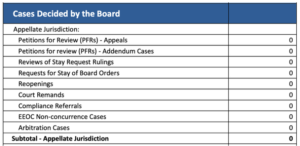
On his last day at MSPB, Robbins released MSPB’s Annual Report for FY 2018. So while we don’t have a Board (and who knows how long that will last since nobody with decision-making authority on Capitol Hill seems worried about it), we do have some new information to share.

Let’s take a look at some of the impressive numbers out by MSPB last year:

Are you seeing a trend here? That’s a whole lot of goose eggs. (And yes, the term “impressive numbers” above was meant to be sarcastic.) Without a quorum, a huge chunk of the Board’s work cannot get done. In a normal year, those subtotals are usually upwards of 1,000, including approximately 800 Petitions for Review.

I share these numbers not to slam Robbins or any of the dedicated employees at MSPB, because none of this is their fault. In fact, we know they have worked hard every day, despite the lack of quorum. The responsibility for this lack of performance falls directly on the Administration and the Congress, which for over two years have refused to put Board Members in place. This inaction has left the MSPB with over 2,000 cases, sitting in a hallway in cardboard boxes, waiting to be adjudicated. To add insult to injury, all of Robbins’ work on those 2,000 cases became obsolete last week and cannot be used by future Board members.

If I come across as upset, it’s because I am. If you’re tired of reading about this, then maybe you shouldn’t finish this article because I have more. There is NO REASON things at MSPB have to be this way. And yet it’s continued, for 786 days. I have contacted everyone I know – and don’t know – on the Hill and in the White House to try to get the message across that while maybe this doesn’t play on TV as well as national security issues, hot-button committee hearings, or North Korean summits, real people are hurting every day, more people get hurt every day, and the fix is SO EASY. Others have joined in this plea, even testifying before congressional committees and pleading with Congress and the White House to do something. And nothing has changed.

This is one of those rare areas where the inaction hurts both sides involved – the agency and the employee. There now are up to 2,000 people waiting for years to find out if they will get their jobs back. There are agencies on the hook for potential back pay in these cases. I’m not a math scholar but I know that three years (and counting) of back pay for a GS-14 in Washington, DC, plus attorney fees, can easily exceed half a million dollars. And that’s just one case out of 2,000.

But all is not lost. There is some light in all this darkness. As of right now the MSPB is still open and operating, aside from the front office. MSPB’s General Counsel, Tristan Leavitt, is now the Acting Chief Executive and Administrative Officer, so fortunately the career staff in the headquarters, regional offices, and field offices are still at work.

Let’s look at some more numbers from the report that aren’t 0s. In FY 2018, the Administrative Judges issued initial decisions (IDs) on 5,134 appeals. Here are a few significant numbers from within these IDs:

2,267: IDs on disciplinary actions

142:     IDs on performance-based actions

416:     IDs on probationary removals

517:     IDs on Individual Right of Action (IRA) appeals [usually whistleblower reprisal appeals]

325:     IDs on USERRA and VEOA appeals

1,058:  Cases settled before hearing

83.2:    Percentage of agency actions upheld

14:       Percentage of agency actions overturned or requiring corrective action

3,077:  Cases dismissed

The agency with the most cases adjudicated was the VA (1,080), and the agency with the fewest cases adjudicated (excluding those that have no appeals pending) was actually a 13-way tie at one appeal each. You can read the full report to see which agencies those were.

At FELTG, we’ll keep you posted on what’s next. And if you want to hear us rant about these injustices in person – while also teaching the law – join us at an upcoming MSPB Law Week in Washington, DC or Dallas, TX. [email protected]


By Deborah Hopkins, February 19, 2019

If you’ve been in the federal employment law arena for more than five minutes, or if you’ve read this newsletter in the recent past, you know that we (the People) have been without a quorum at MSPB for more than two years now. In fact, next Friday marks the end of Mark Robbins’ tenure as the sole remaining Board member, at which time the MSPB will have ZERO members for the first time in its 40-year history.

Last week, the Senate Committee on Homeland Security and Governmental Affairs voted to advance two MSPB nominees (Dennis Dean Kirk and Julia Akins Clark) to the full Senate for a confirmation vote – but the vote won’t be held until a third nominee is named (the remaining nominee Andrew Maunz withdrew his name last week), and clears committee to join them for a Senate vote. In case you didn’t know this: It’s not a legal requirement to confirm all the members together. However, the Committee Chairman, Senator Ron Johnson (R-WI) indicated that would be the process used. (Read the full detail of the committee meeting here.)

So, what will happen next? It’s anybody’s guess. Will the MSPB have to shut down until they get some leadership — or will the General Counsel run the place in the interim? Arguments can be made for either option.

As of today, the Administrative Judges are still holding hearings and issuing decisions on agency removal actions, and your cases still need to be as tight as ever to ensure a favorable outcome. Because if anything is appealed from a judge’s decision, it goes into a stack of 2,000+ cases that are sitting in boxes in the hallways, waiting for Board members to read them and issue opinions. Wouldn’t you rather NOT have to appeal a judge’s decision? Me too.

So what’s the best way to have a judge agree with your choice of discipline? Follow the law. In order to discipline a federal employee for misconduct, there are five legally required elements:

  1. A reasonable rule exists
  2. The employee knew the rule
  3. A preponderance of the evidence (more likely than not) that the employee broke the rule
  4. Choose a defensible penalty
  5. Provide due process

If you miss even one element, you lose your entire case. Let’s look the elements in turn and see how easy they are to check off — and how easy they are to screw up, if you’re not paying attention.

1. A reasonable rule exists. You cannot discipline an employee for breaking a rule that does not exist. The very definition of misconduct is a violation of a rule. So, if you want to reprimand, suspend, or remove someone, you can only do it if they have indeed broken a rule. Also note: the rule must be related to the job; you cannot enforce rules that have nothing to do with the workplace. For example, you can set a rule that an employee to always fill up a GOV’s gas tank when it gets below ¼ tank, but you cannot require that rule for the employee when driving his personal vehicle.

Case example: Doe v. DoJ, 565 F.3d 1375 (Fed. Cir. 2009)

2. The employee knew the rule. An agency cannot enforce secret rules against employees – that would violate the fairness federal employees are guaranteed. If you have a rule that employees wear closed-toed shoes in the office but you’ve never bothered to tell them the rule, you cannot discipline them for wearing open-toed shoes. There are some “commonsense” rules where notice is a given (for example, you don’t need a rule that says employees are not permitted to have a campfire in the breakroom), but when in doubt, TELL the employee the rule. Don’t assume the employee knows it.

Case example for further reading: Tudor v. Treasury, 639 F.3d 1362 (Fed. Cir. 2011)

3. A preponderance of the evidence (more likely than not) that the employee broke the rule – unless you’re at the VA in which case you only have a substantial evidence requirement, that the employee might have broken the rule. Preponderant evidence is not a huge burden, but you do have to have some evidence. Whether you saw the misconduct happen, or witnesses saw it, or you have video evidence or a confession, you need something to show the employee broke the rule. This should not be difficult. The employee has a lunch break from 12-12:30 and you, the supervisor, see the employee come back to his desk with a Chipotle bag at 1:10 – that’s evidence. Don’t make this more difficult than it needs to be. But please have evidence.

Case example: Mott v. DVA, No. 2017-1222 (Fed. Cir. 2018)

4. Choose a defensible penalty. Unless you’re at the VA, you have to justify why you selected the penalty (suspension or removal) you did. This is done by looking at the Douglasfactors and explaining the effect of the misconduct. We consider things such as the harm caused or the potential for harm, the person’s job level and type, any notoriety or publicity, any past discipline the employee has received, what we’ve done with comparators who have engaged in the same type of misconduct, and a number of other factors. The penalty must be appropriate for the level or instance of misconduct the employee engaged in. You may not be able to justify a first-offense removal for a person who got to work five minutes late to a job where being on time doesn’t matter because there was no harm. However, if your employee is an ER surgeon and someone died in those five minutes, you have a completely different scenario and removal might very well be justified. Let the Douglas factors be your guide, and keep in mind, the MSPB is only going to mitigate (change to something less) your penalty if it exceeds the bounds of reasonableness.

Case examples for further reading: Jacoby v. USPS, 85 MSPR 554 (2000); Webster v. Army, 911 F.2d 679 (Fed. Cir. 1990); Mott, supra

5. Provide due process. Federal employees who have successfully completed their probationary periods are entitled to due process in disciplinary situations. Due process has three steps:

  1. Notice of the charged misconduct and the proposed penalty (given by a Proposing Official);
  2. An opportunity to respond to the charges, and to be represented; and
  3. An impartial decision based on the information given in the notice and the response (given by a Deciding Official).

If you miss a step, you lose your case EVEN IF you have 50 witnesses and video evidence of the employee stealing the laptop, punching a customer, sleeping on the job, whatever. A due process violation, sometimes referred to as “losing on a technicality,” is literally a loser every single time. While there are cases where agencies don’t give the employee notice of the charges, or don’t notify the employee of her right to respond, we see most cases lost under the third prong — where the deciding official relies on some bit of information that the employee is not privy to. This is why it is crucial to work with your Deciding Officials on their proper role and encourage them not to go looking for extra information about the employee.

Case example for further reading: Kelly v. Agriculture, 225 Fed. Appx. 880 (Fed. Cir. 2007).

I hope this helps. If you want more – and trust me, you definitely want more – then come to our MSPB Law Week in Washington, DC or Dallas, TX, so we can show you how to win your case in front of the judge, and quickly get back to the business of fulfilling your agency’s mission. [email protected]

By Deborah Hopkins, February 13, 2019

Committee meeting room, pre-vote

Here’s a quick update from today’s business meeting for the Senate Committee on Homeland Security and Governmental Affairs, which held a scheduled vote on the nominees to the Merit Systems Protection Board (MSPB). I was there, and I am still saying “wow.”

Last night, the Senate was informed that Andrew Maunz, the nominee for Vice Chairman, had withdrawn his nomination for unspecified reasons. This morning, the committee, which is made up of 8 Republicans and 6 Democrats, considered the remaining nominees: Dennis Dean Kirk (R) for Chairman, and Julia Akins Clark (D) for Member. When Committee Chairman Ron Johnson (R – WI) opened the floor for discussion, the only person to speak was Sen. Rand Paul (R – KY).

And boy, did Sen. Paul have a lot to say. He voiced the opinion that the MSPB is failing as an agency, saying that it has become a job protector for federal employees instead of a protector of the merit system. Citing facts from a couple of unnamed cases, he claimed that the MSPB thinks child pornographers and VA leadership who allow veterans to die in the hallways belong as federal employees. He said this type of behavior from employees would never be tolerated in the private sector, and if the government can’t fire people for such egregious acts, then the MSPB should cease to exist and Congress should go back to the drawing board to create an oversight agency that actually works.

Here’s the problem: Sen. Paul (along with countless others) doesn’t understand the system. He didn’t give citations for the cases he mentioned, but I believe I know the cases to which he was referring. And in those cases, the MSPB didn’t put employees back to work because they necessarily wanted to; the MSPB was following the law. In the child pornography case, the agency failed to establish a nexus (a connection) between the employee’s off-duty conduct and his government job. The law requires a nexus to exist. (By the way, come to MSPB Law Week and we will show you how to find nexus in a case like that; the agency did not, but it was most likely doable.) The MSPB never said, “Child pornographers are good people and should be working for every federal agency.” The MSPB found that the agency failed to establish nexus, and nexus is required by law.

Regarding the VA cases Sen. Paul mentioned, I believe those cases dealt with senior leadership who were removed, and the Board members (who are no longer there) mitigated the penalties based on Board leadership’s at-the-time view on comparator employees, which has since been walked back in pieces.

Can someone please tell Sen. Paul – and the rest of America – that the system works IF the agency handles the case correctly? Citing the few cases where terrible employees got their jobs back because of procedural defects, while ignoring the 7,000+ removals that stuck in the last FY, does a disservice to the country. I had a hard time sitting still while he was speaking. I wanted to jump up and tell him that he had it all wrong, but I didn’t think it would be a wise move to get kicked out of a Senate Committee meeting.

I digress (for now).

On to the nominees. Both Kirk and Clark were voted out of committee. Everyone on the committee, Rebublicans and Democrats, voted “yes” to send them to the full Senate for a vote, except for Senator Paul.

But – don’t get your hopes up on a quorum just yet. After the “ayes” had it, Chairman Johnson said it’s typical that all nominees get voted on together in the full Senate, so now Kirk and Clark will be waiting for a third nominee to be named and voted out of committee before they can be confirmed.

Hold up just a minute, Mr. Chairman. The MSPB members intentionally have staggered terms and to my knowledge, in the 40-plus years since the Civil Service Reform Act created the current MSPB, we have NEVER had all three nominees confirmed together (except, maybe the very first time members were appointed). Occasionally two go together, yes – but not three.

Whether this is intentional or a misunderstanding about how this part of the system works, I don’t know. But are you ready for the real heartbreak?

If Kirk and Clark were to get confirmed by the full Senate before a third nominee is named, they could vote on dozens or (if they put in some really long hours) even hundreds of the 2,000 Petitions for Review (PFRs) Acting Chairman Mark Robbins has voted on, before his term expires on February 28.

But this is not going to happen. So, all of Mr. Robbins’ work on the PFRs since January 8, 2017, will go to waste, as the Committee chose NOT to vote on an amendment that would have allowed for the holdover term for a sitting Board Member to be extended beyond the one year currently permitted under 5 USC § 1202.

To recap: Robbins’ term expires February 28. Nominees Kirk and Clark won’t be confirmed until the full Senate votes. And the full senate won’t vote until a third nominee is named and the committee votes that person to the Senate floor as well. And we don’t have a third nominee yet. For what it’s worth, Chairman Johnson said he is working with the White House to come up with a nominee soon.

Also heard on the Hill this morning: As long as there’s not a shutdown this weekend, the Senate will be in recess next week. So, push the timeline for the vote back until the final week of February, at the very soonest, only if there’s a third person nominated and voted out of committee before then. If all that doesn’t happen before March 1, the Board may have to shut down entirely until the Senate votes on the nominees.

While this may be considered slight progress, it’s not the kind of progress the civil service needs. We’ll keep you posted on what happens next. [email protected]

By William Wiley, February 6, 2019

Most members of FELTG Nation know that the Douglas Factors are the 12 employee-specific situational factors that agencies use to determine and defend a penalty selection in a misconduct removal appeal. Fail to evaluate the 12 factors the way that MSPB thinks they should be evaluated, and the Board will lower (mitigate) your removal to something less. When that happens, the employee gets her job back and you get sent to the dog house for not foreseeing how MSPB will consider the penalty.

When I was Chief Counsel to the MSPB Chairman, I reviewed thousands and thousands of Douglas Factor assessments. Without a scintilla of hesitation or doubt, I can assure you that the following three graduate-level principles will help you do a better job of defending your penalty section in a removal appeal:

1. Judges think in linear terms. Few people outside of MSPB know this, but when an individual is hired to be a Board administrative judge, that lawyer has to undergo a surgical procedure. In that procedure, 12 groves are made in the acolyte’s brain, one for each Douglas Factor. In assessing an appeal or listening to testimony at hearing, the judge likes to fill each grove with information about just that Douglas Factor, in the order that the factors are listed in the original Douglas decision. So, what does this mean for you as a practitioner?

  • Don’t go discussing the penalty factors in some sort of smashed-together paragraph.No matter how elegant and insightful your narrative discussion might be, you’re going to cause the judge to have to dissect what you’ve said and try to sort it all out into those little groves in his brain. You do not want the judge to have to do that. You do not want a judge to work any harder than necessary to understand the theory of your case and your evidence to support that theory.
  • Address all 12 factors, in order. Even if a factor carries no weight because there’s nothing there, note that the proposing official considered it and found nothing. A simple “Not Applicable” will do the trick. The mistake you are avoiding by doing this is a claim by the employee that you skipped a factor and didn’t even think about it, when the truth is that you thought about it and found it to be irrelevant.
  • Carefully segregate your factual description and limit your discussion of a factor to just that factor. For example, when discussing Factor One, Seriousness, don’t talk about how the misconduct is serious because the employee is a supervisor. You’ll be able to discuss the employee’s supervisory status in Factor Two, Job Level. You get negative points for repeating yourself in a Douglas analysis.

2. Some factors have subcomponents. Factors One, Two, and Four have evolved separate and somewhat distinct subcomponents over the years that the Board has been analyzing penalties. For example, Factor Four, Past Work Record, includes the subcomponents of a) Length of Service and b) Performance Rating. In fact, the Length of Service subcomponent has three subcomponents to it. Be sure to address all subcomponents or the Board will find fault in your analysis and perhaps substitute its penalty determination for yours. You don’t want MSPB doing that. Either come to one of our always-elucidating seminars (next offered in Washington, DC March 11-15) and we’ll teach you all the subcomponents or figure them out for yourself.

3. A Douglas Factor worksheet should be attached to the proposal notice. I’m not sure why this has been such a controversial matter for some agencies. On occasion, I’ve been confronted by more than one practitioner who argued passionately that the proposal notice should NOT contain a Douglas Factor analysis. I never really understood that argument because the Douglas decision itself says:

Moreover, aggravating factors on which the agency intends to rely for imposition of an enhanced penalty, such as a prior disciplinary record, should be included in the advance notice of charges so that the employee will have a fair opportunity to respond to those alleged factors before the agency’s deciding official, and the decision notice should explain what weight was given to those factors in reaching the agency’s final decision. Douglas v. VA, 5 MSPR 280 (1981)
I guess you could split hairs and say that only aggravating, not mitigating, Douglas Factors have to be in the proposal notice. Well, do you REALLY want to bet your case on defending the evaluation of whether a specific factor is aggravating or mitigating? Length of Service can be either aggravating or mitigating, depending on how long the employee has been a civil servant. We have to consider both aggravating and mitigating factors in the final decision. Why would we not put them all in the proposal so that the employee knows what we’re doing and why? Maybe we’ve forgotten something (e.g., military service) that is required to be considered. She should have the opportunity to know this stuff so she can respond and defend herself completely.

In addition, as we’ve taught here at FELTG for nearly 20 years, the Board holds agencies to different burdens of proof when a fact is asserted in the penalty analysis as compared to when a fact is asserted in the charge section of a proposal notice. By analyzing the penalty in a separate document, the Douglas Factor Worksheet, we make it exceedingly clear to the judge exactly what is going where, and thereby which of the two proof burdens he is supposed to use when evaluating our case.

In a recent case I was working with an agency legal counsel, during the prehearing conference the appellant began to argue to the judge that the selection of removal as the penalty was unfair. The judge cut her off right away by saying, “Madam, it is not my job to assess the fairness of the penalty. It is my job to assess whether your supervisors properly assessed all the factors relevant to penalty selection.” That judge understands how Douglas works, and so should you. [email protected]

By Dan Gephart, January 29, 2019

Holding federal employees accountable is a big part of what we teach here at FELTG. Accountability is our goal. It’s in our mission statement. So I read with heightened interest recent stories about Millennials entering the management ranks. I wondered, rather hopefully, if Millennials were better than their colleagues from other generations at the important managerial task of accountability.

I reached out to Jeffrey Vargas, the president/CEO of Generationology LLC. If anybody has the pulse on the intergenerational workplace, it’s Jeff. And he knows the federal workplace, too. He was a recruiter, diversity manager and chief learning officer for several agencies before starting his own firm.

“Millennials are amazing, and so are folks from other generations,” Jeff said. “Millennials don’t have a special connection with workplace accountability, in fact, for many who have less than five years of government experience, they are still learning the tools and mechanisms that are available to Fed managers to ensure proper employee performance and conduct. What Millennials do have is a willingness and a greater comfort to try new things and push for more transparent individual and organizational accountability which in the end, can help speed up important fundamental organizational change.”

For this initial And Now a Word With column, I talked with Jeff about how multiple generations are re-shaping the federal workplace and how federal supervisors should be managing it.

DG: How has having multiple generations impacted the federal workplace?

JV: The concept of “how you get work done” has been redefined. Gen X was the first to push for more “work/life” balance, causing agencies to look at and implement initiatives like flextime. Millennials joined the push and have done a credible job of advancing the work/life conversation, pushing for more telework options. Boomers, as the ultimate group of collaborators, no longer universally believe that an employee is only productive at work if I “can see you at your desk.” Boomers are now, on a more regular basis, seeing the benefits of using technological collaborative tools (i.e. – cloud computing, telepresence, real-time document collaboration, etc) that is helping to make work flows and work products more complete.

DG: What can federal supervisors do immediately to improve communication between different generations?

JV: Talk, discuss, listen … do. Intergenerational collaboration makes the workplace awesome, and intergenerational conflict can bring down morale and productivity at lightning speed. Intergenerational issues need a place to breathe in the workplace, they shouldn’t be ignored. They don’t improve through avoidance. Supervisors should devote time at all-hands meetings or bi-weekly meetings to talk about their focus on improving the workplace through the application of intergenerational knowledge. Lay out a plan, listen to employee input, implement pilots/programs and embrace change. Intergenerational awareness is an important piece, but not the only piece to effective talent management.

That said, it’s important for employees to know that not every idea can be implemented, will make sense in the long term, or fit within the government legal/ethical box. Hence, supervisors need to communicate both the things that they will and won’t do, and supervisors have to take greater accountability for their own decisions and not “blame it on management.” Open, authentic conversations and discussions will help to reduce intergenerational conflict and expand intergenerational collaboration.

DG: What’s the biggest misconception about Millennials in the workplace?

JV: A lot of supervisors see their Millennial employees as “in-house tech staff.” Managers assume Millennials can navigate new systems and programs without any training. [The] truth is, Millennials are digital natives and they do have a comfort with new technology but that doesn’t mean that they are fully prepared to deal with any computer, cyber or system issue that pops up in their office, or across the enterprise.

DG: What are workplace trends you expect to see in the near future based on generational changes?

JV: On the good side, we will continue to see an expansion of work/life programs and an increase in the utilization of collaboration tools and cloud computing. We will see greater focus on the collection and analysis of big data and a stronger reliance on data to influence our decisions. The negative: We will probably see an increase in intergenerational conflict and a flatline/decrease in employee engagement, at least until organizations make a firm commitment to be identifying, addressing and deploying a more intergenerational approach to work.

By Deborah Hopkins, January 2, 2019

Yesterday, as my last official event of the holiday season, I went to see a movie with a friend. Those of you who know me are probably not surprised to learn that my friend and I opted to see On the Basis of Sex, a film focused on Ruth Bader Ginsburg’s fight for gender equality as an attorney in the 1970s, long before she was a Supreme Court Justice. If you don’t recall the history or you haven’t seen the film, then you might be surprised to learn that the key legal case in this fight was a Tenth Circuit appeal over a statute that provided tax deductions for caregivers. Justice Ginsburg’s client was a male caregiver who was exempted from the tax deduction, while similarly situated women who were caregivers were allowed to claim the deduction. Justice Ginsburg viewed this issue as a violation of the 14th Amendment’s Equal Protection Clause, found in Section 1:

All persons born or naturalized in the United States, and subject to the jurisdiction thereof, are citizens of the United States and of the state wherein they reside. No state shall make or enforce any law which shall abridge the privileges or immunities of citizens of the United States; nor shall any state deprive any person of life, liberty, or property, without due process of law; nor deny to any person within its jurisdiction the equal protection of the laws. [emphasis added]

The apex of the movie focuses on her oral argument in front of the Tenth Circuit judges. I won’t spoil the film if you don’t know the real-life ending, but I can tell you the primary argument discussed change, and how the interpretation or reach of the law may need to change as society changes; after all, society doesn’t wait for the law to catch up to it before it charges ahead.

During her argument on the topic of gender protection, a judge challenges her: “The word ‘woman’ does not appear even once in the U.S. Constitution.” Justice Ginsburg’s reply: “Nor does the word ‘freedom,’ your honor.”

Now before you start kicking and screaming and writing emails telling me that Hollywood ruins movies by riddling them with inaccuracies, that the Bill of Rights actually does contain the word “freedom” and that the Bill of Rights is a part of the Constitution, just take a deep breath, count to three, and read on. I know the Bill of Rights uses that word, and I know that the Bill of Rights is part of the Constitution. I think the point being made in the argument is this: In the original text of the Constitution, the word “freedom” was never used, and as America grew and changed so did the reach of the Constitution, the highest law in the land. This growth included the Bill of Rights, which was added to the Constitution in 1791, four years after the original document was ratified.

The truth is, America changes every day. Women in America could not vote until 1920, when the 19th Amendment was ratified. Women in America were not given the legal right to serve on a jury until, in some states such as Mississippi, the late 1960s. (Interesting note: Mississippi was the first state to allow women to independently own property, in 1839. Go figure.) In some states, women could legally be denied the right to practice law until 1971. Women could not apply for bank accounts or credit cards unless a husband or male relative approved, until the passage of the Equal Credit Opportunity Act in 1974. And on and on it goes.

I have done all the things listed above, but had I been born century earlier I would not have been able to do any of them because the law forbade it.

Whether by Constitutional amendment, the passing of legislation, or the interpretation of the courts and administrative bodies, the law changes almost every day. While the movie may not be entirely historically accurate (after all, that’s Hollywood), it does highlight this reality. And though the focus of this film was the fight for gender equality, thousands of movies could be made, and articles written, about other struggles Americans have faced, and are still facing today, on the bases of categories that were not legally recognized until the very recent past: race, color, religion, disability, national origin, age, and genetic information, just to name a few. The fight continues.

And at FELTG in 2019, we promise to continue to bring you the most current information about the law as it pertains to you, and as it changes. It’s what we’re here for – after all, it’s in our mission statement.

Here’s to hoping 2019 is the best year yet, despite the rocky start, with whatever changes may come.  [email protected]

OPM Press Release

FOR IMMEDIATE RELEASE
Friday, December 21, 2018
Contact: Office of Communications
Tel: 202-606-2165

Mark A. Robbins appointed OPM General Counsel

WASHINGTON – Office of Personnel Management (OPM) Acting Director Margaret Weichert announced today that Mark A. Robbins will serve as OPM’s new General Counsel.  Consistent with 5 USC § 1201, President Trump has issued a memorandum directing Mr. Robbins, current Acting Chairman of the U.S. Merit Systems Protection Board (MSPB), to serve concurrently as OPM General Counsel.

Mr. Robbins previously served as OPM General Counsel from 2001 to 2006. He has also served as the General Counsel of the U.S. Election Assistance Commission and as a Senior Rule of Law Advisor for the State Department in Babil Province, Iraq, where he was awarded the U.S. Army’s Commander’s Award for Civilian Service. Mr. Robbins was Executive Director of the White House Privacy and Civil Liberties Oversight Board between 2006 and 2008.  He worked in private practice as a litigation attorney in Los Angeles, California between 1988 and 2000, and in the White House Office of Presidential Personnel from 1984 to 1988. Mr. Robbins began his career as a Legislative Assistant to two Los Angeles area Members of Congress, covering, among other things, civil service and federal human resources management issues.

“I’m very excited that Mark is returning to OPM,” said Acting Director Margaret Weichert. “Mark brings extensive professional experience that will help OPM deliver mission outcomes that will help advance the President’s Management Agenda.”

Mr. Robbins earned his undergraduate and law degrees from George Washington University. He is a member of the California and District of Columbia bars. In recognition of his extensive professional involvement and continued leadership in public administration, in 2013 Mr. Robbins was elected as a Fellow of the National Academy of Public Administration.

This is the last scheduled FELTG Flash of the year, and we here at FELTG Headquarters wanted to use the opportunity to thank all of you — our great attendees, customers, and readers — for making this past year so successful. Together we learned a lot, and we laughed quite a bit, too, as we set about making the government’s accountability systems more efficient.

That’s not to say that it wasn’t an interesting year.  More people ate Tide Pods than we had decisions from the MSPB. Now, we don’t know how many people actually ate Tide Pods, but based on the news coverage it appeared to be dozens. All it would have taken was one to outpace the MSPB, which issued zero decisions this past year.

Will that change in 2019? Will the Administration try to shut down the Board? What will happen with MERIT Act? What will EEOC priorities be in the coming year? What will become of President Trump’s Executive Orders?

Whatever happens, you can count on FELTG to be there. We are especially proud of our talented group of instructors, including Barbara Haga, Katherine Atkinson, Ricky Rowe, Meghan Droste, Anthony Marchese, Shana Palmieri, and those who joined the team in 2018 — Dwight Lewis, Ann Boehm, and Joe Schimansky. Former president Ernest Hadley will be doing training with us in 2019. And while we wish our outgoing president William Wiley a happy retirement, we’d like to point out that Bill is not really going away. You’ll see him at MSPB Law Week and other FELTG events throughout the year. It’s going to be a great year.

Before we turn the page on 2018, let’s take a quick look at the 10 most popular articles (based on number of reads and forwards) from the FELTG Newsletter in the past year.

Unless any major stories break before then, we will see you all again in the new year, where we will once again work together to help make the federal government a model workplace. Best wishes to all for a happy and successful 2019.

By William Wiley, December 11, 2018

Here at FELTG, we pride ourselves on knowing the way out of most every civil service law difficulty. Some answers take more steps than we’d like, but eventually we can help a supervisor get her hands around just about any difficult employee situation. Recently, however, we got asked for advice regarding a problem employee case, and although we’ve come up with a solution, we really don’t like it very much. See if you can do better than we did.

  1. The employee has developed both mobility and concentration problems. She falls down at work even though she uses a walker. On three occasions, coworkers have had to call paramedics to her aid. She cannot carry the files she needs to do her job. She cannot carry her personal belongings to her desk. She relies on coworkers to do the carrying for her. She makes mathematical errors in her timekeeping work. She is late accomplishing tasks.
  2. Her supervisor informed her that her medical limitations were preventing her from performing her job satisfactorily and asked if she would obtain a medical evaluation of her disabilities by her physician to identify any accommodations that could be made. Her physician responded that she was medically able to perform all of the essential functions of her position.
  3. After the medical evaluation, she continued to be unable to perform her work without the assistance of coworkers and otherwise in a satisfactory manner. Her supervisor again requested that she obtain disability accommodation information from her physician. The employee failed to do so.

That’s where we got the call for help. In the old days, the answer was easy: Send her for a fitness for duty evaluation by an agency-selected physician who is not likely to rubber stamp that she can do her job. Obtain a more realistic evaluation of her limitations, determine whether they can be accommodated, and assuming that they cannot, remove her for Medical Inability to Perform.

Unfortunately, today we don’t have that option. As you know if you’ve been to our famous FELTG Absence, Leave Abuse, and Medical Issues Week seminar (next offered March 25-29), OPM abolished the fitness for duty regulations back in 1983. Since then, agencies have been without the authority to direct an employee to undergo a medical evaluation except in three limited situations, none of which apply in this case. The FFD option has been foreclosed.

To our read, that leaves the supervisor with two options, neither of which feels particularly good:

  1. In spite of the employee’s physician’s determination that she can perform her duties, reach the conclusion that she cannot based on a lay person’s observations of her limitations. Determine that she is medically unfit to perform one or more essential functions of her position and fire her for Medical Inability to Perform. Or,
  2. Document her failures at work, relate them to one or more critical elements, then initiate a performance demonstration period (PIP) to give her an opportunity to perform. Document her failures during the demonstration period, then fire her for Unacceptable Performance.

Option A runs the risk of lay evidence of medical inability being contradicted by the employee’s physician’s professional opinion that the employee has no medical limitations. Option B seems cruel in consideration of the employee’s obvious medical infirmities. If the employee would accept Option A, she’s almost guaranteed a disability retirement when she applies to OPM. If the agency decides it has to go with B, there’s no similar almost-guaranteed disability retirement.

Here at FELTG, we feel bad for the employee. We also feel bad for the supervisor. It’s just a darned shame that OPM believes it has to constrain an agency’s ability to require an employee to undergo a medical examination. EEOC has said that it is legal for an employer to require an employee to undergo a medical examination if it has a reason for doing so that comports with a “job-related business necessity.” Were that the standard that OPM would allow us to apply, it would yield a much better resolution than either A or B, above. [email protected]