By Michael Rhoads, January 11, 2021

Happy New Year! The Counting Crows said it best in A Long December: “And there’s reason to believe, maybe this year will be better than the last.” I don’t know about you, but I do have a sense that this year will be better than the last.

A common question in the transition from one administration to the next is which Executive Orders will survive and which will be rescinded. During his campaign, former Vice President Joe Biden signaled that he will rescinding some Executive Orders on his first day in office.

Among the first EOs to be rescinded will likely be those affecting Labor-Management Relations. The National Treasury Employees Union (NTEU) published its recommendation in November to rescind EOs 13836, 13837 & 13839, along with other actions they would like to see the Biden Administration take. Rescinding these EOs will help improve the climate of Labor-Management Relations in the Federal workforce by relieving pressure on the management side to expedite negotiations on new collective bargaining agreements. It will also ease official time restrictions for union work. Yet, there is still more work to do on both sides when it comes to improving Labor-Management Relations.

Diversity Training

Some Executive Orders have already been suspended by court order. In response to a preliminary injunction issued by the US District Court for the Northern District of California, the Department of Labor released a Notice Regarding Executive Order 13950, related to restrictions on diversity training. The Office of Federal Contract Compliance Programs (OFCCP) will stop using the hotline set up to collect information, cease investigations of noncompliance with the EO, and not take any enforcement action outlined in the EO.  OFCCP will also stop publishing any Requests for Information which sought information related to compliance or noncompliance with the EO.  Additionally, contract clauses restricting the use of the diversity terms outlined in the EO, such as “white privilege,” will not be enforced.

Update on Schedule F

Despite calls from good governance and federal employee groups to block Schedule F, Congress did not block it in this year’s spending bill, and Schedule F may not be easy to eliminate with the stroke of a pen. It will still have the support of elected officials eager to reshape the federal workforce. According to University of Texas Professor Dr. Donald F. Kettl, conservatives may use Schedule F to wage a court battle calling into question the constitutionality of the Federal government’s merit-based system itself.  This could hinder the Biden Administration’s ability to run the federal government in the short term and change the Federal workforce in the long run.  The status of this EO is “to be continued…,” even if only in part.

Find out more, along with what else to expect – and what things might not change – by attending our webinar series: Toolkit for a New Administration: Essential Skills and Knowledge for Federal Supervisors, Managers, and Leaders.  The first webinar will be held on January 21, so you can get an immediate jump on what you need to know, and how to apply the knowledge to your day-to-day operations.

Stay safe, and remember, we’re all in this together. [email protected]

DOUGLAS FACTORS WORKSHEET

Douglas v. Veterans Administration, 5 MSPR 280 (1981)

  1. The nature and seriousness of the offense and its relation to the employee’s duties, position, and responsibilities, including whether the offense was intentional or technical or inadvertent, or was committed maliciously or for gain, or was frequently repeated:


  1. The employee’s job level and type of employment, including supervisory or fiduciary role, contacts with the public, and prominence of the position:


  1. The employee’s past disciplinary record:


  1. The employees past work record, including length of government service, performance on the job, ability to get along with coworkers, and dependability:


  1. The effect of the offense upon the employee’s ability to perform at a satisfactory level and its effect upon the supervisor’s confidence in the employee’s ability to perform assigned duties:


  1. Consistency of the penalty with those imposed upon other employees for the same or similar offenses:


  1. Consistency of the penalty with applicable agency table of penalties:


  1. The notoriety of the offense or its impact upon the reputation of the agency:


  1. The clarity with which the employee was put on notice of any rules that were violated in committing the offense or had been warned about the offense in question:


  1. The potential for the employee’s rehabilitation:


  1. Mitigating circumstances surrounding the offense such as unusual job tensions, personality problems, mental impairment, harassment, or bad faith, malice, or provocation on the part of others involved in the matter:


  1. The adequacy and effectiveness of alternative sanctions to deter such conduct in the future by the employee or others:


PENALTY SELECTED:

By Deborah Hopkins, December 15, 2020

During our recent webinar on implementing the new OPM regulations on performance and conduct (if you missed it, you can still view the recording), the following question came in:

There has been some discussion in my agency about providing employees with a notice of appeal rights in the proposal letter. Can you please help clarify whether this notice is now required, and if not when it will be required?

And here’s the FELTG response:

First, the notice of appeal rights is not required in actions taken under 5 USC 315 (probationary removals), 432 (performance-based actions), or 7515 (discipline for whistleblower reprisal). See the discussion on p. 127 of OPM’s regs:

As noted above, the amended regulation will not require that agencies include appeals rights information in a notice of proposed action taken under section 7515. Notwithstanding, it is important that the commenters understand that current and amended parts 315 and 432 do not require that agencies provide advance notice of appeal rights … Further, it is well established in statute, regulation, and case law that an employee cannot appeal a proposed action.

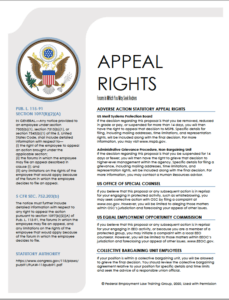
As far as chapter 75 removals, the 2018 NDAA (Pub. L 115-91, Section 1097) says:

(b)(2) INFORMATION ON APPEAL RIGHTS.— (A) IN GENERAL.—Any notice provided to an employee under section 7503(b)(1), section 7513(b)(1), or section 7543(b)(1) of title 5, United States Code, shall include detailed information with respect to— (i) the right of the employee to appeal an action brought under the applicable section; (ii) the forums in which the employee may file an appeal described in clause (i); and (iii) any limitations on the rights of the employee that would apply because of the forum in which the employee decides to file an appeal. (B) DEVELOPMENT OF INFORMATION.—The information described in subparagraph (A) shall be developed by the Director of the Office of Personnel Management, in consultation with the Special Counsel, the Merit Systems Protection Board, and the Equal Employment Opportunity Commission.

Our understanding at the time this law was issued in 2017 was that OPM would provide the official language after consulting with the other agencies mentioned, and that until such language is developed, there was no requirement to include appeal rights at the notice stage. By the way, providing a notice of appeal rights at the proposal stage really doesn’t make sense, as the timing is preliminary (Bill Wiley wrote about this when the law first came out), but hey, we didn’t write that law.

But, then the regs were published and we started to think that maybe OPM was kicking this down to agencies because the regs, including this one, became effective last month: 

752.203(b) Notice of proposed action. “… The notice must further include detailed information with respect to any right to appeal the action pursuant to section 1097(b)(2)(A) of Pub. L. 115-91, the forums in which the employee may file an appeal, and any limitations on the rights of the employee that would apply because of the forum in which the employee decides to file.”

There was no indication in the regulations or the response to the comments that OPM had consulted with MSPB, EEOC, and OSC to develop the appeal rights notification as required by law. In fact, as far as we know, none of the other agencies has acknowledged formally or informally that they have been consulted with regarding the development of appeal notification language.

But then last week OPM issued further guidance that does indeed leave the language development up to agencies.

Here are a few takeaways from the answer to this question:

Are agencies required to provide appeal rights information in an adverse action proposal notice?

    • The requirement to provide the appeal rights information at the proposal notice stage is a statutory requirement under section 1097(b)(2)(A) of Pub. L. 115-91.
    • Part 752 requires that a notice of proposed action under subparts B, D and F include detailed information about any right to appeal any action upheld, the forum in which the employee may file an appeal, and any limitations on the rights of the employee that would apply because of the forum in which the employee decides to file.
    • This regulatory change does not confer on an employee a right to seek redress at the proposal stage.
    • The appeal rights language included at the proposal stage specifically relating to choice of forum and limitations related to an employee’s choice of forum will vary depending on circumstances, the nature of a claim and the type of employee.
    • Appeal rights may include but are not limited to filing an Equal Employment Opportunity complaint with the Equal Employment Opportunity Commission; a prohibited personnel practice complaint with the U.S. Office of Special Counsel; a grievance under a negotiated grievance procedure; or an appeal with the Merit Systems Protection Board.
    • OPM does not view the addition of procedural appeal rights language in the regulation to constitute a requirement to provide substantive legal guidance at the proposal stage or to serve as a substitute for advice an employee may receive from an employee representative.
    • Agencies are encouraged and advised to consult closely with their agency counsel to develop the best course of action for implementation of this requirement.
    • Employees are encouraged to consult with their representatives to determine the best options available to them at the proposal and/or decision stage if an employee believes that an agency has taken an action which triggers the right to file a complaint, an appeal or a grievance.

Ugh. Seems like it could be a lot of work for no reason other than to comply with a law that requires notice at the wrong stage. OR, given the flexibility, it could also be interpreted that a general notice of potential appeal rights would satisfy this regulatory requirement since the proposal stage is preliminary.

The good news is that whatever notice is provided should not affect the merits outcome of the case on appeal. If the final decision contains a fulsome description of the employee’s appeal rights, any error in not providing an appeal rights notice with the proposal (or, alternatively, providing a notice not developed by OPM) would be harmless and the adverse action would not be set aside on procedural grounds. [email protected]

By Deb Hopkins and William Wiley, December 15, 2020

Here’s an email that recently came across the FELTG desk:

Dear FELTG,

Our agency has encountered an issue we haven’t seen, and were wondering if you might have some insight.

Typical for my agency’s chapter 43 removals is that the employee objects to not having access to their work documents, work laptop and programs, etc. (because they are put on admin/notice leave simultaneous with the issuance of the proposal) and thus isn’t able to offer a meaningful reply. We wonder if this is a common issue, and if perhaps there is an easy remedy that we’re overlooking.

Our proposals for chapter 43 removals include specific descriptions of each performance deficiency, with identifiers to specific instances (such as case numbers or project names and dates), but do not include or attach primary documents like screenshots or work files; the materials relied upon (outside of the proposal’s detailed description of the unacceptable performance) are usually the supervisor’s letter from the end of the opportunity period notifying the employee of the unacceptable performance, and if the timing lines up, the performance appraisal in which the supervisor rates the employee unacceptable.

So if an employee wanted to base their defense on individual case files, they would not have access to them through the materials relied upon; case files/documents/screengrabs aren’t provided with the proposal. We can’t anticipate every file an employee would want, so it’s hard to handle this prospectively, but options that have occurred to us are to (1) acknowledge in the decision that the employee objected to not having access, but did not actually identify or request any documents/files that would support a defense; or (2) when an employee objects to lack of access, the deciding official can ask the employee to identify what documents they need, and we can provide them and incorporate them into the materials relied upon. Option 1 may be risky (what if an administrative judge construes their objection to be a request that we failed to respond to?), but option 2 seems like it could delay the process and blow by mandated timelines.

What do you think? Is there a simple solution (or reassuring case) we’re missing, or a risk we’re misevaluating?

And here’s the FELTG response.

Well, we can’t give you specific advice on your situation, but we can speak to the principle in general. There’s a case we cover in MSPB Law Week (next offered virtually March 29 – April 2), that involves a misconduct removal but covers the same principle of access to documents during the notice period. In the event that an agency refuses to voluntarily make pertinent documents reasonably available prior to a Board proceeding, the Board’s rules provide for the issuance of orders compelling discovery by interrogatory or deposition, and for the issuance of subpoenas. See Kinsey v. USPS, 12 MSPR 503 (1982). This language “prior to a Board proceeding” assumes there is a Board appeal, which, of course, is not the case during the notice period.

The agency has no obligation, until the discovery phase, to produce any materials it did not directly rely upon in making the proposal. As long as the employee is given the material relied upon (and in a 432 action that’s entirely what happened during the performance demonstration period, PIP, or whatever your agency calls it now), the agency has fulfilled its obligation.

In another case we talk about during MSPB Law Week, the agency referenced shortcomings in medical care the employee provided to patients, but did not provide the employee the specific deficiencies or the records themselves that contained a description of the deficiencies. In reversing that removal, here’s what the Board said:

During the processing of the appeal, the appellant continued to express her confusion over the nature of the charge and attempted, without success, to  discover  the specific reason for her removal. For example, in “Appellant’s  Motion  to  Compel Production,” the appellant’s attorney stated that the appellant was “charged with failure to maintain her clinical privileges, which, so far as she can determine, calls into question the quality of care she has given to inmates for the undetermined period of time.”

In  “Appellant’s  Prehearing  Submissions,”  the  appellant’s  attorney  asserted  that       “there  is   complete lack of constitutional due  process” because the appellant “never knew prior to the time she was fired, nor does she know now, what acts of omissions on her part are the reasons for her termination nor what standard she fell below.” Alexander v. DoJ, DE–0752-97-0313-I-1 (1998).

The principle involved in situations like these is as old as the Constitution: “Fundamental due process requires that notice of charges against an employee be sufficiently detailed to provide a meaningful opportunity to be heard. In analyzing a claim of denial of due process, the Board will examine, among other things, whether the lack of specificity in the notice affected the appellant detrimentally or caused her any surprise during the hearing.” Mason v. Navy, 70 MSPR 584, 586-87 (1996). In your case, if the proposal said something like: “In case XYZ, you failed to attach an appendix,” then, in our opinion, that would satisfy due process. However, if it says something like: “In case XYZ, you did not conform with our SOP,” then that would not satisfy due process.

A basic way to look at which documents have to be provided is to ask the proposing official what he personally looked at in drafting the proposal. Did he look at a screen shot? If so, then the safest approach would be to include the screen shot along with the proposal. If he did not, then there’s no right for the employee to have access at this stage. The good news is that the employee is not entitled at the proposal/response stage to a fishing expedition to look for exculpatory documents or other evidence. That’s what he gets during discovery. [email protected]

By Deborah Hopkins, November 17, 2020

Nearly every day, we at FELTG get questions about COVID-related federal workplace issues. Here’s a recent one worth sharing with the rest of the FELTG Nation.

Dear FELTG:

I was wondering if there was any guidance on how long an agency must allow an employee to remain on Leave Without Pay status if the employee is high risk. Hypothetically, we have employees working in the stores so telework is not an option. If an employee has been given a medical note stating they should avoid exposure or remain at home, and has now been on LWOP for several months, where’s the limit? At this time, there is no end in sight with regards to the pandemic, so no return to work in sight either.

And our FELTG response:

In some ways this is a hypothetical “who really knows” situation because we don’t have any precedent for this pandemic. OPM has encouraged flexibility with telework and scheduling, but obviously someone who works in a store needs to be onsite to do that. Here are a few general thoughts related to your hypothetical.

The employee’s LWOP may be a reasonable accommodation, since the agency is granting LWOP because the employee’s condition prevents him or her from coming to work. Of course, whether it’s an RA depends on why the employee is high risk: Does the employee have asthma or an autoimmune disorder, for example (disabilities)? Or is the employee over 65 and high-risk according to CDC guidance (not a disability)?

Assuming this is an RA, the proper analysis would be to ask at what point the LWOP becomes an undue hardship for the agency, because EEOC’s stance is that attendance is not an essential function of a federal job. And if it’s not yet documented as an RA, that would be an important thing to do, to show the agency fulfilled its obligation to accommodate the employee.

The next thing to do, after the LWOP was determined to be an undue hardship, would be to consider reassignment to a job the employee could perform from home.

If all that failed, this might be a case where the agency could remove the employee for medical inability to perform, depending on what the medical documentation says, and whether a reassignment was available.

If the employee is high-risk simply because of age, or because they live with someone who is high-risk, then none of the RA steps above will apply. In that case, the agency would need to issue a return to work order (whenever LWOP goes beyond a reasonable time), and then could remove the employee if they refused to report. As far as how much LWOP is too much, we really can’t answer that – some agencies allow employees to use it for years. Others are more strict. It really depends on your agency’s staffing situation.

Down the road, this might become an excessive absence removal, especially if the LWOP goes on for over a year, and the return to work is not foreseeable (be sure to follow the Cook analysis if you go this route, and look at cases to help determine how much leave is “excessive” under the law).

All that said, this employee could be reassigned as well, not as part of RA but because the agency has a business need to fill a job elsewhere and doesn’t want to fire the employee.

This is a tough situation. COVID is out of everyone’s control, and agencies want to protect high-risk employees. However, agencies also have to get the work done. Lots to consider here. Good luck! [email protected]

The information presented here is for informational purposes only and not for the purpose of providing legal advice. Contacting FELTG in any way/format does not create the existence of an attorney-client relationship. If you need legal advice, you should contact an attorney.

By Deborah Hopkins, November 17, 2020

Earlier this week, new and updated OPM regulations on 5 CFR Parts 315, 432 and 752 went into effect. Among the most significant changes included guidance, inspired by Executive Order 13839, on what agencies may and may not do when settling an employment law dispute with an employee. We’ll look at the specific language in § 432.108, the principle of which is also applicable to part 752 actions.

  • 432.108 Settlement agreements.

(a) Agreements to alter personnel records. An agency shall not agree to erase, remove, alter, or withhold from another agency any information about a civilian employee’s performance or conduct in that employee’s official personnel records, including an employee’s Official Personnel Folder and Employee Performance File, as part of, or as a condition to, resolving a formal or informal complaint by the employee or settling an administrative challenge to an adverse action.

FELTG Note: What does this mean for litigation files? Agencies may need to keep track of documentation for litigation in another forum, such as EEOC or OSC. A narrow reading means an agency probably could keep a litigation file without violating this limitation. We won’t know until more guidance is issued, or the matter is litigated before the still-lacking-a-quorum MSPB. One other item to point out: Proposed action memos are not normally retained in official employee files, as they are preliminary steps that may or may not lead to future action.

(b) Corrective action based on discovery of agency error. An Agency may take discipline out of the record if it discovers errors of fact or legality. In all events, however, the agency must ensure that it removes only information that the agency itself has determined to be inaccurate or to reflect an action taken illegally or in error.

FELTG Note: This makes sense. If an employee is disciplined and it turns out the discipline was not warranted (for example, the discipline was whistleblower reprisal), then the discipline should be taken out of the record.

(c) Corrective action based on discovery of material information prior to final agency action. When persuasive evidence  comes to light prior to the issuance of a final agency decision on an adverse personnel action casting doubt on the validity of the action or the ability of the agency to sustain the action in litigation, an agency may decide to cancel or vacate the proposed action.

There’s a whole lot more on these regulations. If you missed the webinar I held earlier this week, we’re reprising Implementing New OPM Regs for More Effective Disciplinary and Performance Actions on December 3 at 2 pm. Register now before it sells out.

By Deborah Hopkins, October 26, 2020

There is a lot going on in our country right now. The election is in just a week (though it feels like it’s been going on for years – and in some ways, it has) and the news cycle is packed with that, plus the ongoing pandemic.

In addition, the telework is continuing for many of you. Can you even remember the last time you actually saw your coworkers in person?

I’m sure you’re exhausted and frustrated and tired of 2020. And given that it’s almost November, it might be tempting to check out for the remainder of 2020, and hope that 2021 holds better things.

But wait!

You can’t check out. There is SO MUCH going on in the federal civil service, from changes that have gone into effect in the last few weeks, to changes that will be implemented within the next several, and your agency cannot afford to miss them.

One of the biggest happenings is the issuance of OPM’s regulations modifying 5 CFR Parts 315, 432 and 752, which go into effect November 15. These 199 pages are packed full of information, some of it surprising and some of it unsurprising yet still significant. I’ll provide an overview of the biggest takeaways during a webinar on November 12, but today I wanted to share a portion that directly speaks to one of the most hotly-contested topics in the history of FELTG training: Who should do the Douglas factors assessment — the Proposing Official (PO) or the Deciding Official (DO)?

Take a look at the below addition to 5 CFR Part 752, which previously only had subparts (a) and (b):

§ 752.403 Standard for action and penalty determination.

(c) …The penalty for an instance of misconduct should be tailored to the facts and circumstances… Within the agency, a proposed penalty is in the sole and exclusive discretion of a proposing official, and a penalty decision is in the sole and exclusive discretion of the deciding official.

To some of you, that may seem like it’s nothing new. However, if you look at the discussion under 752.202, which also applies here, the emphasis is on an individual determination and assessment of each distinct case of employee misconduct. The discussion says, “there is no substitute for managers thinking independently and carefully about each incident as it arises, and, as appropriate, proposing or deciding the best penalty to fit the circumstance.” Subpart (d) also says that a minor indiscretion for one supervisor based on a particular set of facts can amount to a more serious offense under a different supervisor.

So, how does this answer the question about Douglas? Well, taken along with the context provided, each case is unique, and who better knows about all the details relating to the misconduct and its effect on the agency than the Proposing Official? And what better way to tailor the penalty “to the facts and circumstances” than having the PO do a full Douglas penalty analysis? We’ve been saying it for 20 years at FELTG, and we’ll be saying it for the next 20 years.

This language also speaks to advisors who might disagree with the PO’s proposed penalty or the DO’s ultimate decision, and might try to change their minds. The regulation clearly states the penalty is entirely up to the PO and DO. As advisors we may advise on an acceptable range of options, but that document is going to be signed by the person taking responsibility so it needs to match their analysis.

Stay tuned in the coming weeks as we discuss more takeaways from the regulations. Feel free to email Ask FELTG ([email protected]) if you have any questions. In the meantime, take care. [email protected]

By Deborah Hopkins, October 14, 2020

We’ve all learned by now that this COVID-19 thing is intense. Not just the virus, but the effects it has on everyday life. From kids being at home to masks being required in public places, from social isolation to the loss of loved ones, every single American has been affected in some way.

And it’s taking a toll.

In a July 2020 poll from the Kaiser Family Foundation, 53% of U.S. adults said their mental health was harmed because of the worry and stress they’ve experienced over COVID-19 – and that was THREE MONTHS AGO. I can’t imagine what the percentage is today. There have been also been increased reports of substance abuse suicidal ideation among Americans since the onset of the pandemic.

Last week, while he himself was a COVID-19 patient at Walter Reed, President Trump issued an Executive Order On Saving Lives Through Increased Support For Mental- and Behavioral-Health Needs in an attempt to prevent suicides, drug-related deaths, and poor behavioral-health outcomes, as a result of the COVID-19 pandemic. This is a topic FELTG has been covering since the start of the pandemic, and will again discuss during the December 10 virtual training program Managing Employees With Mental Health Challenges During the COVID-19 Pandemic.

I spoke with Shana Palmieri, FELTG’s resident behavioral health instructor, after this EO was issued, about how agencies can best handle some of the related mental health challenges that come along with the pandemic.

DH: What are some of the tells or signs that might indicate an employee is struggling with depression, anxiety, or other mental health challenges? 

SP: The increase in stress and drastic life changes as a result of the pandemic are significant risk factors for increasing rates of depression, anxiety, suicidal ideation and substance use disorders. Key symptoms that may indicate an individual is suffering from a worsening mental health condition include low mood, emotional withdrawal, withdrawal/socially isolating (beyond what is required by CDC guidelines); excessive tearfulness; difficulty with focus and concentration; sleep disturbance/insomnia; anger/moodiness/irritability; forgetfulness; guilt; panic attacks; racing or unwanted thoughts; feelings/expressing pending doom; and excessive worry or fear.

High-risk symptoms that indicate the need for immediate crisis intervention include suicidal thoughts, plans or behaviors; psychotic symptoms (a loss of touch with reality evidenced by delusions, hallucinations or extreme paranoia);  change in mental status evidenced by severe confusion; evidence of a significant increase in alcohol or drug use; and extreme agitation, aggression or expression of thoughts/intent to harm others. 

DH: What are some practical suggestions for agencies to help employees who are dealing with mental health issues?

SP: In order to effectively assist employees dealing with high levels of stress or mental health issues, agencies should engage in a number of proactive steps to keep employees healthy, provide assistance to those who need mental health treatment, and be prepared to intervene should a mental health crisis present itself.

Tip #1. Ensure ease of access to behavioral health treatment. Proactively provide employees with information on how to access treatment such as EAP, behavioral health treatment through their health insurance provider, or through digital telehealth solutions.

Tip #2: Proactively provide key messaging to the agency workforce about:

  • How the agency is responding and able to provide assistance
  • The impact of the pandemic on mental health and substance abuse
  • How employees can access assistance from the agency, resources available, and information for the suicide crisis hotline. (National Suicide Prevention Hotline: 800-273-8255; Veterans Crisis Line: 1-800-273-8255; Veterans Text Line: 838255)

Tip #3: Ensure your agency has a policy and procedure developed for managing a mental health crisis in the workplace. It is crucial to have a plan in place that identifies protocols on the management of a suicidal employee, violent threats/behavior, and risk of or on-site overdose. Ensure supervisors and employees receive training on the protocols for a behavioral health crisis in the workplace.

Tip #4: Provide mental health training to supervisors, managers, leadership and HR staff.  This training should include:

  • An overview of mental health symptoms and conditions and how they can impact employee work performance
  • Implementation of appropriate workplace accommodations
  • How to appropriately – and safely – intervene in a behavioral health crisis

Tip #5: Ensure the agency has a culture that promotes mental health wellness.  Create a culture of physical and emotional wellness within the agency.  Ensure a culture that eliminates stigma and promotes mental, emotional and physical wellness through:

  • Improved access to care
  • Training of supervisors, managers, and leadership
  • Communication strategies from leadership to agency workforce encouraging employees to access resources and engage in strategies and behaviors that promote overall wellness

DH: Do you have any advice for supervisors who suspect an employee might be suicidal but are afraid to ask? 

SP: Remember to take all concerns and statements about suicide seriously.  Your actions can save a life!  Below are some key tips and recommendations if you are worried about an employee being suicidal:

Suicide Warning Signs

  • Making comments or direct statements about suicide
  • Seeking out lethal means or a lethal plan to kill self
  • Expressing a preoccupation with death
  • Expressing a lack of hope and despair about the future
  • Self-loathing, self-hatred
  • Saying goodbye and getting affairs in order, unexpectedly
  • Self-destructive behavior
  • Withdrawing socially from others (a change from the individual’s normal personality)

How to Talk with Someone About Suicide

  • Have an open conversation and state your concern for the individual
  • Stay open and non-judgmental
  • Actively listen and express concern
  • Offer support and guide the individual on how to receive help
  • Access mental health crisis services if necessary

Helpful Things You Can Say

  • “I have been feeling concerned about you lately.”
  • “I wanted to check in with you because you haven’t seemed like yourself lately”
  • “You are not alone, I/we are here to support you”
  • “It may not seem like it is this moment, but the way you are feeling can change”
  • “I may not be able to understand the exact way you are feeling, but I am here for you.  How can I help?

As you can tell, these issues can quickly become serious. FELTG provides training for agency supervisors and employees on how to safely, and legally, handle behavioral health issues in the workplace. Please let us know if there’s anything we can help you with. [email protected]

By Deborah Hopkins, September 16, 2020

We discuss misconduct a lot during some FELTG training classes. And in other classes, we discuss sexual harassment in the workplace. Sometimes these two matters are discussed in the same class because rarely do workplace issues occur in a vacuum.

Among the worst types of misconduct to occur in the federal workplace is sexual harassment, particularly the egregious cases. It’s been almost three years since the #MeToo movement gained widespread traction, but cases of sexual misconduct, harassment, assault and more are still problems agencies face today.

Let’s look at an EEOC decision from last summer. The Complainant made allegations that her second-line supervisor subjected her to numerous incidents of sexual harassment for a period of approximately five months, including:

  • Continuously talking about his sex life.
  • Making sexually suggestive comments in the workplace.
  • When she was putting eye drops in her eyes, he said, “Let me do that for you. I am real good at putting things in.”
  • Discussing women he had affairs with, including his “high school sweetheart,” whom he said he got pregnant three times.
  • Talking about his ability to get sex whenever he wanted, stating, “What Dave wants, Dave gets.”
  • When the Complainant told him she was not feeling well and might go home, he stated that she might be pregnant and told her about his wife stating that she (the wife) needed a pregnancy test and said, “Well, if you hadn’t raped me, I wouldn’t be asking for the test.”
  • Refusing to clean the women’s restroom because “women are dirty and bleed all over the place and are smelly.”
  • Threatening to hit the Complainant with a cardboard roll.
  • Making comments to the Complainant such as said, “Why don’t you try smiling, darling?”
  • Physically touching her in a sexually suggestive or otherwise inappropriate way on multiple occasions.
  • Hitting her with a yardstick.
  • During her performance review, pulling her chair next to his desk, and, after the review, putting his hand on the inside of her thigh and saying, “See, it wasn’t that bad.”
  • Tousling her hair and poking her in the ribs, and after being told to stop, continuing to poke her and asking, “Oh, you are ticklish?”
  • Touching her on the back and shoulders several times, in front of co-workers.

These are just some of the events that were alleged, a number of which were witnessed by others, and many more are detailed in the case. Based on the factual record the EEOC found that the Complainant was subjected to a hostile work environment because of the unwelcome verbal and physical conduct based on sex, that was sufficiently severe or pervasive to create an abusive working environment.

The EEOC noted that a second-level supervisor placing his hand on Complainant’s leg at her thigh, in and of itself, was sufficiently severe to constitute a hostile work environment, because it was an unwelcome, intentional touching of an intimate body area. In addition, the EEOC found the agency liable. The Agency was ordered, among other things, to ensure that the Complainant was removed from the Store Manager’s supervisory/managerial authority. Terrie M. v. DOD, EEOC Appeal No. 0120181358 (Aug. 14, 2019).

You may be wondering why the EEOC only told the agency to separate the Complainant from the offending supervisor, instead of something more severe. That’s because the EEOC does not have the authority to require the agency to discipline federal employees who engage in misconduct. However, you can imagine the issues that arise if this level of misconduct goes undisciplined – issues we will discuss during the upcoming live virtual class Conducting Effective Harassment Investigations, October 6-8.

So, do you want to know what happened in the end? Well, “Dave” quit his job and left the country, so at least we know he isn’t currently doing this to another federal employee. Or, let’s hope he’s not. Dave worked for DOD and we know they have locations all over the world. And because this egregious sexual harassment isn’t in his disciplinary record (remember, he quit before he was disciplined), I sure hope a new employer bothers to call his former supervisor for a reference. [email protected]

By Deborah Hopkins, Ann Boehm, and Bob Woods, September 1, 2020

Here’s a hypothetical reasonable accommodation case to consider:

An employee requests telework due to a medical condition, specifically because of the side effects of the medication being taken for the medical condition. The medical information provided by the health care provider states that the medication being taken causes sleepiness and precludes the employee from driving. Can additional clarification be requested from the employee’s healthcare provider to ensure that the medication being taken by the employee will not affect his ability to perform his essential functions, specifically to handle potentially private information, including personally identifiable information (PII)?

We sure love hypotheticals. Because FELTG is a training company, we can’t give specific legal advice about this scenario. But your authors got together (well, virtually anyway) to discuss some things the agency should probably consider.


The telework request

Sometimes, folks overthink these situations too much. In this time of pandemic, thousands more employees are working from home. It’s still the same work with the same duties and responsibilities, just in a different environment. The employee is responsible for properly safeguarding PII at work, so that’s still a requirement at home. Is the agency allowing other similar employees to work from home? If so, how do THEY safeguard PII? If this employee fails to safeguard PII, the agency should deal with it when it occurs and take appropriate action to hold the employee accountable.

In cases like the hypothetical above, supervisors are often concerned that they can’t keep an eye on the employee to make sure they’re getting their work done and aren’t malingering. There are ways to deal with such concerns. For example, while teleworking, the supervisor can assign projects with specific deadlines or require periodic updates by phone or email. They can also have Zoom or Skype meetings, etc. They just need to think through how they monitor work while in the office and then try to replicate that as well as possible in the virtual environment. If the employee’s production decreases or the employee doesn’t respond in a timely fashion to phone and/or email, then the supervisor just deals with that like they should in the normal workplace (i.e., follow FELTG’s performance cases outline to hold the employee accountable).

The medical request

We know from EEOC cases that assuming or speculating that a certain disability will result in a particular behavior, without any evidence or history of such behavior, can get agencies in trouble. See, e.g., Matilde M. v. SSA, EEOC Appeal No. 0120140147 (Jan.17, 2017); Smith v. Navy, EEOC Appeal No. 01A40794 (June 8, 2006); Lamb v. SSA, EEOC Appeal No. 0120103232 (Mar. 21, 2012).

In our hypothetical, drowsiness as it relates to driving is the reason for the telework reasonable accommodation request. An agency should be very careful not to read into something for which there is no evidence. Drowsiness or sleepiness does not automatically suggest other issues. (In fact, all of your authors have been groggy on the job a time or two.) Grogginess does not automatically mean an employee cannot do the job, and without a direct link to the essential functions – for example, operating machinery or driving – it can be risky to assume one cannot. Lots of medications warn against driving, but that’s a different cognitive need than getting certain types of work done.

Agencies can ask for medical information to substantiate the need for accommodation, and to help understand the functional limitations. If the agency in the hypothetical above accepted the medical information as written (employee needs to telework because they can’t drive due to the effects of medication), granted telework, and the accommodation is working and there are no problems with the employee’s performance or conduct, then why would the agency need additional medical information about the performance of essential functions based on the driving restriction alone?

The bottom line

Telework can be an effective and reasonable accommodation. Whether it’s being permitted as an accommodation or just as a workplace flexibility, supervisors need to determine how they are going to assign and monitor work and how the teleworker will maintain security and PII.

Remember, it’s the same work, just a different location. As for requesting medical information regarding an accommodation, stay focused on the critical elements of the job. Remember, an accommodation is provided to enable the employee to perform the essential elements of the job. If necessary, the employer may request the medical practitioner to answer the following:

  • Nature, severity, and duration of disability;
  • Explanation of impact of disability on and off the job;
  • Extent to which impairment(s) limit ability to perform functions of job;
  • Estimated date of full or partial recovery;
  • Medical professional’s assessment of individual’s ability to successfully perform essential functions of position;
  • Explanation as to how the particular accommodation will assist individual in performing essential functions of position.

We’ll be discussing challenges related to unseen disabilities in more detail on September 8 during the virtual training program Accommodating and Understanding Employees with Hidden Disabilities, and we also have an entire virtual class dedicated to handling employee medical information during Absence, Leave Abuse & Medical Issues Week, September 28-October 2. If reasonable accommodation requests are something you deal with, you will definitely want to join us. [email protected]