By Deborah Hopkins, October 5, 2021

The novel coronavirus has brought about numerous novel challenges in the Federal workplace. It can be tempting to allow all these “new” issues to feel completely overwhelming. But let me share something with you that I first heard from Katie Atkinson, one of FELTG’s instructors and our resident specialist in all things related to COVID-19 and EEO. “You already have the tools to do this. Apply the facts to the existing legal framework” to get the answer you need.

I can think of a couple of areas where this is especially important both now and when return to the workplace orders are implemented.

Reasonable Accommodation

Your agency probably hadn’t received requests for disability accommodation related to a global pandemic before 2020. Now, when you receive a covid-related RA request, you should give the request the same individualized analysis as any other RA case.

1. Does the employee have a disability?

2. Is the employee a qualified individual with a disability?

3. Did the employee request accommodation?

4. Did the agency engage in the interactive process to determine potential accommodations?

5. If an accommodation is denied, is it because the accommodation would not be effective, or would be an undue hardship?

A person with a back problem who requests an ergonomic chair will benefit from the same step-by-step process as a person with asthma or diabetes who is susceptible to severe covid infection if exposed in the workplace.

The facts are new; the process is not. You already have the tools to do this. (If you need a refresher, join FELTG for on the virtual training event The Exemption Proves the Rule: Reasonable Accommodation, Discipline, and the Vaccine Mandate November 3 and we’ll show you how.)

Employee Misconduct

Agencies have been disciplining employees for misconduct under the civil service systems for more than 100 years. The facts related to the misconduct might change, but the framework does not. Whether you have an employee who misuses an agency purchase card, falsifies a timecard, refuses to wear a mask in a Federal building where there is a mask mandate, or refuses to provide proof of vaccination, the misconduct case should be handled according to law and regulation.

FELTG’s Five Elements of Discipline© will get you there:

1. Is there a rule?

2. Does the employee know the rule exists?

3. Does the agency have evidence the employee broke the rule?

4. Can the agency justify the penalty?

5 . Did the agency provide due process?

The facts are new; the process is not. You already have the tools to do this. (If you need a refresher, join FELTG for the webinar series Navigating the Return to the Federal Workplace in October and we’ll show you how.)

A reporter recently asked me if I thought the Federal government was prepared to handle the challenges that are anticipated with return to the workplace orders, and I didn’t hesitate when I said: “They absolutely are prepared. The facts are new but the process is not.” Whether you realize it or not, if you have taken training with FELTG you already know how to do this. And if you need a little refresher or a primer, we’ll be happy to help. [email protected]

By Deborah Hopkins, September 20, 2021

Executive Order 14043, Requiring Coronavirus Disease 2019 Vaccination for Federal Employees, is currently the basis of a lot of conversations in the Federal employment law world, and beyond. I know it’s a potentially divisive topic, and most people have strong feelings about it. However, FELTG’s focus is not on feelings, but rather on the legal issues related to the EO.

Below are three recent questions – and our best attempt at answers based on what we know so far. Please keep in mind the guidance has been changing every few days, so we’ll keep you posted if anything new comes up.

1. What are the “exceptions as required by law” referenced in the Executive Order?

There are two primary areas where legal exceptions might be granted: as reasonable accommodation for disability, and as reasonable accommodation for religion. It’s important to understand the differences between disability accommodation and religious accommodation, as the processes and requirements are entirely different. (Join us October 12 for Handling Pandemic-Related Reasonable Accommodation Requests and Medical Documentation, the first webinar of our three-part series Navigating the Return to the Federal Workplace.) And just because someone has a valid medical reason to not get the vaccine or has a sincere religious belief or practice that prevents them from receiving the vaccine, this DOES NOT mean the agency must waive the vaccine requirement. It merely means the employee is entitled to the RA process to determine whether a reasonable accommodation is available without causing an undue hardship. (Be prepared to address whether allowing an unvaccinated worker to report for duty could cause a direct threat by putting the employee, or co-workers or members of the public, in harm’s way, which is likely an undue hardship.)

Notably, teleworkers and remote workers are NOT exempted from the vaccine mandate. According to updated guidance from the Safer Federal Workforce Task Force (issued last week), “Employees who are on maximum telework or working remotely are not excused from this requirement, including because employees working offsite may interact with the public as part of their duties and agencies may need to recall employees who are on maximum telework or working remotely.” Also, note that political beliefs or personal feelings do not provide a valid reason for legal exemption.

2. Must an employee’s religion explicitly forbid the COVID-19 vaccine for an employee to receive a religious exemption?

Fellow instructor Katie Atkinson and I discussed this topic in a recent FedUpward podcast, and we believe this is going to be an emerging area where agencies will suddenly be inundated with requests; previously religious accommodation requests have not been very common or complicated. In fact, in most agencies there’s not a designated team to assist in religious accommodation requests. We suggest that your agencies train a point person or team to be ready to handle these requests, as such exemptions must be requested by November 22. And because religious accommodation is different than disability accommodation, don’t assume your existing RA team has experience with religious accommodation requests.

Now on to the answer. No doubt you’ve seen media reports of pastors offering religious exemption certificates in exchange for donations to the church, and discussions about whether mainstream religions really forbid the covid vaccine.

For example, Pope Francis publicly stated that the Catholic Church does not forbid the COVID-19 vaccine. He called getting vaccinated “an act of love.” So, here’s an example of what you might see: a request for exemption from an employee who claims their Catholic religion forbids them from receiving the vaccine. Is that a sincere belief even though it’s contrary to mainstream Catholic Church’s stance?

No doubt we will have EEOC cases in the coming years focused on this topic, but here are a few things we already know:

  • Title VII defines “religion” to include “all aspects of religious observance and practice as well as belief.” The definition of religion is broad and includes not only traditional, organized religions, but also religious beliefs that are new or uncommon, or that seem illogical or unreasonable to others.
  • A religion does not have to be an organized, formal religion, and may include moral and ethical beliefs as to what is right and wrong that are sincerely held with the strength of a traditional religious view. 29 CFR §1605.1.
  • Social, political, or economic philosophies, as well as mere personal preferences, are not ‘religious’ beliefs protected by Title VII. EEOC Compliance Manual, Section 12-I, A-2.
  • Agencies should ordinarily assume that the employee’s religious beliefs are sincerely held unless there is “an objective basis for questioning either the religious nature or the sincerity of particular belief.” 29 CFR 1605; EEOC Compliance Manual 12-I. (bold added)
  • Factors that may indicate a belief is not sincere include:
  • Whether employee has behaved in a manner markedly inconsistent with the professed belief
  • Whether accommodation sought is a particularly desirable benefit that is likely to be sought for secular reasons
  • Whether the timing of the request renders it suspect (e.g., it follows an earlier request by the employee for the same benefit for secular reasons)
  • And whether the employer otherwise has reason to believe the accommodation is not sought for religious reasons

EEOC Compliance Manual, Section 12-I, A-2.

As you can see, this area is ripe for potential exploration, perhaps specifically on the sincerity of beliefs. Join us in October for Navigating the Return to the Federal Workplace.

3. If employees refuse the vaccine and don’t qualify for a legal exemption, must agencies use progressive discipline?

I can’t count the number of times in recent days I have seen reports that agencies will or should employ progressive discipline for employees who refuse to get the vaccine. Is progressive discipline (reprimand, suspension, removal) a tool agencies may use in these cases? Yes. Is it mandatory? Unless there’s an agency policy that says so, no. The Task Force guidance says that in cases of employee refusal to be vaccinated agencies “should pursue disciplinary measures, up to and including removal from Federal service.”

As we’ve discussed previously, employees who refuse a mandate to get vaccinated may be removed, even for a first offense. See Mazares, Jr. v. Navy, 302 F.3d 1382 (Fed. Cir. 2002). But some agencies may take the approach that a reprimand and/or suspension should come first, as an attempt to give the employee a chance to correct his misconduct before a removal is proposed.

Be mindful of the charge your agency uses when disciplining an employee for not being vaccinated. Will the agency go with a charge such as “failure to follow instructions” or “refusal to be vaccinated against COVID-19,” or will it choose to look at these cases as “failure to maintain a condition of employment”?

We’ll keep you posted as things continue to develop. Don’t miss the last call for registrations for Federal Workplace 2021: Accountability, Challenges and Trends, where we’ll talk about all this and more. [email protected]

By Deborah Hopkins, September 14, 2021

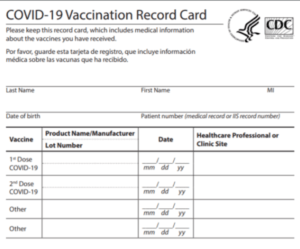
Stories about falsified vaccination cards are now peppering my newsfeed, including government seizure of fake vaccine cards at the border, and highlights of people who got caught attempting to travel to Hawaii with fake vaccination cards in attempt to and avoid mandatory quarantine. The woman whose card said she received a “Maderna” vaccine and the father who presented with vaccine cards for his 5- and 6-year-old children – far too young to be eligible for the vaccine – are the most memorable.

FELTG readers are likely aware of President Biden’s Executive Order 14043 last week requiring all Federal employees to be vaccinated against COVID-19. (FELTG instructor Katie Atkinson and I recently discussed the new vaccine requirement on an episode of the FedUpward podcast.)

This new EO reflects the administration’s increased push to get all eligible Americans vaccinated, and on Monday the White House set the vaccination deadline as November 22. The EO follows a July requirement that employees attest to their vaccination status, otherwise be mandated to weekly testing, limits on official travel, wearing face masks, and physically distancing, plus following other protocols the CDC recommends for unvaccinated people in the workplace.

New! On September 16, 2021, updated guidance was issued:

Q: Must agencies require documentation from employees to prove vaccination status?

A: Yes, agencies must require documentation from employees to prove vaccination, even if an employee has previously attested to their vaccination status. Employees may provide a copy of the record of immunization from a health care provider or pharmacy, a copy of the COVID-19 Vaccination Record Card, a copy of medical records documenting the vaccination, a copy of immunization records from a public health or state immunization information system, or a copy of any other official documentation containing required data points. The data that must be on any official documentation are the type of vaccine administered, date(s) of administration, and the name of the health care professional(s) or clinic site(s) administering the vaccine(s). Employees must certify under penalty of perjury that the documentation they are submitting is true and correct.

Employees may provide a digital copy of such records, including, for example, a digital photograph, scanned image, or PDF of such a record that clearly and legibly displays the information outlined above. In requesting this information, agencies should comply with any applicable Federal laws, including requirements under the Privacy Act and Rehabilitation Act of 1973.

Q: Are there penalties for providing false information on the vaccination attestation form?

A: Federal employees who make a false statement on the Certification of Vaccination form could be subject to an adverse personnel action, up to and including removal from their position. It is also a Federal crime (18 U.S.C. § 1001) for anyone to provide false information on the form. Falsification could also affect continuing eligibility for access to classified information or for employment in a national security position under applicable adjudicative guidelines.

The Task Force will be releasing additional guidance on vaccination requirements later this week, and we’ll be sure to keep you informed. In addition, we’ll be dealing with this topic and more in the October 26 webinar Post-Pandemic Accountability: Handling Employee Performance and Misconduct in a COVID-19 World. That webinar is the final session of the three-part series Navigating the Return to the Federal Workplace, which begins October 12 and includes discussion on EEO issues related to vaccines, reasonable accommodation, and more. [email protected]

By Deborah Hopkins, September 14, 2021

Here’s the scenario: A complainant files multiple EEO complaints including complaints against an attorney in the agency’s Office of General Counsel and the agency’s EEO Director. The complainant requests the attorney and the EEO Director to recuse themselves from the case. The GC and EEO Director happen to be the employees who handle most EEO matters and litigation for the agency in this particular region.

Because of her experience, the attorney would like to be involved in defending the agency against the complaints rather than create a firewall and pass this case off to a less-experienced attorney. And the EEO Director doesn’t want to recuse because he believes there is no merit to the EEO complaint.

What should the agency do?

Ideally, the agency should have a conflict policy in place and an agreement with another region or even another agency to step in for the investigation and defense of complaints in situations like this.  The EEOC issued a report last year with guidance on these conflict policies.

If the agency doesn’t have a conflict policy in place now, the below case discusses the conflict issue and should encourage the agency to address this as soon as possible: Katharine B. v. USPS, EEOC App. No. 0120170444 (Dec. 7, 2018).

“In Monroig, the Commission held that permitting the Deputy General Counsel, one of the responding management officials, to attend the hearing and simultaneously act as agency representative would create an inherent conflict of interest and tarnish other witnesses’ testimony.

EEO Management Directive 110 (EEO MD-110) (Aug. 5, 2015) requires that there be distance between the fact-finding and defensive functions of the agency in order to enhance the credibility of the EEO office and the integrity of the EEO complaints process. EEO MD-110, Chapter 1, at § IV (Aug. 5, 2015). The Commission ruled that even if the Deputy General Counsel had testified before all other witnesses at the hearing, her presence would discourage other employees from testifying freely at the hearing.

The Commission noted that the Agency was well represented at the hearing despite the Deputy General Counsel’s absence.

Accordingly, we find that a conflict of interest existed in the Agency’s representation at [*13] the hearing and that Complainant is entitled to a new hearing, in which S1 may not be involved as an Agency representative. See Rabinowitz v. U.S. Postal Serv., EEOC Request No. 05930348 (Sept. 23, 1993) (officials involved in discrimination may not be involved in processing the complaint).” [bold added]

Bottom line: Take conflict allegations seriously. Find a way to recuse counsel or EEO officials who may have conflicts of interest. Better yet, get ahead of these situations now by putting together a conflict policy, as recommended by the EEOC. It may not be something that arises often but being prepared for a conflict will benefit the agency in the long run. [email protected]

By Deborah Hopkins, August 13, 2021

Over the last four years, the VA has enjoyed a lower burden of proof in taking disciplinary actions against employees covered by the VA Accountability and Whistleblower Protection Act, 38 USC 714. Indeed, Congress passed this law in 2017 to make it easier to fire bad employees at the VA.

Between then and today, we have learned that the law is not retroactive for actions that occurred prior to its enactment (Sayers v. VA, 954 F.3d 1370 (Mar. 31, 2020); Brenner v. VA, No. 2019-2032 (Mar. 9, 2021)) and that, while MSPB has no penalty mitigation authority in actions taken under this law, agencies must show by substantial evidence that their selected penalty is reasonable. Mogil v. VA, No. 2018-1673 (Fed. Cir. May 1, 2019). Ok, fine. We can live with that.

Now, get ready.

On August 12, the Federal Circuit hit us with a big one. In this case, a Supervisory Consumer Affairs Specialist named Ariel Rodriguez yelled and used profanity at a patient in a VA facility. The confrontation escalated and the police were called. The police had to escort Rodriguez to his office because he was so agitated. After that, Rodriguez returned to the reception area, where he again confronted the patient. During the investigation that followed, Rodriguez was dishonest in his account of the events that occurred. He also attempted to influence one of his employees to alter her testimony to the investigator.

Rodriguez was removed on three charges: (1) disruptive behavior toward a veteran patient; (2) conduct unbecoming a federal supervisor, and (3) lack of candor. The facts justified an easy removal for the VA – or so we all thought. Plenty of witnesses, police activity, a patient’s wellbeing in danger, clear nexus – no question there was substantial evidence of misconduct and substantial evidence to support removal.

But wait.

The Federal Circuit saw things differently. There are two huge new takeaways that every management official at the VA must be aware of, courtesy of this case, Rodriguez v. VA, No. 2019-2025 (Fed. Cir. Aug. 12, 2021).

  1. The standard of proof for a VA to take a disciplinary action is a PREPONDERANCE of the evidence; the substantial standard in the statute only refers to MSPB’s review of the action.
  2. The VA must complete a Douglas factors analysis for its disciplinary actions, even though the MSPB lacks authority to mitigate the agency’s penalty.

Let’s look at each in turn.

  1. Burden of Proof

For the past four years, just about everyone in this business has been under the impression that the language in 38 USC 714(d)(2)-(3) “if the decision is supported by substantial evidence” meant that the agency action also required the substantial evidence standard. It’s even in the VA’s Discipline policy.

But the Federal Circuit said otherwise:

The references to “substantial evidence” in section 714 are all explicitly directed to the standard of review to be applied by administrative judges and the Board. Those references do not address the standard of proof to be applied by the DVA in making disciplinary determinations, nor does the remaining text of section 714 explicitly address the standard of proof in proceedings before the DVA…[T]he language of section 714 implies that the proper standard is the preponderance of the evidence. Section 714 provides that an employee may be removed, demoted, or suspended “if the Secretary determines the performance or misconduct of the covered individual warrants” such action. In the case of a disciplinary action based on misconduct, the requirement that the Secretary “determine” that the misconduct in question warrants disciplinary action implies that the Secretary must find that it is likely, i.e., more likely than not, that the employee has engaged in the misconduct that justifies the proposed discipline. [bold added]

The court’s explanation included discussion that if substantial evidence was the standard used, a Deciding Official would be required to find against the employee with regard to the charged misconduct even if the Deciding Official did not personally agree with that conclusion, because when substantial evidence is applied, a reasonable person might disagree and yet the standard is still met. The court said in no uncertain terms that the VA Accountability and Whistleblower Protection Act does not contain “any language stating explicitly, or even implicitly, that the burden of proof in disciplinary actions should be substantial evidence.”

Because the agency applied the substantial evidence standard in this case, what we now know is an incorrect standard, it was remanded back to the MSPB.

  1. Douglas Factors

Because the VA Accountability and Whistleblower Protection Act explicitly states that the MSPB does not have the authority to mitigate the agency’s penalty (38 USC 714(d)(2)(B)), in the first year or two after the law’s enactment the VA was (and the rest of us were) under the impression that Douglas factors were not required. In other words, if a penalty could not be mitigated, then there was no need to justify the penalty – and penalty defense is the primary reason why agencies use the Douglas factors.

Starting in 2019, the Federal Circuit determined that there must be substantial evidence the agency’s penalty is reasonable, otherwise the MSPB could remand a case back to an agency to determine a more appropriate penalty. Mogil, above.

The court in Rodriguez takes things further and says, “this court has made clear that the absence of mitigation authority does not deprive the Board of the authority to review penalties for substantial evidence” and that mitigation authority is completely divorced from “the power to review and strike down the DVA’s imposition of penalties that are arbitrary, capricious, an abuse of discretion, or not in accordance with law.” To that end:

For a reviewing tribunal to find a decision not arbitrary, capricious, an abuse of discretion, or otherwise not in accordance with law, that decision must have been based “on a consideration of the relevant factors and whether there has been a clear error of judgment…” [citation omitted] Accordingly, because the Board must review the DVA’s penalty selection in a section 714 case, that review must ensure that the DVA considered the relevant factors bearing on the penalty determination.

The court emphasized this point by declaring the Deciding Official must “weigh the relevant factors bearing on the appropriateness of the penalty, including the relevant Douglas factors” in cases of misconduct. So, there it is.

There is a whole lot more to discuss from this decision, but we’ll tackle those issues another time. As for now, we are anticipating multiple years’ worth of cases will be remanded to determine whether the VA had a preponderance of the evidence, and not merely substantial evidence, in taking appealable disciplinary actions. The good news for the VA is, preponderance is not too difficult to show, and I would bet they can meet this burden in nearly every case. The bad news is there’s a whole lot more work ahead. Please let us know how we can help – and attend UnCivil Servant September 8-9 or MSPB Law Week September 13-17 for all the details on what happens now. [email protected]

By Deborah Hopkins, July 21, 2021

The question in this article’s title has come up a few times over the last several weeks, particularly during our flagship UnCivil Servant training classes.

We’ll give you the short answer, and then the longer answer.

Short answer: No.

Explanation: According to OPM, “The law and regulations specifically exclude probationary/trial employees from the procedures that require the use of an opportunity to improve. This exclusion is because the entire probationary period is similar to an opportunity period. These employees should receive closer supervision, instruction, and training as needed during the first year of their employment.” The same principle is true when it comes to discipline. The agency doesn’t have to justify its penalty in removing a probationer, so even minor misconduct that wouldn’t justify removal of a career employee can warrant a probationer’s removal.

As soon as there’s a performance or conduct issue, the law allows to the agency to remove the probationer, even if the offense is minor.

Here is why removing a probationer without a Demonstration Period or progressive discipline makes sense:

  • The proof necessary to remove a probationer is very low.
  • The action can be taken and effected in one day.
  • If the probationer is ALREADY having performance or conduct issues, just imagine how they might behave once their due process rights attach.
  • It expedites the process to get the position posted again.

Now, read the headline again and then check out the next piece of discussion.

Longer answer: Maybe, probably not, but if you do then you’d better realize WHY you’re doing it.

Explanation: If a probationary employee is already having performance or conduct issues, the supervisor needs to think very hard about whether the additional time and effort spent to coach, train, work closely with, mentor, and help the probationer along is worthwhile. Because once that probationer hits their one-year mark (in most jobs, anyway), they become a fully vested career employee where civil service protections attach. It’s still possible for the agency to take an action against a career employee, as FELTG readers well know, but the simplicity of a probationer’s removal cannot be overstated.

The below situations might be reasons why a supervisor decides to keep a probationer around:

  • The position is difficult to recruit for or the job is located in a remote place.
  • The benefit to the government of working with the employee outweighs the drawback to the supervisor.
  • The employee has a unique skillset that it is worth the extra oversight to keep that person employed by the agency.
  • The employee’s attitude shows willingness to learn and improve.
  • The misconduct cannot be forgiven, but the supervisor doesn’t think it requires the probationer’s removal.

Surely, there are multiple other reasons why supervisors might keep probationers around. And let me be clear: I am not advocating pro- or con- removal, one way or the other. I just think it is important to point out that probationers have very few rights to their jobs while in the probationary period. If an agency is having a problem with a probationer, that supervisor should think very hard about making life easier and handling the problem now. However, if the supervisor thinks there’s hope for the employee, I can absolutely understand and support that position as well. Regardless of your stance on this issue, best of luck with all your probationary employees.  [email protected]

By Deborah Hopkins, July 12, 2021

A few weeks ago, my colleague and FELTG Founding Father Bill Wiley drew my attention to a Federal Circuit decision that gave the Federal employment law world an important distinction in legal definitions. The case involved an IRS agent who disclosed confidential taxpayer information, including personally identifiable information (PII), to an unauthorized person for her own benefit. The unauthorized person was her attorney, and the information was disclosed as the attorney was preparing a response to a proposed suspension for “displaying discourteous and unprofessional conduct and for failing to follow managerial directives.”

The IRS removed the employee for “intentionally disclosing taxpayer information to an unauthorized person” and the MSPB AJ upheld her removal, agreeing with the agency that the misconduct was severe because “taxpayer privacy is ‘sacrosanct.’” In addition, the employee had received training on the importance of keeping taxpayer PII private, did not redact any PII before sending the information to her attorney, and did not receive permission from the agency to disclose the information.

She appealed her removal to the Federal Circuit. While acknowledging the disclosure of taxpayer PII was improper, she argued on appeal that removal was too harsh because “[t]he penalty imposed was that for willful disclosure, rather than negligent disclosure.”

Keep in mind, the charge was “intentionally disclosing taxpayer information to an unauthorized person.”

The Federal Circuit did not agree with her argument, but rather agreed with the MSPB that her “removal was properly predicated on her intention to disclose the information to her attorney and did not depend on whether she knew that the disclosure was wrong.” Therefore, it was not improper for the IRS “to consider such intentionality as aggravating.”

Now the fun part – the discussion on the use of the words willful and intentional. The court said that in the petition for review, the employee improperly referred to being charged with “willful disclosure” when her actions were actually charged as intentional. The court said these two words are sometimes used interchangeably but shouldn’t be. And then they told us why:

  • An intentional action is one that an employee commits on purpose, not negligently. It is not a requirement that the employee know the action is illegal, if the agency can show the employee’s intent was to commit the action at issue.
  • A willful action is different; it is an action an employee commits on purpose with knowledge that the act is prohibited. If there is no evidence the employee knew the action was prohibited, the misconduct is not willful, but may be intentional.

The IRS employee acted intentionally when she provided taxpayer information to her attorney. The agency did not charge her with willful disclosure and, therefore, was not required to prove that she specifically knew the act was prohibited by law. The employment law nerd in me just loves this kind of stuff. If you’d like to read the case yourself, it’s Vestal v. Treasury, Fed. Cir. No. 2020-1771 (Jun. 14, 2021). And for more fun discussions on disciplinary charges, join FELTG for the virtual training program Understanding Misconduct: Disciplinary Charges and Penalties, held on July 26 as part of our weeklong program The Post-Pandemic Federal Workplace: Managing Accountability and EEO Challenges. [email protected]

By Deborah J. Hopkins, June 16, 2021

Last month, we looked at some of the unique aspects to disciplining a member of the Senior Executive Service (SES). This month, we will cover your agency’s options in the rare event a non-probationary member of the career SES has a performance issue.

Unlike GS and WG employees who can be removed for unacceptable performance entirely unrelated to an annual performance rating, a performance-based removal for an SES member must be based on that employee’s final rating(s) – typically the rating given as part of the annual performance appraisal.

If an SES member is performing unacceptably, however, agencies do not have to wait until the end of the appraisal year. There is flexibility to end an SES member’s appraisal period at any time (after the minimum appraisal period, which is 90 days in most agencies) if there is an adequate basis to prepare a final rating. According to OPM, this rating may “serve as the basis, or part of the basis, for a performance-based action.”

However, the word removal in this context does not mean removal from Federal service (also known as firing); it is removal from the SES, and in cases of unacceptable performance, the SES member has a guaranteed placement right to a non-SES career civil service position. This right to placement does not exist if the SES member is removed for misconduct.

If an SES member is performing unacceptably, the process generally follows these steps:

1 – The agency issues final rating of unsatisfactory or its equivalent (Level 1 in most agencies), at annual rating time or sooner, if the agency has an adequate basis to rate the employee, as detailed above.

2 – The agency notifies the SES member, in writing, of the impending “removal” from the SES, at least 30 days in advance of the removal date. The notice must contain:

  • The reason(s) for the action.
  • The effective date of the action.
  • The employee’s placement rights and information on the position to which the employee will be moved. The placement may be:
    1. A reassignment or transfer to another position within the SES, or
    2. Removal from the SES and placement into a GS-15 or equivalent position, with SES saved pay.

According to OPM, SES saved pay is set at the highest of three alternative rates –

  1. Rate of pay for the position in which the employee is placed;
  2. Rate of pay for the position from which the employee was appointed to the SES; or
  3. Rate of pay earned immediately before removal from the SES
  • Notice of the right to request an informal hearing from the MSPB at least 15 days before the removal is effective (although such an opinion is advisory only and is not binding on the agency). If applicable, the notice must also include the employee’s eligibility for immediate retirement under 5 U.S.C. 8336(h) or 8414(a).

3 – The SES member is placed into the new position on the effective date. Those SES members who held a career or career conditional appointment immediately before entering the SES are entitled to an appointment of equivalent tenure. Those who did not hold such an appointment before SES (for example, they were hired from the private sector) may be appointed using Schedule B authority under 5 CFR 213.3202(m).

There is no traditional MSPB appeal right for a performance-based “removal” from the SES. If the SES member is placed into a GS-15 position and then performs unacceptably, chapter 43 performance procedures would apply.

But wait! We’re not done yet.

Here are a few other odds and ends:

Marginal performance won’t cut it. The SES member receives two final ratings of unsatisfactory within 5 consecutive years, or two final ratings of less than fully successful (a Level 2 rating) within 3 consecutive years, that employee must be removed from the SES and placed in a GS position – they may not be reassigned or transferred to another SES position.

Moratoriums exist. A career SES member may not be reassigned or removed from the SES within 120 days after appointment of a new agency head or of a new noncareer who is the initial rater for the career appointee, unless the reassignment or removal is based upon a final rating of unsatisfactory completed before the moratorium began. This is to protect the SES members from political motivations.

Not demotions, but pay decreases. If an SES member receives a less than fully successful rating or otherwise fails to meet requirements of a critical element and remains in the SES, the agency may reduce the employee’s pay by up to 10 percent, subject to the 12-month restriction on pay adjustments. 5 CFR 534.404(j). [email protected]

By Deborah Hopkins, June 7, 2021

Last week, the MSPB released a research brief Agency Leader Responsibilities Related to Prohibited Personnel Practices. Since the MSPB still doesn’t have a quorum (1,613 days and over 3,400 Petitions For Review – and counting), publishing research briefs is one function the Board is still able to complete.

This brief looks at specifics in the Dr. Chris Kirkpatrick Whistleblower Protection Act (Kirkpatrick Act), 5 U.S.C. § 7515, which was passed unanimously by the Senate in 2017. The Kirkpatrick Act was named after a VA doctor who reported patient abuse and issues with patient medications (opioids) at the VA Medical Center where he was newly employed. Dr. Kirkpatrick made allegations that he was reprised against for being a whistleblower, and died by suicide shortly after he was removed from his position.

In case you’re not familiar, the Kirkpatrick Act sets out specific requirements for discipline against management officials who reprise against whistleblowers and other employees, specifically limited to the 5 U.S.C. § 2302(b) Prohibited Personnel Practices (PPP) 8, 9, and 14:

  • PPP 8 addresses retaliating or threatening to retaliate against a whistleblower.
  • PPP 9 addresses retaliating or threatening to retaliate against a person who exercises his/her/their right to participate in an appeal, complaint, or grievance (including as a witness), and retaliating or threatening to retaliate against an employee who refuses to obey an order that would require an individual to violate a law, rule, or regulation.
  • PPP 14 involves accessing the medical record of an employee or applicant as part of the commission of any other PPP.

If there is a finding of what MSPB in its brief refers to as a “Kirkpatrick PPP,” then specific requirements must be met in proposing discipline. We’ll discuss those below.

But first, according to the report, while “[t]he Kirkpatrick Act does not state what constitutes a determination that a Kirkpatrick PPP was committed or how to determine who committed the PPP in question,” the finding of a Kirkpatrick PPP can only be made by:

  • The head of the agency employing the supervisor;
  • An administrative law judge;
  • The MSPB;
  • The U.S. Office of Special Counsel (OSC);
  • A judge of the United States;
  • The Inspector General (IG) of the agency.

This seems to exclude the findings of a standard misconduct investigation unless, of course, the agency head reads the ROI and decides reprisal has occurred. Once the reprisal finding is made, the Kirkpatrick Act details the following process:

The head of the agency shall:

  1. Propose a suspension of at least three days (for a first offense), or propose removal (for a second offense by the same supervisor).
  2. Provide the employee 14 days to respond to the proposal, and allow the employee to be represented and to review the material relied upon; and
  3. Exercise judgment when considering the employee’s response and deciding to implement the proposed action, with the decision due by the end of the 15th business day (5 CFR § 752.103; this timeline may be amended in the future as a result of Executive Order 14003.)

There’s another interesting caveat to the Kirkpatrick Act. It only applies to actions taken against supervisors, as defined by 5 U.S.C. § 7103(a). If you have a few minutes to look it over, the brief can be found here. It includes a nice side-by-side chart comparing Traditional Discipline with Kirkpatrick Discipline. The brief also details various training on PPPs that agencies must require (including supervisor training on Kirkpatrick discipline), so please let us know if you’d like us to help you out there. After all, it’s what we do. [email protected].

By Deborah Hopkins, May 24, 2021

The 2020 FEVS was released a few days ago. Thanks to COVID-19, it looks somewhat different than past FEVS. But, as always, it is full of interesting and helpful information about how employees view their agencies, their supervisors, their coworkers, and more. Below are three key takeaways.

1. Agencies still have a long way to go on performance accountability.

In the 2020 FEVS, one of the worst scores out of all the topics covered came as a result of this item: In my work unit, steps are taken to deal with a poor performer who cannot or will not improve. (Q. 10). Only 42 percent of employees agreed with this statement, which means 58 percent of employees think that supervisors don’t do enough to hold unacceptable performers accountable. Not great.

While this number is trending better than it has in recent years (it was 36 percent in 2019 and 28 percent in 2018), we can all agree that 42 percent is not the target any agency aims for. That’s a failing grade no matter how you look at it.

FELTG has been working with a few agencies on a targeted approach to increase performance accountability through a structured set of training on topics, including writing effective performance standards, providing feedback that makes a difference, and holding employees accountable. These agencies have seen their individual FEVS scores on this item increase significantly, which tells us that the good employees really appreciate when supervisors focus time and effort on employee performance matters.

2. The grade on diversity hiring and representation is a solid C+.

In response to this item: My supervisor is committed to a workforce representative of all segments of society (Q. 20), 79% of employees agreed.

With President Biden’s numerous Executive Orders highlighting the government’s role in promoting diversity, especially among traditionally underserved populations, we can anticipate that agencies will work on bringing this number up in 2021. In many agencies, leadership is especially focused on nondiscriminatory hiring, reasonable accommodation for employees with disabilities, raising awareness about LGBTQ issues, and training on types of microaggressions and bias that often lead to hostile work environment allegations.

3. COVID-19 definitely impacted agency performance, but not as much as you might think.

One of the new sections in the FEVS dealt with the impacts of COVID-19 on agencies’ ability to meet customer needs and focus on mission results while the world was turned upside down from the pandemic. The graphic below shows that while there have been some struggles, Federal employees have found ways to contribute to agency mission and customer service despite unprecedented working conditions, whether that was transitioning to work 100% from home, spending 12 hour shifts in PPE, working around the clock to develop tests, treatments, or vaccines, and much more.

If you haven’t yet read the FEVS, you can find it on OPM’s website here. It’s worth a look, and when you’re ready to talk to FELTG about how we can help you improve your agency’s scores (because after all, higher scores mean your employees are happier, and if your employees are happier they are more productive), we’ll be here. [email protected]