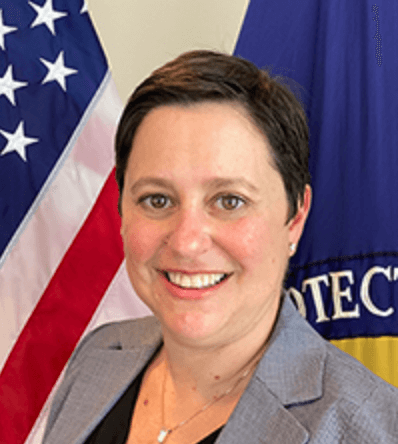
By Dan Gephart, September 26, 2022

When Christine Griffin (photo, right) started her tenure as a commissioner at the Equal Employment Opportunity Commission in 2005, she had a long list of things she wanted to work on. Despite her previous work with the Boston Disability Law Center, the Federal employment of people with disabilities was not at the top of that list.

That quickly changed.

“After learning early on that people with disabilities, and more specifically, targeted disabilities were not represented in the Federal workforce in any meaningful numbers, I decided that should be my focus,” Griffin said. “I always believed that government should live up to the ideals that it was telling everyone else to live up to.”

During her time at EEOC, Griffin and a team of attorneys that included Steve Zanowic and Jo Linda Johnson, developed the LEAD Initiative (Leadership for Employment of Americans with Disabilities) with two goals:

  • Increase awareness of the issue.
  • Increase the number of people with targeted disabilities working for the Federal government.

LEAD laid the groundwork, and numbers have steadily risen. The overall participation rate of individuals with targeted disabilities increased from 1.05 percent in 2003 to 1.80 percent in 2019. Meanwhile, 12 of 28 independent agencies, 11 out of 17 cabinet departments, and 34 out of 98 subcomponents of cabinet departments are meeting the 2 percent goal. In 2016, only 10 independent agencies and subcomponents reached that goal.

Griffin took that work to the Office of Personnel Management five years later when she became the agency’s Deputy Director. Her most memorable moment, she said, was sitting next to President Obama the day he signed Executive Order 13548, aimed at increasing the employment of individuals with disabilities.

“I think it has taken a long time,” Griffin said, “but the work we did at EEOC to create awareness coupled with the Executive Order from President Obama made Federal agencies more accountable. What is measured is treasured and having someone at the highest level ask for those measurements through EEOC and OPM makes a difference.”

At OPM, Griffin’s team created the first government-wide Diversity and Inclusion Work Group that led to the development of the first government-wide diversity and inclusion strategic plan. And there was another first. Griffin and then EEOC attorney Veronica Villalobos set up OPM’s Diversity and Inclusion Office at OPM. [Editor’s note: Another member of that team was J. Bruce Stewart, who will be presenting The Power of an Inclusive Mentality on November 8.]

Griffin is currently senior executive search consultant at Bender Consulting Services, Inc.

DG: What impact has the pandemic had on reasonable accommodation in the workplace?

CG: The most beneficial impact that the pandemic had was to prove to employers that employees can work from home and be productive. With the amazing technology we have access to, there are very few jobs that can’t be done remotely. I think that came as a shock to many who always thought working from home was a boondoggle. I believe that this will prove to continue to have a significant impact on the reasonable accommodation requests to work from home for people with disabilities. This request will be difficult for employers to deny going forward and hopefully difficult for judges to uphold those reasonable accommodation denials, since even they learned how to work remotely.

DG: Why is it important to revisit existing reasonable accommodations — and how often should that be done?

CG: It is important to revisit reasonable accommodations because of the rapid advances in technology that allow more people to enter and remain in the workforce. I can’t think of one disability that would prevent someone from becoming employed. We don’t need our limbs and senses for most jobs and if we think differently, that is usually a plus for employers. I think an annual review of accommodations would be useful for the employer and employees alike. Just an annual check in with an employee to see how the accommodation is working and if there is something that could be changed, tweaked, etc., to make the employee’s and the employer’s experience better.

DG: What should agencies be doing (or doing better) when recruiting employees with disabilities?

CG: The first thing agencies must do is establish a plan to increase the hiring of people with disabilities that is endorsed at the highest level. Schedule A makes it so easy for Federal agencies to hire people with disabilities without going through a lengthy competitive process. When I was at OPM, we developed the Shared List – a list of people with disabilities who were Schedule A eligible and ready to go to work. This list was populated by Bender Consulting, who found individuals with disabilities with the skills requested by the CHCOs. Agencies had access to the list and could search for the person with the skills they needed. OPM stopped funding that list, and Federal agency personnel are still calling and asking where it is. For now, agencies can contract with Joyce Bender, CEO of Bender Consulting, to help them find the candidates with the skills they need. Bender has been working with agencies for more than 20 years to help them recruit and hire individuals with disabilities.

DG: On the flip side, individuals with targeted disabilities are leaving the government at twice the rate as those without disabilities. Where do you think agencies are failing?

CG: I think some Federal agencies have failed to create the inclusiveness necessary to keep any employees who bring diversity to the workplace. People leave a workplace when they don’t feel valued, and that includes employees with disabilities. We used to say that they will hire you because you’re different (check off a box) and get rid of you for not being the same. I also think that people with disabilities in the Federal government don’t enjoy the same opportunities for advancement. If they can seek that advancement elsewhere, if they feel more valued elsewhere, they will leave.

[Editor’s note: Register for Reasonable Accommodation: Meeting Post-pandemic Challenges in Your Agency on November 17, starting at 1 pm ET.] [email protected]

By Deborah J. Hopkins, September 19, 2022

I don’t know about you, but I am still loving the fact that we have a fully functioning MSPB again. While you might be tempted to skip over the non-precedential (NP) cases, you should rethink that because we have found several jewels in NP cases over the past six months.

One of the the trends we’ve seen in 432 actions – performance-based removals and demotions – is that the MSPB has been remanding cases if the record doesn’t contain substantial evidence of unacceptable performance that justified the agency’s decision to place the employee on a PIP. And because that requirement didn’t exist until March 22, 2021 (Santos v. NASA, No. 2019-2345, Fed. Cir. Mar. 11, 2021; see also Singh v. USPS, 2022 MSPB 15 (May 31, 2022)), most of the 432 cases are being remanded on this point. Santos never explicitly stated what types of evidence agencies could use to justify the PIP, instead ruling, “we are not prescribing any particular evidentiary showing with respect to the employee’s pre-PIP performance. Performance failures can be documented or established in any number of ways.”

So, one of the items that jumped out at me in a brand-new case (Slama v. HHS, SF-531D-15-0266-I-4; SF-0432-16-0496-I-1 (Aug. 24, 2022)(NP)) is we now know at least one type of evidence the Board will consider in pre-PIP unacceptable performance determinations.

A bit of history first: In Slama, the appellant’s performance problems started in 2011. Bigger problems emerged in performance year 2013, and he received a Level 1 summary rating in 2014. His unacceptable performance that year led to the denial of a Within Grade Increase (WIGI), which he appealed to the MSPB. For reasons not explained in the case, the appellant was not put on a PIP until 2015 after he received yet another Level 1 summary rating. The appellant failed the PIP and the agency removed him later that year. He appealed … and into the backlog the new case went.

Fast forward to 2022, the return of the quorum, and the new Santos requirement. In Slama, the MSPB joined his two appeals (one over the WIGI denial and the other over the 432 action) and, among other things, decided that the material that forms the basis of a WIGI denial can also be used to justify a PIP and meet the Santos requirement. According to the case:

The administrative judge found that the agency demonstrated by substantial evidence that, before being placed on the PIP, the appellant’s performance in the critical elements of administrative requirements, communication, and technical competence was unacceptable [citation omitted]. The administrative judge based her finding largely on the same facts and analysis under which she had affirmed the agency’s [acceptable level of competence] determination in connection with the WIGI denial. ¶25

While WIGI denials are rare, it’s quite interesting (and time saving) that the Board will rely on that same content to show the agency can justify the PIP. It might be helpful for those of you handling the 432 remands to check the WIGI files and see if you have anything you can use. And then join me for Back on Board: Keeping Up with the New MSPB on October 20. [email protected]

By William Wiley, August 30, 2022

Sometimes an MSPB decision that identifies itself as nonprecedential is still an important decision. That’s especially true in times like these when we have three relatively new members of the Board who are being called on to reconsider established practices of Federal employment law, practices that they have not personally been called on to address before.

A good example of this is the Board’s Final Order in Feesago v. DoD [PDF], SF-0432-16-0458-I-1 (August 10, 2022) (NP). [PDF] When analyzing the appeal of that relatively straightforward 432 unacceptable performance action, the members applied an important principle we have taught here at FELTG for over two decades:

The supervisor MUST tell the employee EXACTLY what level of performance he must attain during the PIP to avoid removal from his position.

In Feesago, the PIP initiation memo told the employee that she would be held accountable for mistakes in her performance in each of four critical elements. However, it failed to tell her how many mistakes she would have to make to be deemed to have failed to meet the standards for two of the critical elements. Therefore, the PIP was invalid for those critical elements.

The cure for this removal-reversing defect that we have incorporated into every PIP initiation memo that we have ever written here at FELTG is this: “During the PIP, you must not make more than three errors relative to this critical element or I will consider you to be performing at the Unacceptable level and thereby subject to removal from your position.”

By the way, I once had an agency attorney try to tell me that the above is an invalid “backwards” standard because it tells the employee what he cannot do rather than what he must do to be performing acceptably. Well, that’s an attorney who has not read the case law very carefully and has not applied common sense to the situation.

A Minimal performance standard (Level 2) is backwards and invalid if it does not clarify where the Unacceptable performance level is, e.g., the agency will lose the appeal if the PIP initiation memo tells the employee that the Minimal standard is “must not make more than three errors.” However, it’s perfectly fine (and according to Feesago, EXPECTED) that you will tell the employee that the acceptable level of performance is “must not make more than three errors.”

Relatedly, several years ago I overheard an Employee Relations specialist tell a supervisor that she should NOT tell the employee how many errors he was making during the PIP that would be counted toward evaluating the minimal level of acceptable performance. I guess that the ER specialist was concerned that if the employee were to be told that he had already exceeded the maximum error level early in the PIP, it would somehow undermine the PIP as “predetermined,” or the employee’s morale would suffer, or whatever. Well, that’s just wrong and a reversible error under the same principle that caused the loss of two critical elements in Feesago.

Of course, the employee should be told how he is doing during the PIP. How can he otherwise know if he is improving or continuing to fail? If you tell the employee that the minimal level of performance is “no more than three errors,” and the employee makes one or two errors during the first week of the PIP and then another couple of errors during the second week, he should be told. If you don’t, the Board will conclude that he has not been given a “reasonable opportunity to improve.”

But what about “morale”? What about “predetermined”? Aren’t those valid concerns? No, they are not. Nothing in law or common sense says that the agency must continue a PIP beyond the point of demonstrated failure. Think about it for a minute. When the supervisor sets a minimum level of acceptable performance in the PIP memo, he is saying that an employee who fails to meet that level is unacceptable and should be removed from the position. If the employee has more than the maximum-allowable errors during the first couple of weeks of a PIP, and the supervisor continues to allow the employee to stay in the position where he can make even more errors after that, doing so undermines the supervisor’s PIP-initiating statement relative to what constitutes Unacceptable performance. The employee cannot undo the early PIP errors by acceptable performance after the point of unacceptability. In this situation, an in-the-know supervisor will end the PIP early and propose that the employee be removed from the position at the moment of failure rather than wait until the PIP expires.

Sadly, here at FELTG we know that there is a fair amount of incorrect advice out there relative to taking unacceptable performance actions. What if the employee has exceeded the maximum number of tolerable errors during the PIP, but the HR/legal advisor erroneously tells the supervisor that the PIP cannot be ended early? How should the supervisor respond if the employee says, “Hey, boss, I’ve already failed. Why should I keep trying? Why are you keeping me on the job?” Easy, if true; the supervisor can say, “Yes, it looks like I’ll have to initiate action to remove you from your position at the end of the PIP because you’ve already failed the performance standard. I’ll continue to observe your performance during the remainder of the PIP so I can decide whether the action I take will be a termination, demotion, or reassignment.” Of course, if demotion and reassignment are not options, the supervisor should not lie. And, of course, the advisor should not be giving bad advice. Federal workplace law is filled with rocks and corresponding hard places for the uninformed.

Although two of the critical elements in Feesago were dismissed as invalid, there were two other critical elements that also formed the basis for the action on appeal. Unfortunately, during the PIP the supervisor did not provide adequate feedback to the employee as to how she was performing under these two valid standards, thereby violating the employee’s right to “a reasonable opportunity to improve her performance.” In the PIP initiation memo, the supervisor (in over-simplification) told the employee, “You are making errors relative to the critical element of Customer Care by doing X.” Then, during the PIP, the supervisor considered Y and Z to be examples of deficient Customer Service performance but did not tell the employee. In finding this oversight to be a critical deficiency in the action, the Board said, “the record does not reflect that any of these issues were ever mentioned to the appellant in the PIP discussions.”

If you are an HR specialist, attorney, or supervisor (or union representative, because we love you guys, too) involved in performance-based actions with unacceptably performing employees, it will be well worth your time to read Feesago from beginning to end. The new Board’s analysis throughout that decision is replete with old-school hints and helpful takeaways relative to how to (or not to) craft a performance-based action. I particularly liked the section where the agency seemed to fault the employee for granting bereavement leave so that a subordinate could make funeral arrangements for his grandmother. Board members have grandmothers, too.

Or you could just sign up to attend FELTG’s next MSPB Law Week seminar September 12-16 or UnCivil Servant September 7-8 and learn about this and all the other principles and best practices to employee accountability. This stuff is not hard IF you’ve been to the training. [email protected]
By William Wiley and Deborah J. Hopkins, August 22, 2022

In a recent MSPB case law update (the next one is October 20, if you’re interested), we discussed the Douglas factors and the new comparator analysis the Board laid out in Singh v. USPS, 2022 MSPB 15 (May 31, 2022). This dramatic change in precedent inevitably led to questions, which we thought were worth sharing with FELTG Nation. So here goes.

Q: For the comparator analysis under Douglas, is it required that the Deciding Official (DO) in her decision letter specify or identify any comparable cases, or is it sufficient to state, for example, “in consultation with HR, I considered how the agency addressed similar misconduct in the past.” Wondering what evidence, if any, needs to be put forth in the decision letter regarding comparators.

A: The best practice is for the DO not to consult with anyone they don’t need to. The requirement is for the DO (and the Proposing Official, or PO) to consider misconduct cases they know about that have the characteristics of “same-or-similar misconduct” we discussed in the training. If the DO knows of any cases that fit that definition, or if she decides to ask HR for same-or-similar cases (even though she doesn’t have to), good appellant’s lawyer will grill her on appeal about what those cases involve, and why she felt that they were different. In detail. If the PO/DO were to reference asking HR for same-or-similar situations, and the HR advisor says that there were none, then that HR advisor becomes the appellant’s witness who will be expected to provide details of the cases surveyed.

Unlike expected testimony on appeal, a broad statement will suffice for the purpose of the Douglas factor analysis in the proposal and decision notices. The language we have recommended at FELTG for more than a decade, as long as it is true, is something like: “I know of no other situations in which an agency employee engaged in similar misconduct and was, thereafter, disciplined at a lesser level.”

On the other hand, if the DO/PO knows of similar cases that support the penalty selected, then something like: “In two misconduct cases similar to this situation, removal was determined to be the appropriate penalty.” And finally, if a similar case is known of in which removal was not the selected penalty, something like: “I know of one other case of AWOL in which the employee was not removed. However, in that case there was no significant harm caused by the unapproved absences. In this situation, the employee’s absences caused the agency to expend $5,000 to hire a contract replacement.” Or whatever the distinction may be.

Q: What is the rationale for separately attaching a Douglas factors worksheet instead of solely discussing it within the proposal notice?

A: We’ve seen numerous cases over the years in which the proposal or decision notice contained the Douglas factor considerations along with the misconduct charges. Unfortunately, doing so has the potential of confusing the Board as to which fact statements are relevant to the charge and which are relevant to the penalty. We have learned from history that the MSPB generally expects us to prove every factual assertion relative to the charge (due process requirement), but only most of the fact statements relative to the penalty, although proving everything is always ideal. Therefore, when the misconduct facts get mixed with the penalty facts, the Board has a problem weighing them. We don’t want the Board to get confused about anything we do.

Separately, using a Douglas factors worksheet forces the PO to go through each of the 12 factors, evaluating those that are relevant and noting which are not. We have seen many cases in which an agency lost the penalty because the PO or DO ignored or failed to adequately address one or more factor. A worksheet reduces the possibility of making this mistake. Administrative judges are trained to assess each of the 12 factors in order. A worksheet lays that out for them to the benefit of the agency.

That said, it is not a critical error to include the Douglas factor analysis in the body of the proposal notice. Clearly delineated and identified as penalty factors separate from the misconduct charge facts, encompassing all 12 Douglas factors would work. But there is no reason you would want to go to that extra trouble and accept that extra risk.

A separate worksheet attached to the proposal notice, as we noted in the recent caselaw in the training, helps the Board understand (and affirm) the agency’s action. It is a good idea without a downside.

One final thought. For goodness’ sake, DO NOT violate the employee’s Constitutional right to due process. The Board will automatically reverse a removal, without consideration as to whether there was any harm, if the DO considers Douglas Factors relied on by the PO, but not communicated by the PO to the employee. See Braxton v. VA, DC-0752-14-0997-A-1, August 12, 2022 (NP).

This really is easy, folks. Just have the PO do a Douglas Factor Worksheet, staple it to the Proposal Notice, and fuhgeddaboudit. [email protected]

By Dan Gephart, August 8, 2022

For five-plus years, we at FELTG and others have referred to the then-growing backlog of cases at the Merit Systems Protection Board with dread. So the enthusiasm with which MSPB Acting Chair Cathy Harris is approaching her new position, as evidenced by her appearance on the radio and here, is surprising. And refreshing. And very hopeful.

The Acting Chair said she was “honored and humbled to be nominated” by President Biden. “I am committed to doing the very best I can to protect the merit systems and achieve justice,” she told us. “What an incredible opportunity!”

Harris says “opportunity.” Others see challenge, to put it lightly. The new Board inherited a 3,500-case backlog, at which they’ve been dutifully whittling away. But there are some anxious employees and agencies, who have been waiting a long time for resolution of their cases. And new cases are coming in every day.

DG: What would you say to someone who has a Petition for Review and is wondering when the Board is going to get to it?

CH: We are diligently working to get to your case. The good news is that the career staff has done the work to prepare the Board members to be able to make efficient and thoughtful decisions, so we are not starting from scratch. That said, it is going to take time for us to consider and get to all the decisions that are awaiting our review. We don’t yet have an estimate as to when we will be able to project when we will get through the case inventory but am hoping we should be able to do that before too long.

DG: What are your thoughts about Federal Circuit decisions on issues that the Board didn’t have an opportunity to address (given the lack of a quorum) and their impact on future MSPB decisions?

CH: Appellants may take their cases directly to the Federal Circuit after a decision from an administrative judge. During the lack of a quorum, this enabled appellants to get appellate review of their cases. But appellants have this right even in the presence of a quorum, so the Board is accustomed to situations where it may not have had an opportunity to opine on certain issues.

DG: Is there any extra effort given to encourage settlement on backlogged cases?

CH: Yes. We are actively exploring ways in which we can identify cases that might be appropriate for settlement. We encourage parties to contact the PFR Settlement Program if they feel their case would be appropriate for mediation at this juncture. As time has passed and circumstances have changed, we understand it may be easier for parties to achieve a resolution now. Interested parties may contact the PFR Settlement Program at (800) 209-8960.

DG: Is the Board considering shortening decisions to speed up the backlog reduction?

CH: Yes. The Board will be issuing shorter decisions where appropriate.

DG: Is there a mechanism in place for giving feedback to administrative judges regarding the quality of their decisions?

CH: Yes. Internally, administrative judges receive instructive guidance through Board decisions. Further, pursuant to MSPB’s Judges’ Handbook, Chapter 12, Chief Administrative Judges review initial decisions written by administrative judges below the GS-15 grade level prior to issuance.

Chief Administrative Judges also review initial decisions for complex cases written by administrative judges at the GS-15 grade level prior to issuance. Other initial decisions are reviewed after issuance. Chief Administrative Judges and Regional Directors provide direct feedback to administrative judges regarding whether initial decisions sufficiently adhered to authorities such as the Judges’ Handbook, MSPB regulations, and relevant statutes and case law.

My message to all federal employees, not just supervisors, is: The Board is fully back, and we are committed to protecting the merit systems. Employees and supervisors would do well to educate themselves as to merit system principles and prohibited personnel practices. There is more information on these topics on our website.

[Editor’s note: See our previous interviews with Member Tristan Levitt and then-Acting-Chair Raymond Limon, and register [PDF, 1.84 MB] for the MSPB and EEOC Case Law Update on August 31 from 3-4:15 pm ET, part of FELTG’s annual Federal Workplace 2022: Accountability, Challenges and Trends event, or MSPB Law Week September 12-16.] [email protected]

By Deborah Hopkins, July 25, 2022

Did you happen to catch the latest precedent-altering MSPB decision related to affirmative defenses? This one’s a little weedy, but interesting nonetheless, especially to MSPB nerds like myself.

The appellant, a custodial laborer for the USPS, was removed on a charge of improper conduct with specifications including:

  • Telling a coworker that if his [the appellant’s] vehicle was towed from the agency parking lot again, he “would come into work and end up shooting someone out of revenge and anger.”
  • Telling the same coworker that he was having law enforcement follow her because of a verbal dispute the two had a year earlier and that the “only reason [he] didn’t have anything ‘bad’ happen to her was because she has children.”
  • Telling the same coworker, the following day, he was having law enforcement follow and harass a supervisor’s son in retaliation for his vehicle being towed from the agency parking lot and that he would make sure that the supervisor’s son was “booked” for “Driving Under the Influence … and other traffic violations.”

The appellant challenged his removal. In addition to claiming he did not engage in the activity leading to the charges, he also raised an affirmative defense of reprisal for prior protected activity – he had filed an MSPB appeal over an “emergency suspension” he received after the aforementioned misconduct occurred. (If you don’t know what an affirmative defense is, please join us for MSPB Law Week September 12-16 for all you need to know.)

The Administrative Judge (AJ) upheld the removal. However, his decision did not reference the affirmative defense, as that had not come up in any prehearing conference. On petition for review to the Board, the appellant challenged his removal, but did not challenge the fact that the AJ never addressed the affirmative defense.

You with me so far?

Before this case came out, precedential MSPB caselaw required the Board to remand cases for consideration of an appellant’s affirmative defense if the AJ failed to comply with certain procedural requirements. Wynn v. USPS, 2010 MSPB 214. The Board overturned Wynn and other related cases, establishing new criteria for the Board to consider in determining whether an AJ erred in not addressing an appellant’s affirmative defense at the hearing stage. As MSPB’s case report said in its summary [PDF], a potential remand hinges on the “ultimate question of whether an appellant demonstrated his intent to continue pursuing his affirmative defense, and whether he conveyed that intent after filing the initial appeal.”

Below is the non-exhaustive list of factors the Board will consider in determining whether a remand is appropriate:

(1) the thoroughness and clarity with which the appellant raised an affirmative defense;

(2) the degree to which the appellant continued to pursue the affirmative defense in the proceedings below after initially raising it;

(3) whether the appellant objected to a summary of the issues to be decided that failed to include the potential affirmative defense when specifically afforded an opportunity to object and the consequences of the failure were made clear;

(4) whether the appellant raised the affirmative defense or the administrative judge’s processing of the affirmative defense claim in the petition for review;

(5)  whether the appellant was represented during the course of the appeal before the administrative judge and on petition for review, and if not, the level of knowledge of Board proceedings possessed by the appellant; and

(6)  the likelihood that the presumptive abandonment of the affirmative defense was the product of confusion, or misleading or incorrect information provided by the agency or the Board.

Thurman v. USPS, 2022 MSPB 21 (Jul. 12, 2022).

In this case, the Board applied the above factors and determined that the appellant abandoned his affirmative defense, thus there was no basis for remand. As a result, the Board upheld the removal. We’ll discuss this one and others during September’s MSPB Law Week. [email protected]

By Deborah Hopkins, June 27, 2022

Updated July 10, 2025.

There are reports in the media about a new facial hair/shaving requirement for members of the military, and how this requirement will impact individuals with certain skin conditions. Did you know that few years ago the EEOC issued a decision on a DOD civilian-side case with very similar facts? See below for the original article.

The reasonable accommodation process is an entitlement that every Federal employee has a right to pursue, regardless of the job. A recent EEO case, which originated back in 2010, caught my attention.

The case involved 10 complainants who all suffered from a medical condition called pseudofolliculitis barbae (PFB). According to the case, PFB is a chronic bacterial skin disorder that’s caused by shaving facial hair. PFB causes pain, skin irritation, pustules, rashes, sores, bleeding, scarring, and infection. Medically, PFB requires abstinence from being clean-shaven, and predominantly affects African American males.

The complainants worked as police officers, within the Pentagon Force Protection Agency. PFPA police officers are required to wear protective clothing and sometimes use personal protective equipment (PPE), as the job includes defending themselves and others against possible exposure to explosives, chemicals, or other weapons of mass destruction.

In 2010, the agency issued a new regulation that impacted police officers:

Supervisors shall ensure that all emergency response personnel are able to safely wear the Level C [Chemical-Biological-Radiological-Nuclear (CBRN)] PPE Ensemble at any time: facial hair that comes between the sealing surface of the face piece and the face or that interferes with the valve function is prohibited. Emergency response personnel who have a condition that interferes with the face-to-face piece seal or valve function shall not be permitted to wear the Level C CBRN PPE Ensemble. [bold added]

Practically speaking, this new regulation required PFPA Police Officers to be clean shaven because the CBRN ensemble would not seal properly if facial hair was present. The complainants, who up until that point had been permitted to have facial hair a quarter inch in length to accommodate their PFB, were now threatened with reassignment or removal if they did not shave their facial hair. They separately filed EEO complaints, alleging discrimination on the bases of race (African American), color (Black), and disability (PFB).

After a complicated procedural history including EEOC ordering supplemental investigations into the qualification standards for the jobs (which included the need for PPE), the EEOC found the standard on facial hair was appropriate because it was job-related and consistent with business necessity to have PPE that sealed properly.

However, the EEOC also found that the agency failed to meet its requirements to consider effective accommodations, namely alternative PPE that would work properly even in the presence of facial hair, because the complainants had all “passed their annual mask fit tests, and there was no evidence that they were unable to perform the essential functions of their position with the waiver or that any incident occurred where they were in danger or risked danger to others due to a respirator mask failure in an emergency situation.”

In this request for reconsideration, the EEOC held to its decision in the original appeal:

In sum, the Commission found the Agency failed to meet its burden of proving that there was no reasonable accommodation that would enable Complainants to meet the existing standard or an alternative approach that would still allow the PFPA Officers to perform the essential functions of their position. The decision concluded the Agency’s imposition of a blanket policy requiring all PFPA Officers to be clean-shaven regardless of their medical condition violated the Rehabilitation Act.

Cleveland C. et al. v. DOD, EEOC Request No. 2020003894 et al. (Apr. 4, 2022).

Now 12 years later, we finally have an outcome. The agency missed one of the basic pieces of the framework: Consider alternative accommodations that will still allow employees to perform essential functions within their medical restrictions. I can’t help but wonder what the damages will amount to in this case, given that 10 complainants were impacted for over a dozen years.

As employees are returning to the physical office and different workplace standards are being implemented in this post-pandemic world, agencies should remember that every reasonable accommodation request should be given an individualized assessment. [email protected]

Related training:

By Deborah Hopkins, June 13, 2022

The MSPB is operating on all levels once again, now that the third and final nominee, Cathy Harris, was sworn in at the beginning of the month. There have, as of this writing, only been 15 precedential decisions issued by the new Board, but we’ve seen dozens of non-precedential (NP) decisions in the past three months.

According to MSPB:

“A non-precedential order is one that the Board has determined does not add significantly to the body of MSPB case law. Parties may cite non-precedential orders, but such orders have no precedential value; the Board and administrative judges are not required to follow or distinguish them in any future decisions. In contrast, a precedential decision issued as an Opinion and Order has been identified by the Board as significantly contributing to the Board’s case law.” See 5 C.F.R. § 1201.117(c).

Despite their NP status, I have found some new lessons in these decisions. One such case that seems consequential to me is Purifoy v. VA, CH-0752-14-0185-M-1 (May 16, 2022)(NP). Take a look at this procedural history:

  • Employee was fired for AWOL (October 2013)
  • AJ mitigated the removal to a 40-day suspension (November 2014)
  • On PFR, the MSPB reinstated the removal (June 2015)
  • On appeal, the Federal Circuit remanded the case back to the MSPB for an independent Douglas analysis (October 2016)
  • Remand goes in the pile that would eventually become a 3,600+-case backlog, and eventually MSPB’s O & O reinstated the removal (May 2022)

If the second to last bullet point made you pause, you aren’t the only one. Ever since the MSPB started operating in 1979, the discipline process has worked like this:

  1. The agency drafts the charge and selects the penalty.
  2. The Board reviews the agency’s penalty determination for reasonableness.

I can’t recall a time when the Federal Circuit ordered the Board to do its own penalty assessment. (That’s not to say it hasn’t happened – but if it has, I don’t recall. And this is certainly a first for THIS Board.) As we have taught in MSPB Law Week for 20-plus years, the Board must give due weight to the agency’s discretion in exercising the managerial function of maintaining employee discipline and efficiency. The Board’s function is not to displace management’s responsibility but to assure that managerial judgment has been properly exercised within the tolerable limits of reasonableness.

So here we are. A bit more on the facts of this case. The employee, Lamonte Purifoy, was employed by DVA as a WG-2 Housekeeping Aid. He was jailed for six months due to drug use, and the VA fired him based on two charges:

  1. Two days of AWOL
  2. Six subsequent months of AWOL while in jail

On appeal, the AJ held that only 38 days of Charge 2 warranted AWOL. As the severity of the Charge 2 was reduced and because the AJ believed the employee showed a potential for rehabilitation, the AJ mitigated the removal to a 40-day suspension. On PFR the MSPB reversed the AJ’s mitigation and reinstated the removal, as it found the appellant did not demonstrate a high degree of rehabilitation potential.

Upon its review of the case the Federal Circuit decided that the Board members erred by not evaluating Douglas factor 12: “The adequacy and effectiveness of alternative sanctions to deter such conduct in the future,” although the AJ had done so, thus the basis of the remand.

In its assessment on remand, the Board looked at the Proposing Official’s testimony which said that he would object to the appellant returning to the workplace because of the negative precedent such an action would set. In addition, the Board was compelled by the Deciding Official’s testimony about deterring similar misconduct by other employees, and the message that imposing a lesser penalty would send. Therefore, this factor supported reinstating the removal penalty.

I talked with Bill Wiley, one of FELTG’s Founding Fathers, about this case and he had some insight about the Board’s decision and its assessment of Douglas factor 12: “When defending a removal penalty, be sure to state what harm would occur if the employee was returned to or remained in the workplace. Often, it can be said truthfully that anything less than removal would send a negative message to other employees. If the employee was disruptive in the workplace before removal, it would be reasonable to predict he would be disruptive if he was reinstated or retained.”

The Board also weighed in on the other Douglas factors. So, while Purifoy is an NP case, it gives us factor-by-factor information on how this new Board views the Douglas assessment. And if you understand the Board’s reasoning in Purifoy, you will be able to better defend the agency’s penalty selection for years into the future.

For more on this and other lessons from the Board, join FELTG for the virtual training Back on Board: Keeping Up with the New MSPB, July 20. [email protected]

By Dan Gephart, June 6, 2022

Tristan Leavitt, Member, Merit Systems Protection Board

When And Now a Word With … last talked with Tristan Leavitt, the word “corona” evoked visions of a weak mass-produced beer not a virus that would eventually take the lives of more than a million Americans. And the Merit Systems Protection Board was in the seventh month of sitting member-less, following the expiration of former Chair Mark Robbins’ term.

As then-General Counsel of the MSPB, Leavitt had assumed the responsibilities for the executive and administrative functions usually vested in the Chair. Over the next couple of years, Leavitt and a dedicated group of agency staff steered the MSPB through its most challenging period.

Three months ago, Leavitt and Raymond Limon were confirmed and sworn in as Members, ensuring a quorum for the first time in more than five years. And now, the backlog of Petitions for Review that we all watched steadily are being addressed. New MSPB Chair Cathy Harris was finally confirmed by the Senate late last month, so the MSPB is back at full strength for the first time in over half a decade.

Like Vice Chair Limon recently, Leavitt very graciously took time to answer our questions, giving us a peek into the new Board’s approach.

 DG: Are you satisfied with the current pace with which you and Acting Chair Limon are tackling the backlog of cases?

TL: I think we’ve made a decent start.  Both he and I have fantastic staff, and I’ve really appreciated how smoothly our two offices have been able to work together.  That said, no matter how fast we move, we recognize that the backlog represents over 3,000 appellants and their agencies awaiting finality, so I doubt we’ll ever shake the sense of urgency that we look for ways to be more efficient.

DG: It appears you are prioritizing whistleblower cases. Is that so and why?

TL: Way back in October 2019 I mentioned in this same forum that MSPB’s career staff had drawn up plans for dealing with the backlog.  Primarily, that consisted of identifying a “priority group” of 300 cases as a first group for an incoming Board to address.  The group included a mix of all types of cases: easy cases to help new Board members acclimatize, cases dismissed as settled, precedential cases on which a number of other cases hinge, extremely old cases, cases potentially involving large amounts of backpay, etc.  When Ray and I were confirmed, we adopted the recommendation of staff and began working through the priority group of cases.  Given that whistleblower reprisal allegations are raised in some 25 percent of all cases before the Board, it’s not surprising that the group has included a number of whistleblower cases, some of them precedential.

DG: Are you planning to prioritize any other types of cases? 

TL: Since the creation of the first priority group, MSPB staff have developed second and third priority groups that are also approximately 300 cases each.  Beyond those groups, we haven’t yet developed a comprehensive strategy for how we intend to deal with the rest of the approximately 2,700 cases in the backlog.  To some extent, I would say that’s because we’ve been in an acclimation period, particularly since Ray is new to MSPB, and to some extent it’s probably also because it’s unclear how close we might be to the confirmation of a third Board member. Nevertheless, by the time we’ve worked through the priority groups there will have to be decisions made about where to go next in the backlog, and I would imagine we’d be well equipped at that point to develop a strategy.

DG: You’ve decided to keep the non-precedential cases and while most are 1-2 pages, others are much longer. Can you explain your approach to NP cases? 

TL: As Ray noted here recently, MSPB staff have already drafted recommended decisions for approximately 3,400 of the 3,600-case backlog, and those were generally drafted under the procedures in use when last the Board had a quorum.  While Ray and I have exchanged proposed edits with one another in cases or sent a handful back to the career staff for particularly involved revisions, I think it’s fair to say that thus far we’ve mostly just worked with the case formats and lengths presented to us by the career staff.  As a general matter, I would say the most abbreviated non-precedential orders tend to come in cases where it seems very clear to us there is no jurisdiction or where the administrative judge adequately addressed in the initial decision all relevant issues.

DG: Why has the board talked about likely resuming reissuing short form decisions again?

TL: There has been discussion about how much time could be saved by reverting to true short form decisions, particularly for the types of cases I mentioned above that are only receiving abbreviated orders anyway.  On the other hand, drafting a very brief opinion doesn’t seem to be particularly arduous, especially since the shortest already tend to simply state the issue in question and articulate the Board’s standard for granting petitions for review.  As I mentioned before, there are a number of decisions to be made that we’ve postponed until we could get our feet wet by working through the priority groups, and my guess would be that this is one of those issues.  If we did decide to revert to short form decisions, I’d imagine it would be implemented with newer cases coming in for which recommended decisions haven’t yet been drafted.

DG: There was a lot of focus and attention on that backlog of cases, but how else has the presence of a quorum positively impacted the agency? 

TL: The restoration of a quorum is certainly beneficial to agency morale, as all of MSPB’s committed staff are eager to fulfill the full scope of the agency’s important mission.  The Office of Policy and Evaluation’s research agenda can now be finalized, and the full version of its studies issued moving forward.  MSPB can also update its regulations, which is long overdue in some instances.  Finally, while it only requires one Board member and not a full quorum, having gone from no Board members to two also reopens the door to issuing stays requested by the Office of Special Counsel in prohibited personnel practice cases.

DG: What is the status of the agency’s plans for returning employees to the physical workplace?

TL: I largely haven’t been involved on this topic since handing agency head responsibilities over to Ray. However, as far as I’m aware most employees have resumed reentering the workplace at least some days of the week.

Leavitt noted that even pre-pandemic, the MSPB had a relatively high telework rate compared to other agencies. [email protected]

[Editor’s note: How is the Board ruling in these decisions? Join FELTG President Deborah Hopkins for the two-hour virtual training Back on Board: Keeping up With the New MSPB on July 20, starting at 1 pm ET.]

By Deborah Hopkins, May 31, 2022

When an employee is too ill to come to work on a regular basis, it puts the agency in a difficult position: wanting to work with the employee and grant leave in hopes they will eventually recover, but also needing someone to complete the job tasks on a regular basis. In some cases, the amount of leave the agency grants becomes problematic and the agency needs the employee to return to duty.

Generally, an agency cannot take an adverse action for approved absences – and that makes sense. After all, the agency grants the leave, or else the employee has an entitlement to the leave. However, an agency may remove an employee for excessive absence if the agency proves the Cook criteria, as identified in Cook v. Army, 18 M.S.P.R. 610 (1984):

  1. The employee was absent for compelling reasons beyond his control;
  2. The absences continued beyond a reasonable time and the agency warned the employee that an adverse action would be taken unless the employee became available for duty on a regular basis; and
  3. The position needed to be filled by an employee available for duty on a regular basis.

A recent MSPB decision, Robinette v. Army, AT-0752-16-0633-I-1 (May 11, 2022)(NP), reminds us the Cook criteria are requirements, not suggestions. The decision reinforces that the Board cannot uphold a removal if the agency does not comply with all three elements in the Cook criteria.

In Robinette, the agency issued the appellant a Notice of Leave Restriction on Feb. 17, 2015, which informed him that his chronic, unscheduled absences were considered excessive and negatively affected the agency’s ability to accomplish its mission.

On May 18, 2016, the agency issued a Notice of Proposed Removal for “excessive absenteeism,” which specified that from Feb. 21, 2015, through April 16, 2016, he was absent 939.3 hours out of a total of 2103.7 available duty hours (almost 45%). The agency removed the employee on June 24, 2016, and he filed an appeal to the MSPB.

In the initial decision, the administrative judge (AJ) found the agency’s action was properly predicated upon approved leave, including annual leave, sick leave, and Leave Without Pay, but that the Leave Restriction Letter did not meet the second element of the Cook criteria; it did not inform the employee his approved absences could lead to removal if he did not become available on a regular basis. So, the AJ reversed the removal.

On Petition for Review, the agency argued that it had suspended the employee in November 2014 and April 2015 for “failure to follow proper leave procedures” and that the statement in the decision letters “[y]ou are cautioned [that] any repetition of this or similar offenses may result in more severe disciplinary action against you” met element 2 of the Cook criteria. Because neither decision letter was part of the record, the Board refused to consider anything except the February 2015 Leave Restriction Letter, which the Board also found did not meet the second Cook requirement.

Excessive absence removals are highly technical. Reading this case reminded me of a VA case from a few years ago where the agency’s removal was reversed because the warning letter told the employee that if he did not return to work, he would be disciplined, but it did not say that continued absence on approved leave would warrant his removal. Miles v. DVA, CH-0752-14-0374-I-2 (May 17, 2016)(ID).

As we teach in all our classes, words matter. For more on this and other leave-related challenges, join us virtually for Absence, Leave Abuse & Medical Issues Week, June 13-17. [email protected]