By Dan Gephart, March 13, 2019

Two weeks ago, nearly 16 million people watched Michael Cohen tell the House Oversight Committee about the many illegal, unethical, disreputable, and downright nasty things that he did, allegedly at his boss’s direction.

Whether you believe the President’s former attorney or not, I’m sure you think that you would, as Spike Lee says, do the right thing if your boss asked you to do something wrong. Heck, I know I would. And no psychology text book or Stanley Milgram experiment is going to change my mind.

This got me thinking about orders disobeyed and generally ignored in the federal workplace. Years of reading MSPB decisions involving charges of insubordination and failure to follow orders leaves me thinking the federal workplace’s problem is different than the one faced by the former Trump Organization lawyer. There are some federal employees, it seems, just looking for a reason — any reason — to ignore their supervisors’ orders.

That’s why every federal employee needs to know what “work now, grieve later” means, especially that first tenet – work now. The employee must follow the supervisor’s order. If not, that employee should be disciplined.

“[A]n employee does not have the unfettered right to disregard an order merely because there is substantial reason to believe that the order is not proper; he must first comply with the order and then register his complaint or grievance, except in certain limited circumstances where obedience would place the employee in a clearly dangerous situation.” Taylor v. HHS, 40 MSPB 106 (1989), citing Gragg v. US Air Force, 13 MSPB 296 (1982).

Ah, the exception. An employee does not have to follow an order that would cause him “irreparable harm.” That would mean orders that are:

  • Illegal, whether the order itself is illegal, or obeying the order would be an illegal act.
  • Unsafe.
  • Immoral.
  • An unwarranted psychiatric examination.

An order can also be rejected if it foregoes a Constitutional right.

But let’s be honest here: When we’re talking about orders that cause irreparable harm, we’re talking a miniscule number of cases. The percentage of orders that would fit into the irreparable harm category are so far to the right of the decimal point, they make pi look like a number Count von Count would rattle off on Sesame Street. It’s more likely that an employee would think the supervisor’s order was wasteful, or argue the order falls outside his position description. And in those cases, it’s simple: Work now, grieve later.

Oh wait. We nearly forgot about the Follow the Rules Act, which Congress sneaked through and the president signed in June of 2017. Yes loyal readers, that’s the bill that FELTG Professor Emeritus and Former President Bill Wiley wrote could create a “hellscape scenario” for the federal workplace if passed. Well, it did pass without much fanfare.

The Follow the Rules Act extends whistleblower protections to federal employees who refuse to obey a direct order that would violate a rule or regulation, whereas previous protections extended only to those refusing an order that would violate a law. Bill wrote about a confused employee who thinks she’s being ordered to violate a rule or regulation:

Well, what if it turns out she is wrong? What if her honest belief about what the order meant was simply mistaken? If she is fired for insubordination, if on appeal her argument that the order violated a rule is not affirmed, she has effectively bet her job that her interpretation was correct at the moment she chose to be insubordinate. Why in the world would we want to entice federal employees into this high-risk gamble with their livelihood when there are other ways to protect them from abuse?

It’s a clear no-win situation. It’s something you want to avoid, just like the anarchy that comes from a workforce that disregards supervisors’ orders. That said, if you have a supervisor who has no fear of ordering an employee to something illegal, unsafe, or immoral, then you’re going to be watching someone from your agency testify before Congress while millions watch. [email protected]

By Deborah Hopkins, March 5, 2019

I’m sure by now you have heard that for the first time in its history, we have zero Members at the Merit Systems Protection Board. Acting Chairman Mark Robbins’ term expired March 1, leaving the front office at 1615 M Street NW completely dark.

On his last day at MSPB, Robbins released MSPB’s Annual Report for FY 2018. So while we don’t have a Board (and who knows how long that will last since nobody with decision-making authority on Capitol Hill seems worried about it), we do have some new information to share.

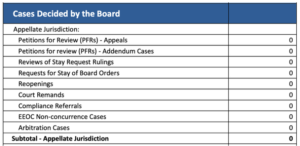
Let’s take a look at some of the impressive numbers out by MSPB last year:

Are you seeing a trend here? That’s a whole lot of goose eggs. (And yes, the term “impressive numbers” above was meant to be sarcastic.) Without a quorum, a huge chunk of the Board’s work cannot get done. In a normal year, those subtotals are usually upwards of 1,000, including approximately 800 Petitions for Review.

I share these numbers not to slam Robbins or any of the dedicated employees at MSPB, because none of this is their fault. In fact, we know they have worked hard every day, despite the lack of quorum. The responsibility for this lack of performance falls directly on the Administration and the Congress, which for over two years have refused to put Board Members in place. This inaction has left the MSPB with over 2,000 cases, sitting in a hallway in cardboard boxes, waiting to be adjudicated. To add insult to injury, all of Robbins’ work on those 2,000 cases became obsolete last week and cannot be used by future Board members.

If I come across as upset, it’s because I am. If you’re tired of reading about this, then maybe you shouldn’t finish this article because I have more. There is NO REASON things at MSPB have to be this way. And yet it’s continued, for 786 days. I have contacted everyone I know – and don’t know – on the Hill and in the White House to try to get the message across that while maybe this doesn’t play on TV as well as national security issues, hot-button committee hearings, or North Korean summits, real people are hurting every day, more people get hurt every day, and the fix is SO EASY. Others have joined in this plea, even testifying before congressional committees and pleading with Congress and the White House to do something. And nothing has changed.

This is one of those rare areas where the inaction hurts both sides involved – the agency and the employee. There now are up to 2,000 people waiting for years to find out if they will get their jobs back. There are agencies on the hook for potential back pay in these cases. I’m not a math scholar but I know that three years (and counting) of back pay for a GS-14 in Washington, DC, plus attorney fees, can easily exceed half a million dollars. And that’s just one case out of 2,000.

But all is not lost. There is some light in all this darkness. As of right now the MSPB is still open and operating, aside from the front office. MSPB’s General Counsel, Tristan Leavitt, is now the Acting Chief Executive and Administrative Officer, so fortunately the career staff in the headquarters, regional offices, and field offices are still at work.

Let’s look at some more numbers from the report that aren’t 0s. In FY 2018, the Administrative Judges issued initial decisions (IDs) on 5,134 appeals. Here are a few significant numbers from within these IDs:

2,267: IDs on disciplinary actions

142:     IDs on performance-based actions

416:     IDs on probationary removals

517:     IDs on Individual Right of Action (IRA) appeals [usually whistleblower reprisal appeals]

325:     IDs on USERRA and VEOA appeals

1,058:  Cases settled before hearing

83.2:    Percentage of agency actions upheld

14:       Percentage of agency actions overturned or requiring corrective action

3,077:  Cases dismissed

The agency with the most cases adjudicated was the VA (1,080), and the agency with the fewest cases adjudicated (excluding those that have no appeals pending) was actually a 13-way tie at one appeal each. You can read the full report to see which agencies those were.

At FELTG, we’ll keep you posted on what’s next. And if you want to hear us rant about these injustices in person – while also teaching the law – join us at an upcoming MSPB Law Week in Washington, DC or Dallas, TX. [email protected]


By Deborah Hopkins, February 19, 2019

If you’ve been in the federal employment law arena for more than five minutes, or if you’ve read this newsletter in the recent past, you know that we (the People) have been without a quorum at MSPB for more than two years now. In fact, next Friday marks the end of Mark Robbins’ tenure as the sole remaining Board member, at which time the MSPB will have ZERO members for the first time in its 40-year history.

Last week, the Senate Committee on Homeland Security and Governmental Affairs voted to advance two MSPB nominees (Dennis Dean Kirk and Julia Akins Clark) to the full Senate for a confirmation vote – but the vote won’t be held until a third nominee is named (the remaining nominee Andrew Maunz withdrew his name last week), and clears committee to join them for a Senate vote. In case you didn’t know this: It’s not a legal requirement to confirm all the members together. However, the Committee Chairman, Senator Ron Johnson (R-WI) indicated that would be the process used. (Read the full detail of the committee meeting here.)

So, what will happen next? It’s anybody’s guess. Will the MSPB have to shut down until they get some leadership — or will the General Counsel run the place in the interim? Arguments can be made for either option.

As of today, the Administrative Judges are still holding hearings and issuing decisions on agency removal actions, and your cases still need to be as tight as ever to ensure a favorable outcome. Because if anything is appealed from a judge’s decision, it goes into a stack of 2,000+ cases that are sitting in boxes in the hallways, waiting for Board members to read them and issue opinions. Wouldn’t you rather NOT have to appeal a judge’s decision? Me too.

So what’s the best way to have a judge agree with your choice of discipline? Follow the law. In order to discipline a federal employee for misconduct, there are five legally required elements:

  1. A reasonable rule exists
  2. The employee knew the rule
  3. A preponderance of the evidence (more likely than not) that the employee broke the rule
  4. Choose a defensible penalty
  5. Provide due process

If you miss even one element, you lose your entire case. Let’s look the elements in turn and see how easy they are to check off — and how easy they are to screw up, if you’re not paying attention.

1. A reasonable rule exists. You cannot discipline an employee for breaking a rule that does not exist. The very definition of misconduct is a violation of a rule. So, if you want to reprimand, suspend, or remove someone, you can only do it if they have indeed broken a rule. Also note: the rule must be related to the job; you cannot enforce rules that have nothing to do with the workplace. For example, you can set a rule that an employee to always fill up a GOV’s gas tank when it gets below ¼ tank, but you cannot require that rule for the employee when driving his personal vehicle.

Case example: Doe v. DoJ, 565 F.3d 1375 (Fed. Cir. 2009)

2. The employee knew the rule. An agency cannot enforce secret rules against employees – that would violate the fairness federal employees are guaranteed. If you have a rule that employees wear closed-toed shoes in the office but you’ve never bothered to tell them the rule, you cannot discipline them for wearing open-toed shoes. There are some “commonsense” rules where notice is a given (for example, you don’t need a rule that says employees are not permitted to have a campfire in the breakroom), but when in doubt, TELL the employee the rule. Don’t assume the employee knows it.

Case example for further reading: Tudor v. Treasury, 639 F.3d 1362 (Fed. Cir. 2011)

3. A preponderance of the evidence (more likely than not) that the employee broke the rule – unless you’re at the VA in which case you only have a substantial evidence requirement, that the employee might have broken the rule. Preponderant evidence is not a huge burden, but you do have to have some evidence. Whether you saw the misconduct happen, or witnesses saw it, or you have video evidence or a confession, you need something to show the employee broke the rule. This should not be difficult. The employee has a lunch break from 12-12:30 and you, the supervisor, see the employee come back to his desk with a Chipotle bag at 1:10 – that’s evidence. Don’t make this more difficult than it needs to be. But please have evidence.

Case example: Mott v. DVA, No. 2017-1222 (Fed. Cir. 2018)

4. Choose a defensible penalty. Unless you’re at the VA, you have to justify why you selected the penalty (suspension or removal) you did. This is done by looking at the Douglasfactors and explaining the effect of the misconduct. We consider things such as the harm caused or the potential for harm, the person’s job level and type, any notoriety or publicity, any past discipline the employee has received, what we’ve done with comparators who have engaged in the same type of misconduct, and a number of other factors. The penalty must be appropriate for the level or instance of misconduct the employee engaged in. You may not be able to justify a first-offense removal for a person who got to work five minutes late to a job where being on time doesn’t matter because there was no harm. However, if your employee is an ER surgeon and someone died in those five minutes, you have a completely different scenario and removal might very well be justified. Let the Douglas factors be your guide, and keep in mind, the MSPB is only going to mitigate (change to something less) your penalty if it exceeds the bounds of reasonableness.

Case examples for further reading: Jacoby v. USPS, 85 MSPR 554 (2000); Webster v. Army, 911 F.2d 679 (Fed. Cir. 1990); Mott, supra

5. Provide due process. Federal employees who have successfully completed their probationary periods are entitled to due process in disciplinary situations. Due process has three steps:

  1. Notice of the charged misconduct and the proposed penalty (given by a Proposing Official);
  2. An opportunity to respond to the charges, and to be represented; and
  3. An impartial decision based on the information given in the notice and the response (given by a Deciding Official).

If you miss a step, you lose your case EVEN IF you have 50 witnesses and video evidence of the employee stealing the laptop, punching a customer, sleeping on the job, whatever. A due process violation, sometimes referred to as “losing on a technicality,” is literally a loser every single time. While there are cases where agencies don’t give the employee notice of the charges, or don’t notify the employee of her right to respond, we see most cases lost under the third prong — where the deciding official relies on some bit of information that the employee is not privy to. This is why it is crucial to work with your Deciding Officials on their proper role and encourage them not to go looking for extra information about the employee.

Case example for further reading: Kelly v. Agriculture, 225 Fed. Appx. 880 (Fed. Cir. 2007).

I hope this helps. If you want more – and trust me, you definitely want more – then come to our MSPB Law Week in Washington, DC or Dallas, TX, so we can show you how to win your case in front of the judge, and quickly get back to the business of fulfilling your agency’s mission. [email protected]

By Deborah Hopkins, February 13, 2019

Committee meeting room, pre-vote

Here’s a quick update from today’s business meeting for the Senate Committee on Homeland Security and Governmental Affairs, which held a scheduled vote on the nominees to the Merit Systems Protection Board (MSPB). I was there, and I am still saying “wow.”

Last night, the Senate was informed that Andrew Maunz, the nominee for Vice Chairman, had withdrawn his nomination for unspecified reasons. This morning, the committee, which is made up of 8 Republicans and 6 Democrats, considered the remaining nominees: Dennis Dean Kirk (R) for Chairman, and Julia Akins Clark (D) for Member. When Committee Chairman Ron Johnson (R – WI) opened the floor for discussion, the only person to speak was Sen. Rand Paul (R – KY).

And boy, did Sen. Paul have a lot to say. He voiced the opinion that the MSPB is failing as an agency, saying that it has become a job protector for federal employees instead of a protector of the merit system. Citing facts from a couple of unnamed cases, he claimed that the MSPB thinks child pornographers and VA leadership who allow veterans to die in the hallways belong as federal employees. He said this type of behavior from employees would never be tolerated in the private sector, and if the government can’t fire people for such egregious acts, then the MSPB should cease to exist and Congress should go back to the drawing board to create an oversight agency that actually works.

Here’s the problem: Sen. Paul (along with countless others) doesn’t understand the system. He didn’t give citations for the cases he mentioned, but I believe I know the cases to which he was referring. And in those cases, the MSPB didn’t put employees back to work because they necessarily wanted to; the MSPB was following the law. In the child pornography case, the agency failed to establish a nexus (a connection) between the employee’s off-duty conduct and his government job. The law requires a nexus to exist. (By the way, come to MSPB Law Week and we will show you how to find nexus in a case like that; the agency did not, but it was most likely doable.) The MSPB never said, “Child pornographers are good people and should be working for every federal agency.” The MSPB found that the agency failed to establish nexus, and nexus is required by law.

Regarding the VA cases Sen. Paul mentioned, I believe those cases dealt with senior leadership who were removed, and the Board members (who are no longer there) mitigated the penalties based on Board leadership’s at-the-time view on comparator employees, which has since been walked back in pieces.

Can someone please tell Sen. Paul – and the rest of America – that the system works IF the agency handles the case correctly? Citing the few cases where terrible employees got their jobs back because of procedural defects, while ignoring the 7,000+ removals that stuck in the last FY, does a disservice to the country. I had a hard time sitting still while he was speaking. I wanted to jump up and tell him that he had it all wrong, but I didn’t think it would be a wise move to get kicked out of a Senate Committee meeting.

I digress (for now).

On to the nominees. Both Kirk and Clark were voted out of committee. Everyone on the committee, Rebublicans and Democrats, voted “yes” to send them to the full Senate for a vote, except for Senator Paul.

But – don’t get your hopes up on a quorum just yet. After the “ayes” had it, Chairman Johnson said it’s typical that all nominees get voted on together in the full Senate, so now Kirk and Clark will be waiting for a third nominee to be named and voted out of committee before they can be confirmed.

Hold up just a minute, Mr. Chairman. The MSPB members intentionally have staggered terms and to my knowledge, in the 40-plus years since the Civil Service Reform Act created the current MSPB, we have NEVER had all three nominees confirmed together (except, maybe the very first time members were appointed). Occasionally two go together, yes – but not three.

Whether this is intentional or a misunderstanding about how this part of the system works, I don’t know. But are you ready for the real heartbreak?

If Kirk and Clark were to get confirmed by the full Senate before a third nominee is named, they could vote on dozens or (if they put in some really long hours) even hundreds of the 2,000 Petitions for Review (PFRs) Acting Chairman Mark Robbins has voted on, before his term expires on February 28.

But this is not going to happen. So, all of Mr. Robbins’ work on the PFRs since January 8, 2017, will go to waste, as the Committee chose NOT to vote on an amendment that would have allowed for the holdover term for a sitting Board Member to be extended beyond the one year currently permitted under 5 USC § 1202.

To recap: Robbins’ term expires February 28. Nominees Kirk and Clark won’t be confirmed until the full Senate votes. And the full senate won’t vote until a third nominee is named and the committee votes that person to the Senate floor as well. And we don’t have a third nominee yet. For what it’s worth, Chairman Johnson said he is working with the White House to come up with a nominee soon.

Also heard on the Hill this morning: As long as there’s not a shutdown this weekend, the Senate will be in recess next week. So, push the timeline for the vote back until the final week of February, at the very soonest, only if there’s a third person nominated and voted out of committee before then. If all that doesn’t happen before March 1, the Board may have to shut down entirely until the Senate votes on the nominees.

While this may be considered slight progress, it’s not the kind of progress the civil service needs. We’ll keep you posted on what happens next. [email protected]

By Deborah Hopkins, February 13, 2019

We know intentional marijuana use, even for medicinal purposes, is a no-no for federal employees (see my recent article here). But what happens to a federal employee who is fired for marijuana use after failing a drug test, when he challenges the removal by stating the intake of marijuana was accidental?

The Federal Circuit recently looked at that very issue in Hansen v. DHS, No. 2017-2584 (Fed. Cir. Dec. 28, 2018). Hansen, an IT Specialist at the United States Customs and Border Protection, was subjected to a random drug test, and the results showed marijuana in his system. The agency proposed his removal for “positive test for illegal drug use— marijuana.” Regarding nexus, a portion of the proposal read “[t]he use of an illegal drug, such as marijuana, stands in direct conflict with the principles of law enforcement, the mission of the Agency, and the public’s trust.”

In his response to the proposal, Hansen said he had inadvertently consumed drug-laced brownies at a barbeque he had attended, which was hosted by someone he did not know. Hansen revealed that he wasn’t initially aware the brownies had marijuana in them, and though he felt no immediate effects from the brownies, later that evening he felt tired and suffered an upset stomach. He attributed the upset stomach to a bratwurst he had consumed at the party, and as a result he called in sick the day after the barbecue.

The Deciding Official gave Hansen’s response “significant consideration” but ultimately determined it was not convincing. In her explanation, the DO said the employee did not present “any evidence from either the person who purportedly brought the brownies, or from the host” or even “a statement from anyone else who either knew that the brownies contained marijuana or who did not know, but felt the effect of the drug.” The DO subsequently removed Hansen.

Hansen appealed his removal to the MSPB, where it was upheld. The Board said that inadvertent marijuana ingestion would be relevant to its decision, if shown, but it determined that Hansen, not the government, bore the “burden of showing such inadvertent ingestion” and he did not show any evidence to convince the Board. The decision from the Board also said Hansen relied on “thirdhand hearsay” to support his story about marijuana in the brownies, and had not supplied “statements from the hosts, other attendees who observed the presence of the brownies, or the individuals who brought the brownies,” or even any evidence confirming that he ate brownies at all.

The Board further noted that though Mr. Hansen claimed fatigue and upset stomach after consuming the brownies, he attributed those ailments to marijuana consumption only after the deciding official expressed skepticism regarding his lack of symptoms.

Hansen also argued that the removal should be reversed because the agency could not show his “intent” to use marijuana, but the Federal Circuit correctly said the charge as written did not have an intent element. The agency was not required to show intent; it was only required to show by preponderant evidence that the employee tested positive for marijuana. This highlights a fundamental principle we cover in MSPB Law Week and Developing and Defending Discipline: Words matter when drafting a disciplinary charge. Had the agency charged “intentional use of marijuana,” then Hansen might very well be back at work today.

Hansen also argued that the agency violated his Fourth Amendment right against unlawful search and seizure by conducting the drug test because the government failed to show that he occupied a testing designated position, This argument failed because the agency’s “Drug-Free Federal Workplace Program” handbook listed employees with “access to the Customs Law Enforcement Automated Systems” as testing designated, and IT Specialists fall under that designation. The Federal Circuit upheld the removal.

If you’re interested, you can read the full decision here. In the meantime, stay away from the brownies. [email protected]

By Barbara Haga, February 13, 2019

I am shaking my head again. I was told by a supervisor in a recent class that one of his supervisors had called the servicing HR office in December about initiating an opportunity period for an employee whose appraisal cycle ends on March 31. He was told that he was too late and couldn’t do one.

I really am at a loss. This is a responsible non-bargaining unit position, the employee was relatively new in that job, although he had been a Federal employee for a few years, and they had a lot of examples of how the employee was not performing at the level necessary.

There is nothing in their appraisal system that sets any limits on when an action could be initiated. It is a mystery to me what would have been necessary to satisfy this HR practitioner that they could and should proceed.

Back to Basics

5 CFR 432.104, entitled “Addressing unacceptable performance,” states:

At any time during the performance appraisal cycle that an employee’s performance is determined to be unacceptable in one or more critical elements, the agency shall notify the employee of the critical element(s) for which performance is unacceptable and inform the employee of the performance requirement(s) or standard(s) that must be attained in order to demonstrate acceptable performance in his or her position.

The first phrase is relevant to this discussion.  The regulation says “at any time” during the cycle. It doesn’t say “at least 90 or 120 days before the end of the cycle” or “by some arbitrary date set by the HR office prior to the end of the cycle” or “the employee has to be warned at the progress review.”  It just says the employee may be notified at any point during the cycle.

I read the regulation in 430 to say that a cycle may be extended if needed in order to prepare a rating (which could include completing a PIP in my book). 5 CFR 430.208(g) states, “When a rating of record cannot be prepared at the time specified, the appraisal period shall be extended.  Once the conditions necessary to complete a rating of record have been met, a rating of record shall be prepared as soon as practicable.”  My take is that a PIP could be initiated on the last day of the cycle.  To me that’s better than giving the employee (and I chose that verb for a reason) a rating they didn’t earn.  It’s a gift that can come back to bite later.

The View from Outside HR and Legal

When HR practitioners advise, sometimes that advice can come back to roost in the future. If you advise managers not to take action or that they can’t take action, sometimes they learn to stop calling you. They may reach the conclusion that the HR or Legal staff is not able to support them (or fill in unwilling, untrained, unmotivated, etc.)

Recent history would seem to tell us that this is the perception across government.  Witness the OMB Directive M-17-22 issued on 04-12-2017 entitled “Comprehensive Plan for Reforming the Federal Government and Reducing the Federal Civilian Workforce.”  While many were very excited about the second part of the title, I think there wasn’t much attention paid to the part about reform.  One portion of the directive had to do with performance. Section III, Para D iii directed agencies to “Develop a plan to improve the agency’s ability to maximize employee performance.” Agency responses were due at OMB by June 30, 2017. You can check and see what your agency did with it. The list of required actions included:

  • Review policy, procedures, and guidance on how to address poor performance and conduct.
  • Remove any unnecessary barriers to addressing performance, eliminating steps not required by statute or regulation.
  • Set a date by which all supervisors will be provided a copy of rules and guidance regarding PIPs, including timing of PIPs and use of Chapter 75 procedures.
  • Ensure all managers and HR staff are appropriately trained on managing employee performance and conduct.
  • Establish real-time manager support to assist them in taking needed actions.

If that isn’t a clear signal that the Administration perceives that HR practitioners are not doing what needs to be done, we could turn to Executive Order 13839, which echoed some of the same themes. Even though the two other EOs issued last May were largely enjoined by the DC Circuit decision from last August, very little in 13839 was found invalid.  What did that order direct agencies to do regarding performance actions?  Here’s part of the list:

  • Minimize burden on supervisors.
  • Eliminate pre-demonstration period requirements.
  • Eliminate any requirement to use 432 procedures and use 752 when appropriate.

I read these two documents to say that HR practitioners need to do a better job helping managers hold their employees accountable – whether it is drafting notices in a timely manner, not agreeing to extra steps with unions, or using the right tool for the problem.

If that weren’t enough, the hits just keep coming.  On July 16, 2018 a coalition of the Senior Executives Association, Federal Managers Association, and other manager associations provided input to House Oversight and Government Reform Government Operations Subcommittee on what they thought needed to be done to fix the civil service system.  They had numerous recommendations, including implementing pay banding and merit pay, and also to:

  • Eliminate the statutory requirement that creates Performance Improvement Plans (PIPs), and the really scary one …
  • Provide funding for an online playbook with information on how to handle adverse actions, performance problems, improving employee morale, and other areas supervisors may need guidance.

Why are these manager groups asking for funding for an online tool to help them deal with their employee relations issues?  Could it be that they don’t think they are getting good service from the human beings who presently are supposed to be providing these things?  Could it be that they are tired of being told you can’t do this or that?  Could it be that it takes too long to get the actions prepared?

The Current Case

So, what about the manager who wanted to take action but was told he couldn’t?  The HR office may have thought they dodged an action, but this case is not going away.  As it happens, the manager who asked about initiating the improvement period departed.  A new supervisor is now in place dealing with this employee. I am convinced that this supervisor will persist in getting this person to perform or will take action.

However, the new manager is starting out behind the eight ball.  Because the HR office advised that an action could not be initiated in December, that departing supervisor had to complete a close out rating.  And, because according to HR nothing could be done to take this person to task for the poor performance, that rating was a Fully Successful (their system doesn’t have a Level 2).  Their system makes that close out rating the rating of record when there are not 90 days remaining in the cycle.  So, the EPF is going to include an unearned Fully Successful rating for this year.  The new supervisor will have to confront the inevitable questions if there is an action down the road about why this person was rated FS by the prior supervisor and why this employee’s performance is not good enough anymore.

The bad advice from last fall is going to add extra complication for the manager and HR to resolve this situation down the road if there is a 432 action.  This is sad – and completely unnecessary.

By Meghan Droste, February 13, 2019

Although the movie theater closest to where I live features reserved seating, small theaters, and upscale snacks, I have to admit that I don’t see movies in the theaters all that often. So many of the big movies that come out every year are just the second, third or even seventh in a franchise.  Call me a snob, but I would appreciate some original ideas from time to time. I try to apply a similar standard for these articles, focusing on different topics, or at least a new spin on a topic, each time. As you can probably guess from the title of this month’s EEOC case update, I’m breaking my own rule.  A pair of decisions the Commission issued last fall involving the issue of affirmative defenses — a topic I covered in articles on the Jenna P. case last April  and November – were just too interesting to overlook.

In Sallie M. v. U.S. Postal Service, the complainant alleged that her supervisor subjected her to sexual harassment on a daily basis. See EEOC App. No. 0120172430 (Oct. 16, 2018). The harassment ultimately culminated with unwanted touching while the complainant was out on her postal delivery route. When the complainant reported the harassment, another supervisor told her that the harasser could be dangerous but apparently did not do anything else. After the complainant’s union steward got involved, the agency placed the harasser in non-duty status and initiated an investigation.  When the harasser then threatened to rape and kill her, the complainant asked the agency to move her to a different location for her safety.  She expressed her willingness to go to any location other than the post office near the harasser’s home. The agency then transferred her to that location in direct conflict with her request.

Although the agency placed the harasser in a non-duty status, investigated the allegations, and ultimately proposed the removal of the harasser, the Commission held that the agency could not successfully assert any affirmative defenses for several reasons.  First, the agency failed to take any action when the complainant initially reported the harassment and the management officials denied knowing about the report in their EEO affidavits. The Commission found these denials lacked credibility, in large part because the management officials’ responses to the EEO investigator were short and contained no details. Second, although the agency concluded its investigation within weeks of the union steward’s report of the harassment, the agency waited another two weeks to issue a report and then another month a half to propose the harasser’s removal. Finally, the Commission found that the agency failed to take proper action to prevent further harassment when it moved the complainant to a location closer to the harasser who had threatened her with physical harm.  As a result, the Commission found the agency liable for the sexual harassment as well as for retaliation.

The Commission issued its decision in Isidro A. v. U.S. Postal Service on the same day as the Sallie M. case.  See EEOC App. No. 0120182263 (Oct. 16, 2018).  In Isidro A., a manager used the n-word and the phrase “you people” during a staff meeting while referring to a group of African-American employees. The complainant and a union steward reported the comments within days of the meeting, but the agency did not initiate its investigation for another three weeks. The investigator issued a report less than two weeks later, finding that the manager admitted to making the statements. The agency waited another three months before issuing a proposed letter of warning in lieu of a 14-day suspension. Ultimately, the agency concluded that although the complainant had been harassed by the manager’s comments, it was not liable because it took prompt and effective corrective action. The Commission rejected the agency’s findings regarding the affirmative defenses. It found that the agency waited too long to initiate the investigation and too long to take any action after the investigator issued a report. The Commission also held that the proposed letter of warning was “a woefully inadequate response” to the harassment.  As a result, the Commission concluded that the agency was liable for the harassment.

The main takeaway from these cases is that any corrective action should be prompt — remember waiting for a week or two to start an investigation is not prompt — and effective in correcting what happened and preventing any further harassment. These are key points not just to avoid liability, but also to ensure a productive and safe work environment. [email protected]

By Ann Boehm, February 13, 2019

I know, I know.  How can there possibly be any good news after the 35-day government shutdown? But please hear me out.

Those who were required to work are exhausted, exasperated, and bummed that they did not have an opportunity to clean out closets and basements. Those who did not work are frustrated and feeling undervalued. Let’s not forget the overdue bills and debts incurred when hundreds of thousands weren’t paid for 35 days.  Everybody is angry – and that’s understandable.  You should be.

During the 2013 shutdown, I was “essential,” or whatever the buzzword of the day is for “having to work during a shutdown.” I wasn’t sure I would be essential, so I started a basement paneling painting project, expecting to have lots of time to see that to completion. But I was essential, so my “furlough project” became my evenings and weekends project.

There’s always some relief in being essential, because you know you will get paid. But then Congress also pays the non-essential employees for the time they did not have to go to work. I will fully admit that I was bitter about having to work while others did not. And we all got paid the same. And my basement still had to be sanded, primed, and painted.

Why am I going over all of this?

To move forward as an effective body of federal government employees, everyone needs to acknowledge the frustrations felt by everyone else (except maybe Congress and the President, who haven’t seemed particularly bothered by it) during and after this shutdown. Perhaps those who did get a substantial amount of paid time off can pick up some slack as they return and help those who had to work without pay. Maybe agencies can come up with creative ways of rewarding those who had to work. Maybe agencies can also figure out ways to show those who were non-essential that they are highly valued.  Most importantly, everyone needs to be mindful of everyone else’s needs. Federal employees need to work together to get this government back in shape.

Okay, Ann, you may be saying. Still waiting for the good news. Well here goes.

The American public is starting to realize that government employees are skilled, hard-working, and dedicated, and that they’re critical to the nation’s effectiveness. That is really good news.

As you know from our newsletters, federal employees have been a target for Congress and the President, and even the public. But you know the old adage: You don’t know what you’ve got until it’s gone. Now Congress is actually contemplating a 2.6 percent pay raise for 2019! Let’s hope the good will and positive feelings toward Federal employees continue.   We need that for federal workers and for the good of the country.

What else?

We at FELTG are here to help. Our instructors are available to assist the overworked among you. Along with the training we provide, we can serve as advisors, consultants, and even litigating attorneys. Need help reviewing discipline proposal and decision letters?  We can do that.  Need help reviewing investigative reports? We can do that too. Heck, we can even provide oversight and other assistance on performance-based actions and personnel litigation.  Human resources professionals, counsel, and managers out there: If you need assistance to get moving again, we can help.

Also, join me for a 60-minute webinar Boosting Employee Morale: 10 Dos and Don’ts for Federal Managers. I’ll share specific actions you can take to lead employees through these difficult times.

Any more good news?  Yes. This article will be a regular feature of our newsletter. We want you to feel good about yourself and your jobs. We are going to make an effort to highlight what is going well in government—“The Good News.”  Feel free to share any stories with us by emailing me at [email protected].

We know we often focus on the crazy judges, problem employees, missing MSBP members, and Congressional attacks, among other things, but we know there is good out there.  You need to know those things. But with this column, you can stay tuned for more good news! [email protected]

By Meghan Droste, February 13, 2019

The EEO process, which should be your valentine, does not end when an agency issues a Report of Investigation. It often continues in front of an EEOC administrative judge, which means both sides spend a fair amount of time requesting, producing, and reviewing information in discovery. For the next few Tips from the Other Side, I am going to share some tips that should make the discovery process more efficient and less painful for you.

The first discovery tip is to avoid boilerplate objections.  It is not enough to simply say that a request is vague, or overly broad, or unduly burdensome.  If any of these things are true about a request from the other side, be sure to explain exactly what the issue is — what part of the request is vague, in what way (scope, time period, etc.) is the request overly broad, or why would responding to the request actually be burdensome? You should also keep in mind that a boilerplate objection that the requests are not likely to lead to the discovery of admissible evidence is not going to get you very far.  See Petty v. Dep’t of Defense, EEOC App. No. 01A24206 (July 11, 2003) (finding that objections about the likelihood of leading to admissible evidence are largely unhelpful and improper because “questions of evidentiary admissibility are rarely implicated in federal sector hearings”).

Boilerplate objections are objectionable (yes, pun intended) for two main reasons.  The first is that they are a waste of time.  They do not assist the parties in resolving any discovery disputes and instead lead to unnecessary correspondence and motions that could be avoided with more meaningful objections.  The second reason is that they may very well backfire against the party raising them.  Some courts have held that not only will they overrule boilerplate objections, but they will also find that the party making them has waived all objections and therefore must respond fully to the original request.  See, e.g., Kinetic Concepts, Inc. v. ConvaTec Inc., 268 F.R.D. 226, 247 (M.D.N.C. 2010) (“By failing to present valid objections to these discovery requests, Plaintiff ‘waived any legitimate objections [they] may have had.’”); Williams v. Sprint/United Mgmt. Co., No. 03-2200-JWL, 2005 U.S. Dist. LEXIS 16946, at *31 (D. Kan. Aug. 12, 2005) (“Defendant . . . fails to explain how the request is overly broad and any alleged overbreadth is not apparent on the face of the request.  The court, then, must overrule the objection.”).  In order to preserve your right to object, as well as your time and resources, you should be as specific as possible in your objections.  Leave the boilerplate language for the printing presses where the term may have originated. [email protected]

By Deborah Hopkins, February 13, 2019

The longest shutdown in history is over, but there is a threat of yet another shutdown coming up in just a couple of days. At FELTG, we’ve gotten a LOT of questions about the shutdown, including a number on shutdown-related employee performance issues. So I think it makes sense to address some of the questions, and answers that have arisen over the last 7 weeks or so.

Do you need to alter performance requirements after a shutdown?

Yes, No, Maybe.

Yes. Of course, you can’t hold accountable any work that was not done during the shutdown; you essentially have to ignore the work that was not done and be reasonable in rating the employee’s performance after she gets back to work. For example, let’s say to be fully successful, one of the critical elements of the employee’s performance plan requires the employee to return all customer voicemails within 24 hours. Well, if the voicemails had been piling up for 35 days while the government was shut down, it’s completely unreasonable to require the employee to return every single call within 24 hours.

No. If the employee’s performance plan is broken down into daily requirements that haven’t been impacted by the shutdown, and the employee has not come back to a huge backlog, there may not be any need to alter the performance requirements. If an employee on the custodial staff is required to clean 10 offices each day, and those 10 offices have been empty for the last 35 days, you wouldn’t need to alter the performance requirement.

Maybe. Let’s use the example of custodial staff again, and those same 10 offices the employee is required to clean every day. If those offices had been used by essential personnel during the shutdown and after 35 days of not being cleaned they are atrocious and take 10 times as long to clean to the appropriate standard, then you may have to temporarily modify the performance requirements until things are back to normal.

The best idea is to communicate with your employees and set reasonable expectations for performance during this “dig out” period. When the backlog is cleared, let the employee know it’s back to business as usual. Oh, and follow up the discussion with an email as documentation of what you discussed.

What do you do if an employee’s Performance Improvement Plan was scheduled to start during the shutdown?

Oh, what a fun one. Remember, to put an employee on a PIP, you only need to be able to articulate a reason for doing so – that the employee fell below acceptable on at least one critical element of his performance plan. Therefore, you can put an employee on a PIP post-shutdown based on his performance leading up to December 21. If you had planned to launch a PIP January 2, but couldn’t because the employee was furloughed, then you can start it any time you want, as long as you can articulate the reason for the deficient performance.

The only time you might want to re-think it is if your poor performing employee came back post-shutdown and has been a rock star for the last couple of weeks, outperforming everybody.

What do you do if an employee’s Performance Improvement Plan was scheduled to end during the shutdown?

Unless there was only a day or two remaining in the PIP, you must extend the PIP by however many days were left in the PIP when the shutdown occurred, and you must ignore the period the government was shut down in the overall assessment of performance productivity. You will also need to look closely at the PIP requirements and make adjustments as necessary, to reflect the legal requirement that you allow the employee an opportunity to demonstrate acceptable performance.

For example, let’s say the employee had 15 days left on the PIP when the agency shut down. Now, you’re picking up with the remaining 15 days on the 30-day PIP and perhaps setting new deadlines and goals for the weekly assignments you’ve laid out. (If you haven’t done this, come to MSPB Law Week to learn why it’s so important). You can’t change or alter a performance standard, but you can clarify it. If the draft grant proposal was supposed to be completed by day 25 of the PIP, you’ll let the employee know he has 10 days to finish that proposal. Be specific, be clear, to let the employee know what exactly is expected.

If the PIP was all but over, and was supposed to end December 24 (Merry Christmas!), you probably have enough evidence to show whether or not the employee was successful. The shortest PIP on record, that the MSPB held was a reasonable amount of time to demonstrate performance, was 17 days. See Bare v. DHHS, 30 MSPR 684 (1986). 

Can you cancel an employee’s already approved leave once the shutdown ends due to performance workloads that now exist because of the shutdown?

Absolutely – you can always cancel previously-approved leave if you have a legitimate, business-based reason for doing so – as OPM puts it, for “project related deadlines or the workload of the agency.” And a 35-day backlog with all the related issues is most certainly related to the agency’s mission. So if you have to do it, go ahead and do it.

At FELTG we are keeping our fingers crossed that there is NOT another shutdown this weekend. But we’ll be here, either way. [email protected]