By Michael Rhoads, March 15, 2022

Compensatory damages are available in cases of intentional discrimination under Title VII and the Rehabilitation Act, 42 USC 1981a(b), as well as the Genetic Information Nondiscrimination Act (GINA). While past pecuniary damages (do you have a receipt for that?) and future pecuniary loss (I’m going to have to keep paying how much?!?) are relatively cut and dried, non-pecuniary damages (emotional harm, or pain and suffering) are less certain to predict.  Looking at a couple of the EEOC’s recent cases on non-pecuniary damages is a good reminder that what your agency might award, and what the EEOC might award on appeal, could vary greatly.

Bill A. v. U.S. Postal Service, EEOC Appeal No. 2020003332 (June 3, 2021).

In 2017, the complainant was diagnosed with major depressive disorder, and suffered from anxiety and insomnia. He began to take medication. The agency sent him home, refused to allow him to come to work, and suspended him, among other things. The complainant was separated from the agency effective April 2019. He claimed that due to the agency’s actions, he suffered from gastrointestinal issues, hearing voices, and suicidal thoughts. The complainant had filed two previous complaints, and amended his second complaint, which is addressed here. As a part of the amendment to the second complaint, the complainant’s wife provided an affidavit confirming the complainant’s symptoms had worsened since the complainant was separated from the agency.

In a prior EEO complaint, the agency awarded $85,000 to the complainant. The agency took this amount into consideration when issuing $2,000 in non-pecuniary damages related to the amended complaint. The agency concluded the complainant’s conditions were “mostly pre-existing” and the prior damages paid by the agency covered these conditions.

The Commission modified the final agency decision from $2,000 to $35,000, finding the agency fell short on the reasonable accommodation process when it failed to consider reassignment as a reasonable accommodation for the complainant’s disability. The Commission opined, “The Agency’s suggestion that Complainant’s claim for non-pecuniary damages consisted of little more than speculation is offensive in light of …” the Commission’s previous decision awarding the Complainant $85,000.  The Commission decided the first payment should not inform how much the second payment should be, considering each decision covered two different time periods.

It is also important to note that in non-pecuniary damages cases, the complainant does not have to present medical evidence. The complainant does bear the burden of proof, but in this case, he submitted an affidavit from his wife to prove his claim.  Also, the agency did not refute his evidence in the first case. The Commission took this into consideration when deciding on the appeal.

Stanton S. v. U.S. Postal Service, EEOC Appeal No. 2019004097 (Apr. 15, 2021).

In this case, the complainant requested a religious accommodation. His religion did not permit him to work on Sundays.  However, management ordered him to be trained as a backup to work on Sundays if the need would arise. Training for the role took place on Sundays. Management issued two removal notices when the complainant missed three training dates. The EEOC ordered the agency to investigate the claims. The agency found no discrimination in its final decision.  On appeal, the Commission found the complainant established a prima facie case of religious discrimination because the agency could not show undue hardship, and sent the case back to the agency to determine the damages to be paid to the Complainant. The agency estimated the complainant was off work for approximately four months and awarded him $10,000. The complainant appealed the Agency’s compensatory damages.

In its decision, the Commission cited: “Complainant has the burden of proving the existence, nature and severity of the alleged emotional harm.”  Man H. v. Dept. of Homeland Security, EEOC Appeal No. 0120161218 (May 2, 2017). The complainant may report as evidence emotional harm, such as stress, anxiety, interference with a firmly held religious belief, etc.  However, the lack of supporting evidence may affect the amount of damages related to a case. Also, non-pecuniary damages are meant to repair the damage caused by the harm to the complainant – not to punish the agency. The Commission cited three similarly situated cases, and accordingly raised the amount of the non-pecuniary damages to $30,000.

For expert advice on how to handle compensatory damages, join Bob Woods on Thursday, March 24 from 1 – 2 pm ET for Damages and Remedies in Federal Sector EEO Cases. One hour of your time could save your agency tens of thousands of dollars in compensatory damages! Stay safe, and remember, we’re all in this together. [email protected]

By Barbara Haga, March 15, 2022

Last month, I wrote about the case of Freeland v. Department of Homeland Security, No. 2020-1344 (Fed. Cir. Aug. 7, 2020). Freeland was a supervisory human resources specialist who was hired by DHS after resigning from his Army job under shaky circumstances. Most of what I covered last time centered on how exactly DHS hired someone with this kind of background. After all, we in the HR Office should be pretty good at recognizing the signs of trouble and knowing how to check references and ask good questions about past employment.

Let’s look at the lack of candor charge in Freeland’s removal case.

To recap: DHS brought Freeland to work on Sept. 20, 2015. He was removed in 2017 from the position of supervisory human resources specialist in the Recruitment and Placement Branch of a DHS Human Resources Operations Center. Prior to working for DHS, Freeland held the same type of position at an Army Civilian Human Resources organization. He resigned in May 2015 after he was issued a proposed 14-day suspension for negligent performance of duties. At the time of his resignation, he was also the subject of a workplace sexual harassment investigation.

After the tentative DHS offer, Freeland was required to complete an SF-85P, Questionnaire for Public Trust Positions. Question 12 of the form asks: Has any of the following happened to you in the last 7 years?

  1. Fired from a job
  2. Quit a job after being told you’d be fired
  3. Left a job by mutual agreement following allegations of misconduct
  4. Left a job by mutual agreement following allegations of unsatisfactory performance
  5. Left a job for other reasons under unfavorable circumstances

Freeland completed and signed his SF-85P form on two occasions, once on July 18, 2015, and again on Sept. 23, 2015. In both instances, he answered “no” to this question without providing any further details in the corresponding comments section.

(Note: The SF-85P was revised in 2017. The current version of the form has these questions in Section 13, not 12, and the questions asked are different.)

The Investigation

Roughly four months after Freeland completed the form the second time, he was interviewed by an OPM investigator. The investigator asked about the situation surrounding the departure from his Army position. Freeland initially denied any issues with his Army employer until he was directly confronted by the interviewer who had information that the Army had proposed a disciplinary action against him. Freeland also initially denied the sexual harassment allegation until he was directly confronted by the interviewer with the allegation. OPM issued its findings to the DHS Office of Security and Integrity, Investigations Division (OSI). OSI noted that OPM rated it a D-issue, indicating that a significant impediment existed for obtaining background clearance. On Aug.18, 2016, OSI sent its review and excerpts from the OPM background investigation to the Chief of the HROC.

One year later, DHS issued a notice of proposed removal based on lack of candor. The charge was supported by three specifications. Two of the specifications were based upon the responses on the two SF-85P forms he completed. The third specification was based on the follow-up interview when Freeland initially denied having any problems or issues in his prior Army employment.

I am biting my tongue. I want to write about why it took one year to get this person off the rolls. He was a supervisor. He was a staffing specialist. Based on the third specification, he was not honest in responding about the circumstances of his departure from the Army. He would have signed an OF-306 as a new employee which gave permission for DHS to go directly to the Army to get the information. According to the Federal Circuit decision, Freeland was placed on a probationary period when hired by DHS. The probation would have ended on Sept. 19, 2016. The DHS OSI turned over its report on August 16, 2016.

Why did they not terminate him? Pre-appointment procedures would have required notice and a “reasonable” period of time to respond, but that’s all. (See 5 CFR 315.805(b)). I’m going to let that go, though, and end with what Freeland said in his defense. That’s the unbelievable part.

Freeland’s Response?

Freeland argued that he had finished his “conditional” period with DHS, ostensibly meaning that agency couldn’t take action on the information about his Army employment. The Court found that Freeland had completed his one-year probationary period, but that he confused that with the requirement of being subject to a background investigation. (One would expect that a supervisory staffing specialist would understand these things.)

The truly surprising arguments were these:

Freeland stated that his incorrect answer on the SF-85Ps was not done for “personal gain.” The Court dealt with this as a Douglas factor issue and upheld the AJ’s determination. The proposed removal notice stated: “You were aware that the prior Proposed Discipline and sexual harassment investigation would interfere with your recruitment and placement into the supervisory position that you currently hold.”

Freeland also argued “that the Board disregarded that he did not take his ethics training until after the dates on which he completed iterations of the SF-85P — therefore, he was not on notice that he had to be forthcoming on his SF-85P form.” The Court pointed out that the form specifically required certification that the responses were “true, complete and correct.”

Wow. A supervisor who receives and handles official documents with applicant and employee signatures all day long doesn’t know that one needs to be truthful without the ethics training. I’m still offended when I read this. When you have a few minutes, look at the case. Maybe you will be shaking your head, too.


By Dan Gephart, March 15, 2022

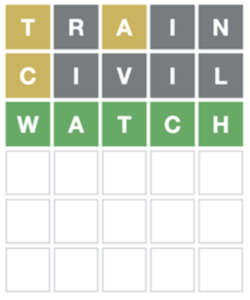
If you’ve been on email, text, or social media in the past couple of months, you’ve undoubtedly seen those ubiquitous green, yellow, and black squares. Maybe someone you know is obsessed with Wordle or, maybe you’re the one obsessed. Or, as it is in my family, everyone is obsessed.

Not familiar with Wordle? It’s a free daily Internet-based game where you get six guesses to figure out a five-letter word. On each turn, you guess a word. A space turns green if the letter is that exact location in the solution, yellow if the letter is in the word but in a different spot, and black if the letter is not in the word at all.

The rules of Wordle and the strategies developed to succeed at it can be applied to numerous situations, including those faced by Federal supervisors.

Your first move is important. Most Wordle players have a favorite first word. For some, it’s RATES, STARE, or another word with the common letters. Others prefer words like AUDIO or ADIEU so they can determine immediately which vowels are in the word.

Supervisors: First moves set the tone in the workplace, too. Your actions (or lack thereof) when first faced with an employee’s poor performance or misconduct send a strong message and set a precedent.

It’s not a secret that accountability is a huge problem in the Federal sector. Each year, the Federal Employee Viewpoint Survey asks employees whether they agree with this statement: In my work unit, steps are taken to deal with a poor performer who cannot or will not improve. Only 42 percent of employees agreed with this statement in the most recent FEVS. Granted, that percentage has risen in recent years. But it’s still a sad statement that 58 percent of employees think supervisors don’t do enough to hold unacceptable performers accountable.

The confidence in managers to take appropriate action on misconduct isn’t much higher. When those problems repeat themselves later (and oh yes, they will), you will curse yourself for not acting earlier.

At FELTG, we’ve heard dozens of stories about managers who overlooked misconduct for months then suddenly decide to address with a suspension or removal. Remember that thing called progressive discipline? If you fail to act on conduct or performance problems, those problems may have well never happened, and you’re starting from scratch.

Don’t let that happen to you. Join us on the afternoons of May 24-25 for our flagship program UnCivil Servant: Holding Employees Accountable for Performance and Conduct.

Old-fashioned pen and paper are still useful. I dislike staring at a phone screen for a long time. However, Wordle sometimes gets particularly challenging. So, I pull out a pen and paper to figure it out. Sometimes seeing the letters in a different format helps to jostle free some solutions.

Supervisors: Going old school will help you jostle free some memories. As FELTG President Deborah Hopkins has pointed out numerous times during sessions and on this website, the cheapest but most valuable investment you can make is the purchase of a notebook.

“It might seem obvious, yet many supervisors don’t take the time to make contemporaneous notes,” Deb wrote. “You might never need them, but you’ll be very glad you have them if the situation calls for evidence in addition to your testimony.”

Everyone plays by the same rules. Not only is there only one Wordle per day, but it’s also the same puzzle for everyone. This is a key to Wordle’s success.

Supervisors: It’s important that agency rules and expectations are shared clearly with everyone. Remember, it’s the agency’s burden when imposing discipline to prove not only that the rule exists, but that the employee knew (or should have known) the rule.

There are several ways to inform employees of a rule, such as bringing it up in a staff meeting, posting to a bulletin board, sending out an email, or covering it during a training session. Or a combination of these options, with the follow-up email ensuring it reaches all employees.

Watch your language. When the New York Times purchased Wordle recently, a newspaper representative promised few, if any, changes with one exception: The Times would be removing offensive words from the game. This includes curse words, as well as sexist and racist terms. For those who like to type the kind of five-letter NSFW terms that make middle schoolers giggle, there’s always Lewdle and Swerdle.

Supervisors: Unless you’re involved in a “robust” discussion with the union, you will be held accountable for your speech. Words matter. And we’re not talking swear words. Beware of biased language. That would be words or phrases that demean or exclude people because of age, sex, race, ethnicity, religion, disability, or other categories.

If you’re scoffing to yourself about “censorship” or “political correctness,” get yourself to one or more of FELTG’s Diversity, Equity, Inclusion, and Accessibility classes. There’s still time to register for today’s Nondiscriminatory Hiring in the Federal Workplace: Advancing Diversity, Equity, Inclusion, and Accessibility or Promoting Diversity, Enforcing Protections for LGBTQ Employees on June 9.

Don’t try something that you already know doesn’t work. The black squares in Wordle denote that the letter you selected is not in the word. So why use another word with that letter again?

Supervisors: The best thing about mistakes is that you learn from them. But, how many times have you found yourself about to follow the same darn process you followed unsuccessfully before?

Here’s an even safer option: Learn from other people’s mistakes. In FELTG training, we like to share mistakes supervisors have made either via our instructors’ own experiences or through legal cases. Perfect example: Reasonable Accommodation: The Mistakes Agencies Make, a 60-minute webinar held on April 21.

You don’t get do-overs. Wordle only offers one puzzle per day. If you fail to get the word in six tries, you feel awful and want to immediately try again. But you’re going to have to wait until the next day for your next chance.

Supervisors: Supervisors are, rightly so, held to a higher standard than line-level employees. It’s right there in the second Douglas factor, which suggests that, when disciplining, agencies consider: The employee’s job level and type of employment, including supervisory or fiduciary role, contacts with the public, and prominence of the position.

Here’s the thing: Unlike Wordle, you may not get another chance the next day. Remember your role, your agency mission and do the best that you can to adequately prepare to handle any challenges that come your way.

Despite being five letters, F-E-L-T-G is an acronym and so it wouldn’t be a solution for Wordle, but we can be a solution for your training needs. [email protected]

By Frank Ferreri, March 15, 2022

As with just about everything employment-related, COVID-19 continues to have a shifting impact on the federal workers’ compensation landscape, with the Office of Workers’ Compensation Programs pivoting in its guidance to meet the demands of a workforce entering its third year of pandemic-related challenges.

In its latest recommendations, issued in mid-February, OWCP focused on continuation of pay and how employees must demonstrate that they had COVID-19 to earn COP. The following chart highlights the agency’s latest updates for when employees file COVID-related claims under the Federal Employees Compensation Act.

Topic OWCP guidance
Establishing a COVID-19 claim To show that she has COVID-19 for purposes of receiving COP, the employee:

1.     Must be diagnosed with COVID-19 via a positive test result – excluding home tests – or a medical professional; and

2.     Within 21 days of diagnosis, must have carried out duties that required contact with patients, members of the public, or coworkers.

Continuation of pay COP is payable if a federal employee must miss time from for isolation after a positive COVID-19 test only if:

1.     The employee can demonstrate she has COVID-19 via a positive test result or a medical professional.

2.     The employee files a CA-1 within 30 days of the last exposure to COVID-19 at work.

Days of COP for isolation for COVID-19 Although OWCP pointed out that the latest CDC recommendations indicate that five days of isolation following a positive test is enough, OWCP will not intervene until the 10-day regulatory timeframe of 20 CFR 10.222 has passed.
Filing a FECA claim without demonstrating positive COVID-19 status If an employee files a FECA claim without evidence of a COVID-19 positive test result or a report from a medical professional within 10 days, OWCP will formally adjudicate the claim and make a determination of COP. If it turns out that OWCP denies the claim, the agency can recover any COP previously paid to the employee.
Employees who don’t have COVID-19 but must quarantine due to exposure OWCP cannot accept a workers’ compensation claim based solely on quarantine or exposure, and COP is not payable solely for quarantine or exposure.
Safety concerns Although COP is not available for quarantine or exposure only, OWCP advised employees and agencies to consider possible safety leave, which can include paid leave, for quarantining purposes.

So, what’s the takeaway? When it comes to OWCP’s current stance regarding workers’ compensation and COVID-19, COP will be available – but only if employees have a positive test that’s not a home test or a report from their doctor indicating they are COVID-19-positive. [email protected]

By Deborah J. Hopkins, March 2, 2022

Late yesterday, while the world was focused on the Ukraine crisis and the country discussed the State of the Union address, the Senate confirmed two individuals to the U.S. Merit Systems Protection Board (the Board) by voice vote: Raymond L. Limon, and Tristan L. Leavitt.

While there was not a vote on the third and final nominee, Cathy Harris, two out of three members still makes a quorum, which means we’ll soon see decisions on the 3,600+ Petitions for Review awaiting action. The Board will have its work cut out for it, as decisions will need to be issued on topics including:

  • Whistleblower reprisal allegations
  • New performance requirements in the wake of Santos v. NASA
  • Challenges to Administrative Judge authority
  • Interpretation of the VA Accountability And Whistleblower Protection Act
  • Pendulum shifts in Executive Orders and OPM regulations

We’ve long said that justice delayed is justice denied, and this Senate action, while long overdue, is an important step in the right direction for all the people impacted by the 5+ year lack of quorum at the MSPB. Stay tuned to FELTG for all the latest information, and join us at the end of the month for MSPB Law Week, where we’ll unpack all the latest information from the new Board. [email protected]

By Dan Gephart, February 22, 2022

What do you want first — the good news or the bad news? The Equal Employment Opportunity Commission’s recent report on older Federal workers offered a little bit of both. Let’s start with the good news. General job satisfaction, perceptions of workplace inclusion and fairness, as well as having your agency EEO Director report directly to the agency head, all lead to a decreased likelihood of having an age discrimination complaint, according to the report conducted by the EEOC’s Office of Federal Operations. Basically, the data is providing a clear path to limiting discrimination complaints at your agency. And following this path will improve your FEVS scores and make your workplace more desirable to current and future employees. Kind of a win-win-win-win.

And there’s more good news. Employees 40 years or older make up 72 percent of the Federal workforce. That’s a whopping 18 percent higher representation than 40-and-up employees in the overall civilian labor force (CLF). Also, the Federal cohort is more diverse than its private sector counterpart.

Now the bad news. The report found a a significant pay disparity between older men and older women in the Federal workforce. The EEOC also found a persistent pay gap between white and Asian Federal employees as compared to other groups of older Federal employees.

Mxolisi Siwatu, PhD, an EEOC Office of Federal Operations (OFO) social scientist research analyst, took time to answer our questions about the report.

DG: Why do you think the 40 and older cohort is better represented in the Federal workplace than the private sector? What do Federal employers do right?

MS: We argued that it is possible that the difference between the private sector and the public sector in EEO performance may be due to greater oversight. The Office of Federal Operations gained increased oversight responsibilities with the introduction of Management Directives 110 (2003), which provides guidance to federal agencies for how to process EEO complaints; and Management Directive 715 (2003), which provides guidance to agencies for how to maintain an EEO program. Also, OFO provides ongoing technical assistance to Federal agencies in support of these directives, which may also contribute. However, it must be noted that this is speculation on the part of the authors and no causal analyses were conducted in the current research.

DG: Men account for 57 percent of the Federal workforce 40 or older, while it is only 45 percent in the private sector. Is there an explanation for that wide gap, and what do you suggest that agencies do differently to narrow that gap?

MS: We did not speculate on why this gap was found. However, OFO conducts technical assistance visits regularly with each Federal agency. During these visits, their participation data are assessed in relation to the CLF. Recommendations are provided to Federal agencies to address any discrepancies observed and progress is monitored thereafter. So, if we note gender disparities, it is addressed with the specific agency.

DG: The report identifies the perception of fairness as a predictor of age discrimination complaints and shares six strategies to achieving that fairness based on research by Jennifer Lee and Ann Smith. What actions can EEO specialists and supervisors take to immediately improve the perception of fairness?

MS: Lee and Smith’s article was written primarily for private sector companies. Many of the strategies identified by Lee and Smith are already practiced in the Federal sector due to guidance derived from MD-110 and MD-715. To drill down to the office or supervisory level, agencies may engage in demonstrated commitment to EEO in a way that is visible and meaningful to their workforces as a way of improving perceptions of fairness.

[Editor’s note: The six strategies identified in the Lee and Smith research are: authorizing workers’ complaints by allowing third parties to advocate on the part of disadvantaged populations and employees; creating enhanced penalties for engaging in discrimination; mandating that employers disclose information to workers about their rights; having strong anti-retaliation laws; expanding liability by placing the burden of proof on the employer; making reporting of employer discrimination data to the public and governing bodies mandatory.]

OFO recommends activities that promote EEO awareness, anti-harassment education for staff and managers, timely complaint processing and resolutions, and having a reporting structure in which the EEO program director reports directly to the agency head. In addition, ongoing monitoring of diversity and inclusion at the agency with respect to hires, promotions, and separations is required. Ongoing commitment and proactive prevention efforts may help promote a climate of EEO among the workforce that encourages lawful treatment, but also confidence in reporting unlawful treatment when appropriate.

[Editor’s note: FELTG offers virtual training events that can help improve your agency’s efforts including:

DG: One of the main findings of the report is the importance of having EEO high up in the reporting structure, most effectively having the EEO Director report directly to the agency head. For those agencies where that’s not the current situation nor likely to be, what advice can you provide for EEO professionals and supervisors?

MS: OFO has been working to encourage all agencies to reorganize their EEO office so that the EEO Director reports directly to the agency head, as required by MD-110. As of FY2019, currently 61 percent of agencies have an EEO Director that reports directly to the agency head. OFO continues the goal of achieving 100 percent compliance among all agencies with this requirement as it remains one of the key priorities during technical assistance visits and audits.

Siwatu did not specifically say whether agencies are making progress on the hiring of a Chief Diversity Officer, as suggested in Executive Order 14035. However, he did say that the EEOC has been an “active participant in the implementation” of the EO and the goal is to have the CDO and EEO Director positions “complement one another to meet the Administration’s broad equity goals.” [email protected]

By Deborah Hopkins, February 15, 2022

Many agencies are in the process of hiring new employees, keeping in mind that the workforce should represent all of America, including traditionally underserved populations.

President Biden’s recent announcement that his pick for the Supreme Court would be an African American woman has also raised questions about what is and is not permitted in the hiring process within the Federal government – something we’ll be tackling in the March 16 virtual training event Nondiscriminatory Hiring in the Federal Workplace. As we await this important event, I wanted to share three items to consider if you’re involved in the hiring process in any way.

  1. Sometimes it is legal to hire someone because of their sex.

Occasionally, a person’s sex can legally be a bona fide occupational qualification (BFOQ). While this only applies in very limited circumstances, agencies can set this requirement if there is a legitimate, business-based reason. See, e.g., Dewey R. v. DOJ, EEOC App. No. 0120142308 (May 20, 2016) (sex was a BFOQ for a correctional officer position that required performing strip searches on female inmates).

  1. It is illegal to refuse to hire someone because of their sexual orientation.

While this has been the law in the Federal government since the July 2015 decision Baldwin v. Secretary of Transportation, EEOC Appeal No. 0120133080, it became law for the rest of the country in the June 2020 Supreme Court decision Bostock v. Clayton County, 140 S. Ct. 1731.

As I say in many classes, just because a law exists doesn’t mean everyone follows it. In a recent EEOC decision, a complainant was discriminated against based on his sexual orientation when he was not hired for an Assistant Fire Operations Supervisor. While the agency claimed non-discriminatory reasons for the nonselection, EEOC found these reasons were pretextual.

For example, the complainant was ranked as the top candidate among seven after a selection panel recommended individuals to hire. However, one of the supervisors involved in the hiring process decided to expand the field to 12 candidates and changed the weight that references held. That supervisor also did not contact any of the references the complainant provided. As a result, the complainant dropped from the top spot to eighth on the list and was not given a second interview. EEOC found this discrimination was motivated by the complainant’s sexual orientation.  Bart M. v. Interior, EEOC Appeal No. 0120160543 (Jan. 14, 2021).

  1. Sometimes, the complainant doesn’t even need to apply for the job in order to state a claim of discrimination in the hiring process.

While you might think that applying for a job is a prerequisite to claiming discriminatory nonselection, there are always exceptions. A complainant need not establish that he applied for a job as an element of a prima facie case if he can show that he was actively discouraged by management from applying for the job in the first place, and that discouragement was tied to or motivated by the complainant’s protected EEO category or EEO activity. See O’Connor v. Secretary of Veterans Affairs, EEOC Appeal No. 0120112072 (2011).

We’ve got plenty more, which we’ll be sharing with you in this space and in our upcoming training sessions. We hope to see you there. [email protected].

By Dan Gephart, February 15, 2022

Within 24 hours of receiving an unwelcome picture of a sexual nature from a coworker, EMT Andrea Vasquez was fired.

For sexual harassment.

How does something like that happen?

Vasquez v. Express Ambulance Service, 835 F.3d 267 (2d Cir. 2016) is a private sector case. And it’s a few years old now. Yet, it vividly illustrates what happens when an employer relies on evidence of questionable validity. Vasquez is also an example of lazy investigation and victim-blaming. It is one of many cases that will be discussed during  Workplace Investigations Week. The virtual training event runs from February 28-March 4, and will focus on employee misconduct, including workplace harassment.

Here are the details:

Ambulance dispatcher Tyrell Gray flirted regularly with Vasquez. This included touching her shoulders, putting his arm around her, and asking her out. Vasquez regularly rebuffed Gray’s advances. One night, Vasquez reminded Gray that she had a boyfriend. Gray told her that he “could make her leave her man” and promised to send her something during her shift.

Common parlance for what Gray sent Vasquez is as crude as the actual action – a naked picture that made famous people like Brett Favre and Anthony Weiner infamous. Gray captioned the photo with “Wat u think?”

When her shift ended, Vasquez reported the photo incident to her supervisor, who told her to file a complaint right away. Gray saw a visibly shaken Vasquez filling out paperwork and surmised that she was reporting him. He left the room and asked a coworker to lie to supervisors that Vasquez and Gray had a romantic relationship. The coworker declined, and Gray left the building.

Vasquez filed the report. An HR official and supervisor thanked her and assured her that they won’t tolerate this behavior and that they would “sort the situation out.” Vasquez offered to show them the phone messages, but they declined.

The employer’s response sounds reasonable so far, right? Not so fast.

Gray altered a text chain with another woman to make it look like he and Vasquez were having a romantic relationship, and then provided copies of that altered text chain to a supervisor to “prove” that he and Vasquez were dating.

By the time Vasquez was to meet with a committee that included a union rep, the HR official, and the owner of the company, Gray’s “evidence” had already been considered, and Vasquez was told that that she had been terminated for having an “inappropriate sexual relationship” with Gray.

The investigation was certainly prompt, though it was clearly far from effective. What can agencies learn from this debacle? Here are a few points to consider:

  • Gather sufficient evidence to establish uncontested facts in case. How was reviewing the alleged harasser’s text messages consider sufficient, while refusing to review the complainant’s phone?
  • Gather as much evidence as possible on contested facts so the fact finder can reasonably draw conclusions. Beyond looking only at the alleged harasser’s text chain, why was the coworker asked to lie not interviewed?
  • Consider the reliability of the evidence. The fact that the alleged harasser just happened to have photocopies of amorous email exchanges on the very morning that he’s accused of harassment should have been important to the fact finder in drawing conclusions.

And remember this: Failure to appropriately investigate claims of harassment will come back to bite you.

Vasquez filed a retaliation complaint. Although a district court granted Express Ambulance Service’s motion to dismiss, the Second Circuit Court of Appeals reversed that decision.

In its decision, the court wrote:

“Although Vasquez does not use the term “negligence” in her complaint, we conclude that she has pled facts from which a reasonable person could infer that Empress knew or should have known that Gray’s accusations were the product of retaliatory intent and thus should not have been trusted.”

What can be trusted is FELTG training. We hope to see you later this month at Workplace Investigations Week. [email protected]

By Ann Boehm, February 15, 2022

Communication in 2022 is dominated by Twitter, which limits users to 280 characters per Tweet. Online news organizations provide news feeds specifying number of words and expected reading time. Brevity is so important that online news organization, Axios, has trademarked and is marketing the concept of “Smart Brevity.”

So FELTG friends, stop writing such long discipline documents!!!

No one wants to read a 10-, 15-, or heaven forbid, 25-page proposal to remove or suspend.

Why do managers, employee relations specialists, and attorneys write such long documents? Probably because of fear. The fear is unjustified.

Writers of documents with legal implications believe that providing more words will protect in the event of a lawsuit. In reality, more words are likely to prove detrimental.

We write the way we talk, and in oral communication, silence is uncomfortable. Writing becomes excessive because of unnecessary space fillers — comfort words. Learn to recognize those and cut them! Examples: therefore; essentially; literally (I hope you don’t use that, but suspect you may); henceforth, the, that, etc. Writing is not the same as speaking.

We also worry that failing to cover every possible detail will hurt our case. Judges are guilty of this. Long decisions prevail. If you asked judges, though, they probably prefer to read shorter documents from litigants.

The challenge to concise writing is knowing what is important to the reader. I imagine news organizations now providing word counts and reading times had to adjust to the societal desire for brevity. But reading these news feeds provides the information you need to know without the fluff. People love it!

I challenge you to read the now-prevalent shortened communications. Note how effectively people on Twitter communicate with 280 characters. Pay attention to how news feeds highlight critical information.

Next, apply what you learn to your writing. Resist long factual narratives and put relevant factual information in specifications supporting charges. Trust me. Try it. You will be amazed.

Then, edit your documents. Cut out extra words. Read for what matters. Take out what does not. This takes confidence. The benefits will be significant. You will save time and energy for all subsequent readers. Those readers are likely decision-makers. They will see points concisely and cogently and will not get mired in extraneous details.

This will be an adjustment. It will take confidence. It will improve the discipline process. And that’s good news! [email protected]

[Ann’s note: The original version of this article had 491 words. After editing, it has 396 words. You didn’t miss a thing!]

For more on drafting disciplinary documents join FELTG for MSPB Law Week March 28-April 1, 2022. 

By Barbara Haga, February 15, 2022

In August 2020, I wrote about a case involving an HR official who sent racists texts about other employees to subordinates, which the subordinates reported. Jenkins v. Department of Transportation, No. 2019-2075 (Fed. Cir. Aug. 6, 2020).

Jenkins, the HR official, was removed for (1) inappropriate conduct, (2) making disparaging remarks racial in nature, and (3) lack of candor. The Federal Circuit upheld the charges and the removal.

Jenkins had made several attempts to avoid responsibility. For example, her initial response was that she didn’t send the texts, then she said she didn’t remember sending them, and finally she argued that the texts were sent from her personal phone and, thus, not the agency’s business. None of these attempts worked.

I didn’t think I would be shocked by this kind of HR practitioner lack of candor again, but I recently found a case that I missed in the weekly MSPB report that summer, because this one was issued the very next day. The case is Freeland v. Department of Homeland Security, No. 2020-1344 (Fed. Cir. Aug. 7, 2020).  Before we get to the lack of candor charge, let’s look at the hiring of this individual by DHS.

Freeland’s Story

Freeland was removed in 2017 from the position of Supervisory Human Resources Specialist in the Recruitment and Placement Branch of a DHS Human Resources Operations Center.  Supervisory staffing positions would typically be concerned with ensuring that appointees are qualified for the jobs they are placed in, and that the required drug tests, physicals, and background checks are completed. Basically, their job is to ensure that the recruitment process is carried out properly and that appointments are legal.

Prior to working for DHS, Freeland had held the same type of position at an Army Civilian Human Resources organization. He resigned in May 2015 after he was issued a proposed 14-day suspension for negligent performance of duties. At the time of his resignation, he was also the subject of a workplace sexual harassment investigation. DHS brought Freeland to work on Sept. 20, 2015. Yes, that’s right. They hired a supervisory HR specialist four months after he resigned from another supervisory HR specialist position. His SF-50 stated that he gave no reason for resignation.

Given what transpired with his security paperwork, which led to the lack of candor charge, it seems that DHS hired Freeland without knowing about the prior issues.

I regularly teach classes on interviewing and reference checking. It’s important. You don’t need to bring another agency’s problem child onto your rolls. Freeland’s recent work history should have been a flashing red light to anyone looking at his resume.  He resigned with no reason given.

That’s Strange

A staffing specialist resigns with no reason given? That’s strange. He applies very quickly to come back to the government in a similar position? That’s strange.

Federal employees and staffing folks who understand what it takes to get back onto the Federal rolls from the outside, don’t resign. They apply for reassignments and transfers and promotions.

Did DHS interview Freeland? I would have asked what his reason was for resigning since none was given. He didn’t have to answer. He might have made up some story, but I would ask. I would also routinely ask:

  • Have you been the subject of any sort of performance counseling in the past appraisal cycle? If so, what was the outcome of the counseling?
  • Have you been questioned and/or counseled by your supervisor about any type of disciplinary infraction in the past year? If so, what was the outcome?

Suggested Questions

If I am interviewing for a supervisory position, I would ask something like, “If I contacted your supervisor and asked about your three major accomplishments in your supervisory position, what would he or she say?” I would let Freeland know that I was going to follow up on these issues with his past supervisor.

If he said I couldn’t contact his last supervisor? I would tell him that it’s highly unlikely he would fare well in the rest of the process if I could not validate the information he provided. If he didn’t give permission, I would be very unlikely to hire him.

It’s important to follow up on these questions. In this case, Freeland’s selecting official should be an even higher-level supervisor in HR so he/she/they should have known that an in-depth reference check was needed.

Freeland’s Army supervisor should have been asked the same things.

  • The SF-50 provided doesn’t give a reason for Freeland’s resignation. Are you aware of a reason? (Remember there is no settlement here, so the agency wasn’t prohibited from releasing information by terms of a contract.)
  • Did you counsel Freeland about any type of performance deficiencies in the past appraisal cycle? What happened as a result?
  • Did you have occasion to question or counsel Freeland about a disciplinary matter in the past year? What was the outcome of that?
  • What were the three most important contributions Freeland made as a supervisor?

One of my final questions would be: “If Freeland was eligible for a promotion and you had a vacant job at the higher grade that you could put him in today, would you?” Unless that Army supervisor (who is also an HR Specialist) is a seasoned prevaricator, you are likely to get him/ her/them to spill the beans during the conversation.

Freeland was issued a 14-day suspension notice on negligent performance of duties. We don’t know whether this was negligence related to his staffing/recruitment duties or his supervisory functions, but I think using the in-depth questions I described might get you to a point where you figure out that something isn’t right. As far as the sexual harassment investigation, there may have been no conclusions from that at the time he departed his Army job, but that could have come later. (I will do a column on annotating investigations per provisions included in the NDAA for FY 2017 in the near future.)

I was working with a supervisor on a GS-14 performance plan a week ago, and he was complaining that he had picked up a problem employee from another agency. He was upset with the losing supervisor. He said, “I did a reference check, and that person didn’t tell me the truth.” I knew he was frustrated. It didn’t change anything we were doing, so I didn’t press the issue, but I really wanted to know what questions he asked.

Did he ask, “Is this person reliable?” The answer could be yes. The work is barely acceptable, but they always turn something in on time.

Did he ask, “Is the person regular in their attendance?” The answer could also be yes. The person is always there, but they don’t do much when they are there. The losing supervisor might technically have answered what she was asked truthfully.

Without getting into in-depth areas like the questions described above, your selecting officials may not find out about issues that would cause them to move on to another candidate.

Next month, we will look at what happened once Freeland was brought on board.

[Editor’s note: Would you like to bring Barbara Haga’s Successful Hiring: Effective Techniques for Interviewing and Reference Checking to your agency, either on-site or virtually? contact Training Director Dan Gephart at [email protected].]