By Deborah Hopkins, June 13, 2022

The MSPB is operating on all levels once again, now that the third and final nominee, Cathy Harris, was sworn in at the beginning of the month. There have, as of this writing, only been 15 precedential decisions issued by the new Board, but we’ve seen dozens of non-precedential (NP) decisions in the past three months.

According to MSPB:

“A non-precedential order is one that the Board has determined does not add significantly to the body of MSPB case law. Parties may cite non-precedential orders, but such orders have no precedential value; the Board and administrative judges are not required to follow or distinguish them in any future decisions. In contrast, a precedential decision issued as an Opinion and Order has been identified by the Board as significantly contributing to the Board’s case law.” See 5 C.F.R. § 1201.117(c).

Despite their NP status, I have found some new lessons in these decisions. One such case that seems consequential to me is Purifoy v. VA, CH-0752-14-0185-M-1 (May 16, 2022)(NP). Take a look at this procedural history:

  • Employee was fired for AWOL (October 2013)
  • AJ mitigated the removal to a 40-day suspension (November 2014)
  • On PFR, the MSPB reinstated the removal (June 2015)
  • On appeal, the Federal Circuit remanded the case back to the MSPB for an independent Douglas analysis (October 2016)
  • Remand goes in the pile that would eventually become a 3,600+-case backlog, and eventually MSPB’s O & O reinstated the removal (May 2022)

If the second to last bullet point made you pause, you aren’t the only one. Ever since the MSPB started operating in 1979, the discipline process has worked like this:

  1. The agency drafts the charge and selects the penalty.
  2. The Board reviews the agency’s penalty determination for reasonableness.

I can’t recall a time when the Federal Circuit ordered the Board to do its own penalty assessment. (That’s not to say it hasn’t happened – but if it has, I don’t recall. And this is certainly a first for THIS Board.) As we have taught in MSPB Law Week for 20-plus years, the Board must give due weight to the agency’s discretion in exercising the managerial function of maintaining employee discipline and efficiency. The Board’s function is not to displace management’s responsibility but to assure that managerial judgment has been properly exercised within the tolerable limits of reasonableness.

So here we are. A bit more on the facts of this case. The employee, Lamonte Purifoy, was employed by DVA as a WG-2 Housekeeping Aid. He was jailed for six months due to drug use, and the VA fired him based on two charges:

  1. Two days of AWOL
  2. Six subsequent months of AWOL while in jail

On appeal, the AJ held that only 38 days of Charge 2 warranted AWOL. As the severity of the Charge 2 was reduced and because the AJ believed the employee showed a potential for rehabilitation, the AJ mitigated the removal to a 40-day suspension. On PFR the MSPB reversed the AJ’s mitigation and reinstated the removal, as it found the appellant did not demonstrate a high degree of rehabilitation potential.

Upon its review of the case the Federal Circuit decided that the Board members erred by not evaluating Douglas factor 12: “The adequacy and effectiveness of alternative sanctions to deter such conduct in the future,” although the AJ had done so, thus the basis of the remand.

In its assessment on remand, the Board looked at the Proposing Official’s testimony which said that he would object to the appellant returning to the workplace because of the negative precedent such an action would set. In addition, the Board was compelled by the Deciding Official’s testimony about deterring similar misconduct by other employees, and the message that imposing a lesser penalty would send. Therefore, this factor supported reinstating the removal penalty.

I talked with Bill Wiley, one of FELTG’s Founding Fathers, about this case and he had some insight about the Board’s decision and its assessment of Douglas factor 12: “When defending a removal penalty, be sure to state what harm would occur if the employee was returned to or remained in the workplace. Often, it can be said truthfully that anything less than removal would send a negative message to other employees. If the employee was disruptive in the workplace before removal, it would be reasonable to predict he would be disruptive if he was reinstated or retained.”

The Board also weighed in on the other Douglas factors. So, while Purifoy is an NP case, it gives us factor-by-factor information on how this new Board views the Douglas assessment. And if you understand the Board’s reasoning in Purifoy, you will be able to better defend the agency’s penalty selection for years into the future.

For more on this and other lessons from the Board, join FELTG for the virtual training Back on Board: Keeping Up with the New MSPB, July 20. [email protected]

By Dan Gephart, June 6, 2022

Tristan Leavitt, Member, Merit Systems Protection Board

When And Now a Word With … last talked with Tristan Leavitt, the word “corona” evoked visions of a weak mass-produced beer not a virus that would eventually take the lives of more than a million Americans. And the Merit Systems Protection Board was in the seventh month of sitting member-less, following the expiration of former Chair Mark Robbins’ term.

As then-General Counsel of the MSPB, Leavitt had assumed the responsibilities for the executive and administrative functions usually vested in the Chair. Over the next couple of years, Leavitt and a dedicated group of agency staff steered the MSPB through its most challenging period.

Three months ago, Leavitt and Raymond Limon were confirmed and sworn in as Members, ensuring a quorum for the first time in more than five years. And now, the backlog of Petitions for Review that we all watched steadily are being addressed. New MSPB Chair Cathy Harris was finally confirmed by the Senate late last month, so the MSPB is back at full strength for the first time in over half a decade.

Like Vice Chair Limon recently, Leavitt very graciously took time to answer our questions, giving us a peek into the new Board’s approach.

 DG: Are you satisfied with the current pace with which you and Acting Chair Limon are tackling the backlog of cases?

TL: I think we’ve made a decent start.  Both he and I have fantastic staff, and I’ve really appreciated how smoothly our two offices have been able to work together.  That said, no matter how fast we move, we recognize that the backlog represents over 3,000 appellants and their agencies awaiting finality, so I doubt we’ll ever shake the sense of urgency that we look for ways to be more efficient.

DG: It appears you are prioritizing whistleblower cases. Is that so and why?

TL: Way back in October 2019 I mentioned in this same forum that MSPB’s career staff had drawn up plans for dealing with the backlog.  Primarily, that consisted of identifying a “priority group” of 300 cases as a first group for an incoming Board to address.  The group included a mix of all types of cases: easy cases to help new Board members acclimatize, cases dismissed as settled, precedential cases on which a number of other cases hinge, extremely old cases, cases potentially involving large amounts of backpay, etc.  When Ray and I were confirmed, we adopted the recommendation of staff and began working through the priority group of cases.  Given that whistleblower reprisal allegations are raised in some 25 percent of all cases before the Board, it’s not surprising that the group has included a number of whistleblower cases, some of them precedential.

DG: Are you planning to prioritize any other types of cases? 

TL: Since the creation of the first priority group, MSPB staff have developed second and third priority groups that are also approximately 300 cases each.  Beyond those groups, we haven’t yet developed a comprehensive strategy for how we intend to deal with the rest of the approximately 2,700 cases in the backlog.  To some extent, I would say that’s because we’ve been in an acclimation period, particularly since Ray is new to MSPB, and to some extent it’s probably also because it’s unclear how close we might be to the confirmation of a third Board member. Nevertheless, by the time we’ve worked through the priority groups there will have to be decisions made about where to go next in the backlog, and I would imagine we’d be well equipped at that point to develop a strategy.

DG: You’ve decided to keep the non-precedential cases and while most are 1-2 pages, others are much longer. Can you explain your approach to NP cases? 

TL: As Ray noted here recently, MSPB staff have already drafted recommended decisions for approximately 3,400 of the 3,600-case backlog, and those were generally drafted under the procedures in use when last the Board had a quorum.  While Ray and I have exchanged proposed edits with one another in cases or sent a handful back to the career staff for particularly involved revisions, I think it’s fair to say that thus far we’ve mostly just worked with the case formats and lengths presented to us by the career staff.  As a general matter, I would say the most abbreviated non-precedential orders tend to come in cases where it seems very clear to us there is no jurisdiction or where the administrative judge adequately addressed in the initial decision all relevant issues.

DG: Why has the board talked about likely resuming reissuing short form decisions again?

TL: There has been discussion about how much time could be saved by reverting to true short form decisions, particularly for the types of cases I mentioned above that are only receiving abbreviated orders anyway.  On the other hand, drafting a very brief opinion doesn’t seem to be particularly arduous, especially since the shortest already tend to simply state the issue in question and articulate the Board’s standard for granting petitions for review.  As I mentioned before, there are a number of decisions to be made that we’ve postponed until we could get our feet wet by working through the priority groups, and my guess would be that this is one of those issues.  If we did decide to revert to short form decisions, I’d imagine it would be implemented with newer cases coming in for which recommended decisions haven’t yet been drafted.

DG: There was a lot of focus and attention on that backlog of cases, but how else has the presence of a quorum positively impacted the agency? 

TL: The restoration of a quorum is certainly beneficial to agency morale, as all of MSPB’s committed staff are eager to fulfill the full scope of the agency’s important mission.  The Office of Policy and Evaluation’s research agenda can now be finalized, and the full version of its studies issued moving forward.  MSPB can also update its regulations, which is long overdue in some instances.  Finally, while it only requires one Board member and not a full quorum, having gone from no Board members to two also reopens the door to issuing stays requested by the Office of Special Counsel in prohibited personnel practice cases.

DG: What is the status of the agency’s plans for returning employees to the physical workplace?

TL: I largely haven’t been involved on this topic since handing agency head responsibilities over to Ray. However, as far as I’m aware most employees have resumed reentering the workplace at least some days of the week.

Leavitt noted that even pre-pandemic, the MSPB had a relatively high telework rate compared to other agencies. [email protected]

[Editor’s note: How is the Board ruling in these decisions? Join FELTG President Deborah Hopkins for the two-hour virtual training Back on Board: Keeping up With the New MSPB on July 20, starting at 1 pm ET.]

By Deborah Hopkins, May 31, 2022

When an employee is too ill to come to work on a regular basis, it puts the agency in a difficult position: wanting to work with the employee and grant leave in hopes they will eventually recover, but also needing someone to complete the job tasks on a regular basis. In some cases, the amount of leave the agency grants becomes problematic and the agency needs the employee to return to duty.

Generally, an agency cannot take an adverse action for approved absences – and that makes sense. After all, the agency grants the leave, or else the employee has an entitlement to the leave. However, an agency may remove an employee for excessive absence if the agency proves the Cook criteria, as identified in Cook v. Army, 18 M.S.P.R. 610 (1984):

  1. The employee was absent for compelling reasons beyond his control;
  2. The absences continued beyond a reasonable time and the agency warned the employee that an adverse action would be taken unless the employee became available for duty on a regular basis; and
  3. The position needed to be filled by an employee available for duty on a regular basis.

A recent MSPB decision, Robinette v. Army, AT-0752-16-0633-I-1 (May 11, 2022)(NP), reminds us the Cook criteria are requirements, not suggestions. The decision reinforces that the Board cannot uphold a removal if the agency does not comply with all three elements in the Cook criteria.

In Robinette, the agency issued the appellant a Notice of Leave Restriction on Feb. 17, 2015, which informed him that his chronic, unscheduled absences were considered excessive and negatively affected the agency’s ability to accomplish its mission.

On May 18, 2016, the agency issued a Notice of Proposed Removal for “excessive absenteeism,” which specified that from Feb. 21, 2015, through April 16, 2016, he was absent 939.3 hours out of a total of 2103.7 available duty hours (almost 45%). The agency removed the employee on June 24, 2016, and he filed an appeal to the MSPB.

In the initial decision, the administrative judge (AJ) found the agency’s action was properly predicated upon approved leave, including annual leave, sick leave, and Leave Without Pay, but that the Leave Restriction Letter did not meet the second element of the Cook criteria; it did not inform the employee his approved absences could lead to removal if he did not become available on a regular basis. So, the AJ reversed the removal.

On Petition for Review, the agency argued that it had suspended the employee in November 2014 and April 2015 for “failure to follow proper leave procedures” and that the statement in the decision letters “[y]ou are cautioned [that] any repetition of this or similar offenses may result in more severe disciplinary action against you” met element 2 of the Cook criteria. Because neither decision letter was part of the record, the Board refused to consider anything except the February 2015 Leave Restriction Letter, which the Board also found did not meet the second Cook requirement.

Excessive absence removals are highly technical. Reading this case reminded me of a VA case from a few years ago where the agency’s removal was reversed because the warning letter told the employee that if he did not return to work, he would be disciplined, but it did not say that continued absence on approved leave would warrant his removal. Miles v. DVA, CH-0752-14-0374-I-2 (May 17, 2016)(ID).

As we teach in all our classes, words matter. For more on this and other leave-related challenges, join us virtually for Absence, Leave Abuse & Medical Issues Week, June 13-17. [email protected]

By Deborah Hopkins, May 16, 2022

Every now and then, a supervisor in one of my classes will ask if they have a right to file an EEO complaint alleging harassment by a subordinate employee. I’ll tell them yes, they do have that right. I also tell them handling the harassment as a conduct issue is a much quicker process that yields rapid results and allows the supervisor to avoid the EEO complaint process entirely, if they prefer not to file.
How so, you might wonder?

Well, a supervisor who believes a subordinate is harassing him must simply set a rule of conduct (for example, do not refer to me as a “f*g” or “f*ggot”), and then discipline the employee if she violates the rule. [Note: We are using asterisks so that your agency’s firewall won’t block you from receiving this message. We recommend NOT using asterisks in establishing rules of conduct, reports of investigation, disciplinary letters, or other official agency documents.]

A few days ago, I came across a fairly recent EEO decision where a supervisory health system specialist at an IHS medical facility alleged harassment based on sexual orientation. The harassment was coming from a subordinate. The agency FAD acknowledged unwelcome conduct but said the conduct was not sufficiently severe or pervasive, and the complainant failed to take advantage of a key corrective opportunity provided by the agency.

The complainant was the employee’s supervisor and he did not discipline the employee for the conduct. The complainant appealed the FAD to the EEOC.

The EEOC reversed the FAD and found the agency liable for hostile work environment harassment.

Here are relevant details from the case:

  • Over a 21-month period, the employee engaged in at least nine incidents of harassment based on the complainant’s sexual orientation, including multiple uses of the words “f*g” and “f*ggot.”
  • Seven of these incidents included comments made to other agency staff or directly to, or within earshot of, at least four agency management officials. Examples of the employee’s comments included:
    • “If they want to pay me for fighting with a f*g all day, then I guess that is what I will do.”
    • “I hate [Complainant], that f*cking f*ggot!’”
    • “I have the ear of the Area Director and I am going to report your f*ggot *ss and everyone in this clinic for everything that is going on in this clinic.”
  • The complainant’s immediate supervisor, the CEO, informed him that the employee had been making derogatory comments about the complainant’s sexual orientation directly to the CEO. When the complainant questioned whether the CEO had taken corrective action, the CEO said that she had admonished the employee, and referred the complainant to the EEO Complaint process for next steps. The CEO admitted she did not discipline the employee who engaged in the harassing conduct because “she did not feel that it would be appropriate to interject herself …” into the situation.
  • The complainant said that he made multiple attempts to discipline the employee, but that the discipline was returned to him. The agency did not present a rebuttal to this statement.

Taking these facts into consideration, the Commission found a hostile work environment based on sexual orientation. It attributed liability to the agency because management officials did not take prompt and effective action once they became aware of the employee’s conduct. The Commission said it was improper for the agency to place the onus on the complainant to discipline the employee or file an EEO complaint, and further stated:

We remind the Agency that the EEO process is not a substitute for the Agency’s internal process. Moreover, we find that the inadequate responses from Complainant’s chain of command likely emboldened [the employee] to continue harassing Complainant, diminished his authority as her supervisor, and heightened the severity of the alleged incidents. Debbra R. v. Dep’t of Veterans Affairs, EEOC Appeal No. 0120161305 (Jul. 26, 2016) (finding that when harassment is repeated, a supervisor’s failure to respond to instances of alleged harassment heightens the severity of the alleged act). As such, we find that [the employee]’s actions unreasonably interfered with Complainant’s work environment and management officials failed to take prompt and effective action.

Foster B. v. IHS, EEOC Appeal No. 2019005682 (Apr. 12, 2021).

The case didn’t discuss anything about the returned discipline the complainant alleged, and I can’t help but wonder if that was a deciding factor in the Commission’s decision. One thing is for sure, a lesson learned from this case: Any agency management official who has knowledge of harassing conduct has an obligation to take prompt, effective corrective action – even if the harasser is not in that person’s chain of command. A failure to act can cause agency liability, and potentially immeasurable harm to the victim.

To learn about making the Federal workplace a welcome and inclusive environment, join us on June 9 for Promoting Diversity, Enforcing Protections for LGBTQ Employees. [email protected]


By Barbara Haga, May 16, 2022

In supervisory training classes, I have heard participants comment about a double standard for corrective action. In essence, they said that if a non-supervisory employee messed up and violated some conduct rule, he would be hammered, but if it was a higher-level manager, it would be swept under the rug.

My usual response is that’s not true, which is based on my own experience. I could rattle off specifics regarding some of the cases I worked on myself or have studied thoroughly. I usually make a comment along the lines of “the bigger they are, the easier they fall,” since the Douglas factors take into account the type of position held. Also, managers are held to a higher standard.

I was reviewing decisions issued by the newly comprised Board and I was struck by the fact that several involved those high-level officials. The decision I am writing about this month particularly caught my attention because:

  1. The charge of conduct unbecoming is one I have written about more than once.
  2. Some of the specifications involved thorny actions for which it’s debatable whether they were removal-worthy misbehavior.

It is a non-precedential decision, but helpful for understanding where the lines can be drawn.

The Initial Decision

The case is Hornsby v. FHFA, DC-0752-15-0576-I-2 (April 28, 2022). [Editor’s note: Read about FELTG President Deborah Hopkins’ recent take on Hornsby.]

This was an appeal from an action that took place in 2015. Hornsby was the Chief Operating Officer for the Federal Housing Financing Administration. He was removed for conduct unbecoming, including 18 specifications.

Four of the specifications were threats. One was: “I can understand how someone could go postal. If I decide to take myself out, I will walk into Ed DeMarco’s (Former Acting Agency Director’s) office and blow his brains out and then kill myself.”

The AJ did not sustain these four specifications based on her credibility findings. This was a “he said – he said” issue. The other party was the HR Director who was subordinate to the appellant. The AJ found the appellant’s version of what he had said and done at least as credible as the HR Director’s version. The Board did not disturb the AJ’s credibility findings on these specifications.

The AJ also did not sustain the remaining specifications, which included the appellant engaging in the following actions:

  • In a meeting, he placed his hand over the mouth of the project director for the National Mortgage Database to silence him from making further comments.
  • He told two agency attorneys that a memorandum they had drafted discussing agency liability regarding data breaches might be a “career ender.”
  • On unspecified occasions when he was dissatisfied with one or more HR employees, he told the HR Director that he would outsource the HR function. Specification 13 involved saying the same thing about the Contracting Operations group.
  • He lost his composure in an HR meeting and expressed a desire to fire anyone who had complained about him.
  • He asked the HR Director to go to the former acting director and ask him to raise his Level 3 rating so that he could get an executive bonus.

The AJ found six of the specifications in this group weren’t supported with sufficient evidence. For the remaining eight specifications, the AJ found discipline wasn’t reasonable. The AJ accepted the explanation regarding the incident with the mouth-covering and determined the person with the covered mouth was a friend and he was protecting him by stopping him from talking. The AJ found that the statement about ending one’s career with a particular legal position was simply not unbecoming.

After reading all of this, I couldn’t help but think what it would be like to work in an organization whether this person would have been my second-level supervisor. I’ve worked in a situation where the person superior to the HR Director didn’t know much about how HR should work, knew very little about ER/LR, and might have made decisions that I didn’t agree with, but I have never been in a situation where that individual was threatening or malicious. I think it would make it very hard to go to work every day with optimism about what you could accomplish or the future of your program or your agency — or yourself.

The Board’s Decision

The Board reinstated the removal. Among other rulings, the Board found that even though the subordinate wasn’t offended, a manager putting his hand over an employee’s mouth in a meeting was improper and unsuitable. The Board also found the “career ender” remark was intimidating. It upheld that specification.

Regarding the specification about asking the subordinate to intervene regarding the appellant’s appraisal, the Board stated, “We find that it was improper for the appellant to do so. As previously noted, the appellant was the HR Director’s immediate supervisor. Thus, in making this request, the appellant was placing the HR Director in the untenable position of either refusing his supervisor’s request or negotiating with his former second-level supervisor for a better performance rating for his supervisor.”

The ruling on the penalty is worth reading. Many of the things cited are bad behavior that many of us may have seen in our careers. Any one of those things alone might not support significant discipline.  However, when taken together, they show a manager not operating appropriately in that role.  Only 5 of the 18 specifications were sustained. However, in the words of the Board, several of them were serious or highly serious.

Noting that Hornsby was a high-ranking supervisor who occupied a position of trust and responsibility, they found it appropriate for him to be held to a higher standard.  The Board concluded:

“Although the agency failed to establish much of the specific misconduct, the specifications we do sustain are without question quite serious. Thus, based on the specific facts of this case and the proven level of impropriety, we find that the agency’s chosen penalty is within the parameters of reasonableness and that the sustained specifications warrant removal.”

By Ann Boehm, May 16, 2022

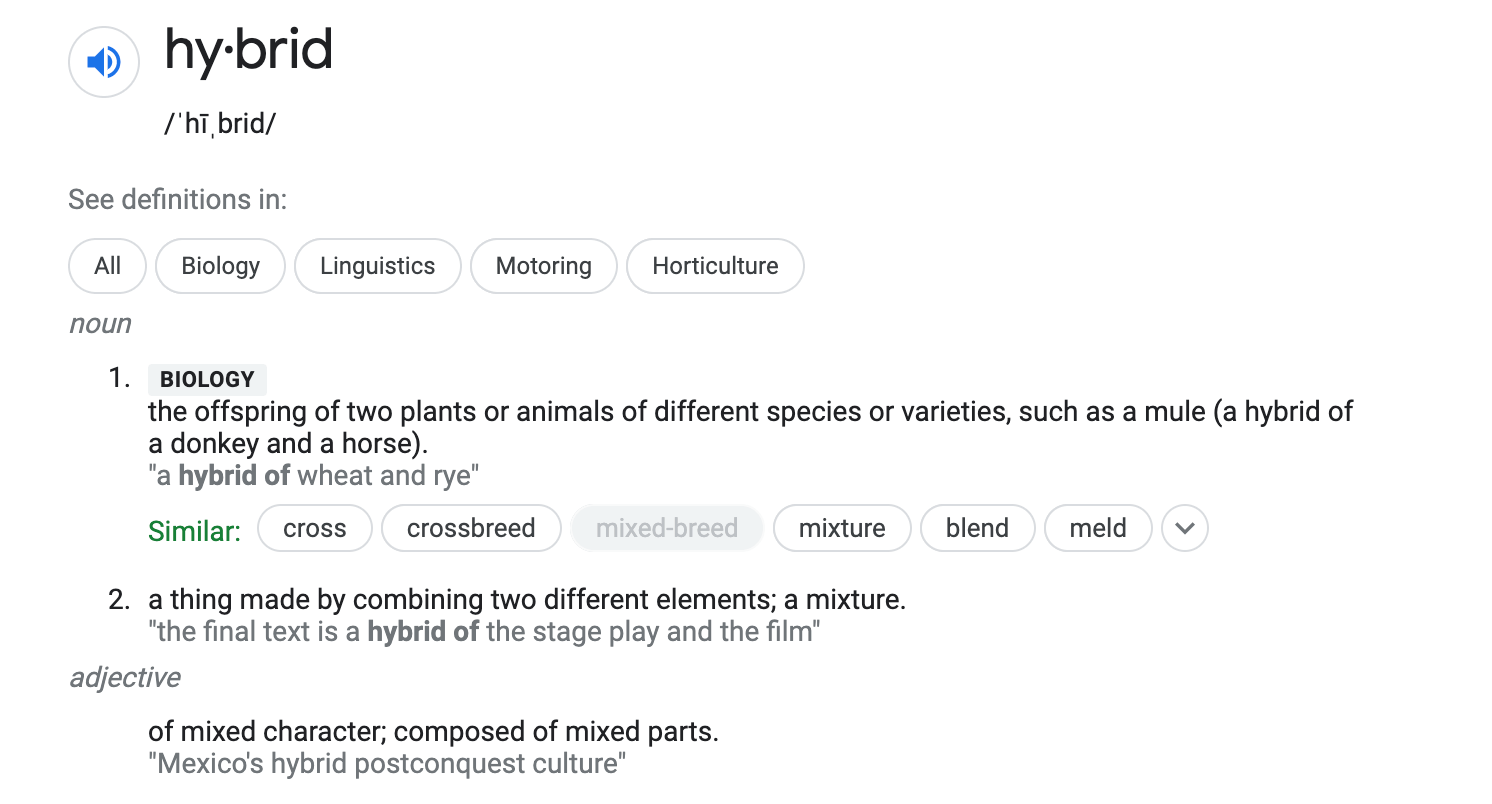
I’m predicting it now. The Merriam-Webster word of 2022 will be “hybrid.” I could be wrong. They may choose “inflation.” But I’m an employment lawyer, so I’m going with “hybrid.”

In case you don’t pay attention to the Merriam-Webster word of the year, I’ll relay that the word of 2021 was “vaccine.” In 2020, it was “pandemic.” Seems logical to me, given the theme of the past two years, that “hybrid” will win in 2022.

Why “hybrid”? It’s the post-pandemic workplace dynamic being utilized by most employers in 2022. Employers are requiring employees to come to the office X days per week, and work from home X days per week. Or month. Or whatever. It’s like trying to have your cake and eat it too. (I’ve never really understood that expression. Have your cake and eat it too? If you have cake, don’t you eat it? Anyway, I’m using it here.)

The hybrid workplace is an effort to satisfy the 75% of executives who want to come back to the office three or more days a week and appease the 63% of rank-and-file employees who want to stay at home in their jammies and comfy shoes with Fluffy on their laps. (Statistics from “1 Big Thing: Your office, forever changed,” Axios Finish Line (March 23, 2022)). It’s also an acknowledgment that “[n]ever again will most office workers spend five-day, 40-hour weeks in physical buildings, jammed with humans,” per that same article.

Just for the record, I’m a big fan of the idea that 40 hours a week in an office is history, but not everyone is. And pre-pandemic, the Federal government was one of the ultimate employers of the in-office, 40-hour-week.

Here’s the thing to keep in mind: Work is not a place, it’s what you do. You may have seen that slide if you’ve taken some of our training. It makes a lot of sense.

There’s another thing to keep in mind. Every Federal agency has a mission and obligation to the public to fulfill that mission. Where the mission is accomplished is not what matters. What matters is that it is accomplished.

I’ve read a lot of articles about the workplace and the pandemic. One of my favorite quotations explains that “expecting people to just ‘return to work’ does not acknowledge the challenges and difficulties employees endured. Employers can’t expect employees to pretend like we didn’t just live through a social catastrophe …  Employers need to understand the employees returning to the office are not the same people who left last March,” Stanford University sociologist Marianne Cooper told The Washington Post.

“America’s workers are exhausted and burned out – and some employers are taking notice.”

I think that’s freaking genius. The article is pretty daggum old in the pandemic scheme of things – June of 2021 – but the quote resonates. The other thing to keep in mind is that the quote applies to everyone in the workplace — supervisors, employees, HR specialists, counsel, etc.

Everyone is dealing with the post-pandemic world in their own way.

So, I’ve been reflecting. Pre-pandemic, agencies offered telework and flexible work schedules. I used to have a supervisor who had an alternative work schedule that meant she did not work at all every other Friday. She worked her eight nine-hour days, one eight-hour day, and had every other Friday off. It drove me crazy. Can I tell you how many times I needed something approved on her “AWS”? I would have greatly preferred that she be at home teleworking every day.

As a supervisor, I much preferred teleworking employees to AWS employees who had a full day off every other week. Remember: Work is not a place. It’s a thing you do.

There will always be supervisors who want to eyeball their employees, have them in the office. That’s why hybrid work is what 2022 is all about.

How should you handle this hybrid world? Please do me the favor of managing effectively. Figure out whether telework helped or hindered your mission. If it hindered it, you need your people to return to the office for at least part of the week. You will be in hybrid land.

The hybrid workplace will not make everyone happy. In early April, the Washington Post published an article focusing on the stressors of hybrid work. “Hybrid work for many is messy and exhausting.” One of the frustrated workers explained that going from total telework to three days in the office requires her to wake up an hour earlier, spend an hour driving, and miss out on breaks for fresh air, and hinders her ability to stretch regularly to alleviate her chronic back pain. Other issues with hybrid work include problems keeping track of belongings in two workplaces and trying to figure out when office visits coordinate with those of colleagues. Some workers are also mystified by making the effort to go into work only to find that they are in the office alone.

Despite these frustrations, the stressors of the hybrid working world are better than spending full time in the office, according to the Post article. And thus, it seems certain that hybrid is here to stay.

Expect some growing pains. Expect some frustrations. Expect employees to complain. But in the end, hybrid is better than the old school version of the in-person government workplace. Remind your employees of that. It’s not horrible. And that’s Good News. [email protected]

By Dan Gephart, May 16, 2022

Have you ever had an employee challenge your order or refuse an assignment? Has an employee ever replied to an order with the question: What gives you the right to make me do this?

Regarding the latter, the answer is simple — 5 USC 301-302. Here’s what it says:

“The head of an Executive department or military department may prescribe regulations for the government of his department, the conduct of its employees, the distribution and performance of its business … and to [D]elegate to subordinate officials the authority vested in him … by law to take final action on matters pertaining to the employment, direction, and general administration of personnel under his agency.”

The willful and intentional refusal to obey an authorized order of a superior that the superior is entitled to have obeyed is called insubordination. With employees returning to the physical workplace and the vaccine mandate kicking back in at the end of the month, there’s a good chance you will come face-to-face with situations that look like insubordination in the upcoming weeks. For example, maybe you’ll have:

  • An employee who will not get vaccinated.
  • An employee who will not provide proof of vaccination.
  • An employee who won’t wear a mask where required, or won’t follow other safety protocols.

Or here’s another likely possibility: An employee wants to remain in telework status, and continues to stall the process, by not responding to questions.

These are all instances of misconduct. But is it insubordination? Knowing this in advance is critical to whether any action you take will succeed if challenged.

In a recent class of Insubordinate Employees? Don’t Mess With the Wrong Elements, FELTG President Deborah Hopkins explained what it takes for insubordinate charges to succeed, and she shared some alternative charges that may more appropriate. [Want to bring this 60-minute training to your agency? Contact me or send an email to [email protected].]

The important question you need to ask when faced with insubordinate-like actions is this: Is it a failure to comply or a refusal? When you charge an employee with insubordination, you must prove intent.

In the following two examples, one agency proved insubordination, and the other didn’t. This first decision is 20 years old, however, the topic is quite relevant.

Refusal to be Vaccinated

The Kilauea, a ship supplying ammunition to an aircraft carrier operating in the western Pacific Ocean, was headed toward Korea, a high-risk area for biological weapons. The Commander of the Military Sealift Command ordered that all members of the crew – civilian and military – receive vaccinations against anthrax.

Two Navy employees refused. The chief mate, their supervisor, ordered them to report to the Medical Services Officer to be vaccinated. Again, they refused to be vaccinated and the chief mate warned that they would be removed if they did not receive the vaccination. A week later, they were “signed off the ship.”

After investigating the employees’ claims that they were entitled to medical waivers, the agency removed both employees for “failure to obey a direct order to receive mandatory injections of an anthrax immunization vaccine.” The decision was later affirmed by the Board and the Federal Circuit, who found the removals neither excessive nor unauthorized.

“The misconduct constituted insubordination, which this court defines as a willful and intentional refusal to obey an authorized order of a superior officer, which the officer is entitled to have obeyed.”

A Change of Heart

Remember, intent is the key. The Navy employees refused to get vaccinated. And they followed through on their commitment. But what if they changed their minds? They certainly had plenty of opportunity to do so.

That wasn’t the case with the employee in Milner v. Department of Justice, 77 MSPR 37 (1997). The DOJ employee was being questioned as a witness in an investigation. She was ordered to turn over documents to the investigator. She initially refused, citing concerns about her colleague’s confidentiality. But she went home, gave it some more thought, and brought in the information the next day.

The agency wasn’t pleased with the delay and removed the employee for insubordination.

It didn’t hold up. The MSPB found the agency failed to prove a “willful and intentional refusal” because she ultimately complied. The agency could have charged the employee with something else, but they struck out with insubordination. [email protected]

By Deborah Hopkins, May 16, 2022

One of the considerable ways in which Federal employment is different from at-will employment, is that the Civil Service Reform Act allows a Federal agency to fire a career employee only for cause (with a few exceptions we won’t get into today).

An adverse action may be brought “only for such cause as will promote the efficiency of the service.” 5 USC 7513(a); 5 CFR 752.403. This is where we get the nexus requirement. A nexus is defined as a connection or a link.

The specific charges, no matter how they’re drafted, are notice concepts that relate to due process, but efficiency of the service is the legal criteria. The agency needs to prove two things in an adverse action:

  1. The reason, charge, and specified conduct (by the employee) occurred, and
  2. The action (taken by the agency) promotes the efficiency of the service.

Miller v. Dept. of Interior, 119 MSPR 331 (2013)

In law, as well as logic, there must be a clear and direct relationship demonstrated between the articulated grounds for an adverse personnel action and either the employee’s ability to accomplish his/her/their duties satisfactorily or some other legitimate government interest promoting the “efficiency of the service.” Doe v. Hampton, 566 F.2d 265 (D.C. Cir. 1977).

It’s dangerous for agencies to assume the nexus is clear. In most cases, even if an employee engages in egregious criminal conduct, the agency should not rely merely on speculation or an unfounded assertion that the misconduct impacts the efficiency of the service; the agency has the burden of establishing the nexus by specific evidence. Douglas v. Veterans Administration, 5 MSPB 313, 334 (1981); Allen v. U.S. Postal Service, 2 MSPB 582, 584 (1980).

If the misconduct occurs on duty, or using agency resources, it is much easier for the agency to show nexus. MSPB has said it is well-settled that there is a sufficient nexus between an employee’s misconduct and the efficiency of the service when … the conduct occurred at work. Hornsby v. FHFA, DC-0752-15-0576-I-2 (Apr. 28, 2022)(NP), citing Parker v. U.S. Postal Service, 819 F.2d 1113, 1116 (Fed. Cir. 1987); Miles v. Department of the Navy, 102 M.S.P.R. 316, ¶ 11 (2006). But what if the misconduct occurs off-duty?

The MSPB generally recognizes three independent means by which an agency may show a nexus linking an employee’s off-duty misconduct with the efficiency of the service:

  • a rebuttable presumption of nexus that may arise in “certain egregious circumstances” based on the nature and gravity of the misconduct;
  • a showing by preponderant evidence that the misconduct affects the employee’s or his co-workers’ job performance, or management’s trust and confidence in the employee’s job performance; and
  • a showing by preponderant evidence that the misconduct interfered with or adversely affected the agency’s mission.

See, e.g., Johnson v. Department of Health and Human Services, 22 M.S.P.R. 521, 526 (1984); Merritt, 6 M.S.P.R. at 590-606; Gallagher v. U.S. Postal Service, 6 M.S.P.R. 572, 576-77 (1981).

Here’s an example where the agency properly established nexus: The agency charged the appellant with conduct unbecoming and removed him after it learned he had consensual romantic relationships with three subordinates. Even though no agency policy prevented such relationships, the Board upheld the removal because the agency showed the relationships affected his supervisory role, his interaction with his subordinates was negatively affected, and the appellant’s supervisor lost confidence in the appellant’s judgment. Robacker v. USDA, Fed. Cir. No. 2009-3289 (July 9, 2010)(NP).

And here’s an example when the agency did not properly establish nexus: An FBI agent filmed sexual encounters of himself and another agent without her knowledge. The FBI removed the appellant and using the concept of “clearly dishonest” behavior to establish nexus between the misconduct and the efficiency of the service. The Federal Circuit found the agency’s nexus argument to be too vague. Doe v. DoJ, 565 F.3d 1375 (Fed. Cir. 2009).

Nexus is too important to skip over, so join FELTG and instructor Bob Woods on June 7 for the 60-minute webinar Got Nexus? Accountability for Off-duty Conduct. [email protected]

By Michael Rhoads, May 16, 2022

The results are in! Every year, OPM takes the pulse of what Federal employees are thinking and catches the latest trends. It’s a great chance for agencies to take pride in what they are doing well, recalibrate what needs to be fine-tuned, and look for blind spots that may have eluded their attention.

So, what can we learn from this year’s Federal Employee Viewpoint Survey (FEVS)?  Quite a lot.

Let’s start with what agencies are doing well. The highest percentage level of agreement, at 88%, was “Employees in my work unit meet the needs of our customers. (Q. 14).” Most Federal employees know their colleagues work hard every day for our nation. Supervisors should also be given proper recognition as well: 86% of respondents felt their “supervisor treats me with respect. (Q.29)” and 82% feel “my supervisor listens to what I have to say (Q. 28).”

What could be fine-tuned? Employees seem to receive a mixed message about work-life balance depending on the messenger. Eighty-four percent report that “my supervisor supports my need to balance work and other life issues. (Q. 25).” However, only 60% believe “Senior leaders demonstrate support for Work-Life programs. (Q. 38).”

But this is not a time to rest on our laurels. At 42%, the second lowest percentage level of agreement is “In my work unit, steps are taken to deal with a poor performer who cannot or will not improve. (Q. 10).” This is a common theme we here at FELTG address in many of our courses. However, managers can – and should – take action.

It is our mission here at FELTG to give supervisors the appropriate tools to handle poor performers.  If you are a supervisor who could use help dealing with poor performers at your agency, FELTG’s flagship course UnCivil Servant will take you step by step through the process of dealing with unacceptable performance. Join us on Tuesday, May 24 and Wednesday, May 25 from 12:30 – 4 pm ET each day.

Another important takeaway I found in the FEVS is employees want better recognition for their job performance, and “differences in performance” compared to their co-workers. Better communication is also on the minds of employees since only 59% report “Managers promote communication among different work units (for example, about projects, goals, needed resources). (Q.35)”

One thing is relatively clear in reviewing the FEVS, telework makes people happy. Looking at the individual questions there was a positive upward trend in responses from 2017-2020. The 2021 FEVS responses declined in almost every case.

I can hear the statisticians out there yelling, “correlation is not causation!”  However, when almost every metric comes down year over year, I’m willing to take the educated guess a decline in telework might be the culprit.

To back up my assumption, the telework status of ‘I telework every workday’ started at 2% in 2019, rose to 47% in 2020, and came down to 36% in 2021 as reported in the FEVS. OPM also came to the same conclusion, “Telework is positively related to higher scores on Employee Engagement and Global Satisfaction and declines in telework could be linked to a decline in these scores.”

What is clear is that change marches on in our society. We’re still coming to terms with the drastic changes everyone in the world was forced to face over two years ago. When it comes to dealing with changes to Federal Employment Law, FELTG is here to assist you.  Stay safe, and remember, we’re all in this together. [email protected]

By Deborah Hopkins, May 9, 2022

As new cases start coming out of the MSPB after its 5-year wait for a quorum, cases containing lessons with broad applicability to Federal agencies are still few and far between. But a recent decision, involving an appellant’s removal based on conduct unbecoming a Federal manager, caught my attention. The agency charged the employee with 18 specifications. After a 5-day hearing, the Administrative Judge (AJ) found that the agency failed to prove any of the specifications supporting the charge, and ordered the agency to reinstate the employee. The agency filed a PFR.

In its decision, the Board reiterated that a charge of conduct unbecoming has no specific elements of proof; the agency establishes the charge by proving the appellant committed the acts alleged under this broad label. Then it turned its attention to the specifications, a number of which the Board said did evidence conduct unbecoming, and several that did not. Let’s take a look.

The below specifications are conduct unbecoming.

  • During a meeting with another agency employee, the appellant held up a copy of an email the employee had sent him, which was seeking clarification about pay raises, and the appellant said, “[L]ooking at this email … I found it [expletive] offensive.” (FELTG’s best guess is that the expletive started with the letter “f” and rhymes with “trucking,” which we confirmed after reading the initial decision. And with that please, new MSPB, would you consider ending the practice of sanitizing expletives in your opinions? Let the words speak for themselves.)
  • In a meeting with a fellow manager about outsourcing information technology services, the appellant told the manager about a specific employee who had filed an EEO complaint in order to illustrate that one advantage of outsourcing is that the agency does not have to deal with personnel matters such as EEO complaints.
  • During a meeting with several colleagues, the appellant placed his hand over a Project Director’s mouth to prevent him from making further comments.
  • The appellant intimidated two attorneys who wrote a draft memo for the Director and told them that issuing the memo would be a “career ender.”
  • After he received a Level 3 performance rating, the appellant asked the HR Director to negotiate with the agency’s Acting Director on his behalf for a higher rating so that he would receive a bonus, “thus placing the HR Director in the untenable position of either refusing his supervisor’s request or negotiating with his former second-level supervisor for a better performance rating for his supervisor.”

These specifications are not conduct unbecoming.

  • During a meeting with the EEO Director, the HR Director, the HR Deputy Director, and agency attorneys about anonymous EEO complaints, the appellant commented that employees should not be allowed to make anonymous EEO complaints and that they should have more “skin in the game.”
  • The appellant told the agency’s EEO and Diversity Director and an EEO Counselor that he did not believe any of the complaints about the HR Deputy Director, and that if there were any more complaints about her there would be serious consequences. (While the Board found this behavior troubling, the agency’s lack of discipline of the employee when he made the comment several years earlier meant they failed to prove this specification, because the agency “merely [took] “the remedial step of advising the appellant of the legal and policy importance of allowing employees to file anonymous internal complaints.)
  • The appellant stated in front of a group of employees that a fellow senior-level employee should be put on a PIP.
  • The appellant told a fellow manager that the allegations in her grievance against the agency’s CIO would be reflected in the CIO’s performance evaluation.
  • The appellant “became agitated” when the Acting Director questioned him about a workplace matter.

Not all 18 specifications are listed; a number of specifications the AJ found the agency did not prove were left undisturbed because of the AJ’s credibility assessments of the evidence at hearing. Hornsby v. FHFA, DC-0752-15-0576-I-2 (Apr. 28, 2022)(NP).

Quite a lot in a non-precedential case, wouldn’t you say? We’ll be discussing a lot more takeaways at the July 20 virtual event Back on Board: Keeping Up with the New MSPB. [email protected]